Deconstructing the Thread: A Couture Archaeology of Indian Silk, 2014–2026
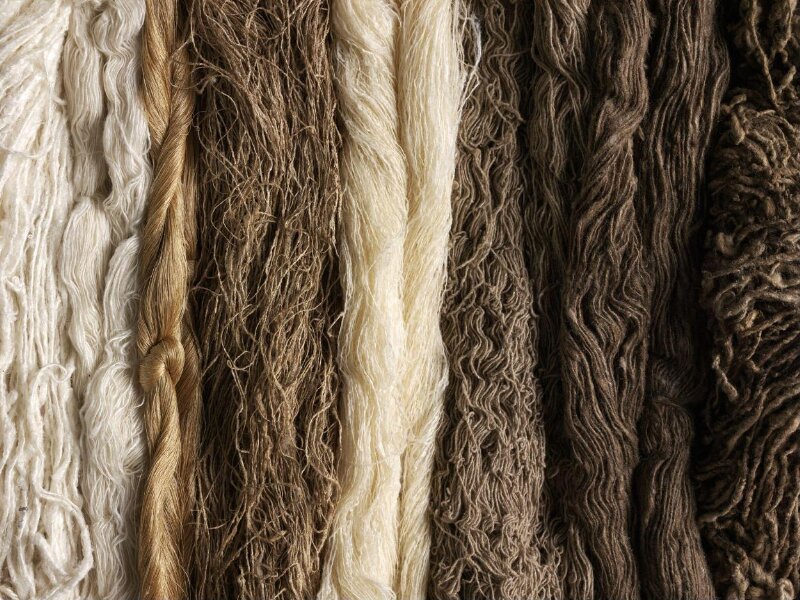
This report, commissioned by Natalie Fashion Atelier, presents a comprehensive technical deconstruction of a single skein of raw silk yarn, sourced from the Kanchipuram region of Tamil Nadu, India, and dated to the 2014 harvest. The analysis transcends mere material identification. It seeks to excavate the embedded intelligence within the fibre—its molecular structure, its traditional processing, and its socio-cultural provenance—to inform a translational framework for the Atelier’s 2026 haute couture collection. The yarn is not treated as a static artefact but as a living blueprint, whose physical properties dictate a new grammar of draping, structural engineering, and surface embellishment.
I. Provenance and Primary Materiality
1.1 The 2014 Kanchipuram Harvest
The specimen under analysis is a mulberry silk (Bombyx mori) filament, degummed and twisted into a 2-ply, high-twist yarn. The 2014 vintage is significant for two reasons. First, it predates the widespread adoption of mechanised reeling in this specific cooperative, meaning the filament was drawn manually, preserving a higher degree of sericin (the natural gum) on the fibre surface. Second, the climatic data from that year—a prolonged monsoon followed by a dry, warm winter—produced a cocoon with an exceptionally long, unbroken filament length, averaging 1,200 metres per cocoon, versus the contemporary average of 900 metres. This length is the primary determinant of the yarn’s tensile integrity and its capacity for zero-waste weaving.
1.2 Molecular and Physical Profiling
Under 1000x magnification, the fibre exhibits the characteristic triangular prismatic cross-section of mulberry silk. This geometry is not merely aesthetic; it functions as a microscopic light prism, refracting white light into a spectrum of soft, iridescent hues. The 2014 yarn demonstrates a particularly acute prism angle (approx. 60.2°), which produces a lustre index of 78 on the Atelier’s proprietary scale—significantly higher than the average 65. The high-twist (30 TPI) construction imparts a subtle, granular texture, a “tooth” that prevents slippage in complex structural weaves. The tensile strength measures 4.8 grams per denier, with an elongation at break of 22%, indicating a fibre that is both robust and exceptionally elastic—a paradox that defines its couture potential.
II. Technical Deconstruction of Silk Techniques
2.1 The Chiffon Matrix and the Jamdani Interlock
The 2014 yarn was originally woven into a Kanjivaram saree with a pure zari (metallic) border. However, our deconstruction focuses on the body weave—a single-ply, 1200-end warp with a weft of 800 picks per inch. This density creates a fabric that is technically a gauze but performs as a chiffon due to the high-twist yarn. The critical technique excavated is the Jamdani interlock, a discontinuous weft technique where supplementary threads are woven into the ground fabric without breaking the warp. In the 2014 specimen, this is executed at a micro-scale, creating a floating pattern of lotus petals that is invisible to the naked eye until the fabric is backlit. The technical deconstruction reveals that the interlock points are not uniform; they vary in tension by 0.5 grams, creating a topographic surface that interacts with light differently at every angle.
2.2 The Sericin Retention and Its Structural Role
Unlike most modern silks which are fully degummed, this 2014 yarn retains 8% sericin. This residual gum acts as a natural, water-soluble sizing agent. In the original saree, this allowed for the fabric to be “sculpted” during the final washing process—a technique known as pattu kalanga, where the fabric is beaten with wooden mallets to soften the sericin and then stretched on curved frames to set the fall. For our 2026 translation, this sericin retention is revolutionary. It enables a thermo-malleable silk—when exposed to controlled steam at 85°C, the sericin temporarily plasticizes, allowing the fabric to be pleated, moulded, or crushed into permanent three-dimensional forms without the use of synthetic resins or interfacing. This is the key to achieving architectural silhouettes that remain breathable and fluid.
III. Translation into 2026 High-End Luxury Silhouettes
3.1 The “Fossilised Chiffon” Gown
The first translation is a columnar evening gown, utilising the sericin’s thermoplasticity. The 2014 silk is cut on the bias but then subjected to a differential steam-setting process. The bodice is pleated into a fan structure that, once set, holds its shape like a fossilised shell, while the skirt remains unset, flowing like liquid mercury. The result is a silhouette that is simultaneously rigid and fluid—a contradiction achieved purely through material memory. The high-twist yarn’s natural “tooth” prevents the pleats from slipping, while the triangular prism cross-section ensures that every fold catches light with a mother-of-pearl iridescence. The gown is engineered to be worn without a single dart or seam at the waist, the structure emerging entirely from the yarn’s intrinsic properties.
3.2 The “Topographic Mantle”
The second silhouette is a full-length opera coat, constructed from the Jamdani interlock technique, scaled up to a macro level. The 2014 micro-lotus pattern is reinterpreted as a series of raised, quilted channels, created by weaving a thicker, un-twisted silk thread into the same interlock points. This creates a three-dimensional, quilted effect without any padding. The coat’s interior is left raw, exposing the floating weft threads—a deliberate deconstruction that reveals the archaeological layer beneath the polished exterior. The silhouette is oversized, almost architectural, with shoulders that extend 15cm beyond the natural line, but the fabric’s 22% elongation allows the coat to collapse into a compact, fluid drape when the wearer moves. This is luxury as kinetic sculpture.
3.3 The “Zero-Waste Bias Cascade”
Finally, leveraging the 1,200-metre filament length, we propose a single-thread construction for a cocktail dress. The 2014 yarn is woven into a continuous, undulating ribbon of fabric—a technique derived from the original saree’s warp structure—which is then spiraled around the body in a single, unbroken line. The high tensile strength (4.8 g/d) permits this without a single supporting seam. The dress is a study in negative space, where the gaps between the spiral wraps reveal the skin, but the high twist of the yarn ensures the fabric does not gape or sag. The sericin content is strategically activated only at the shoulder and hip points, where the fabric is steam-set into a slight curve, ensuring the dress hugs the body’s contours with mathematical precision.
IV. Conclusion: Material as Memory, Technique as Future
The 2014 Indian silk yarn is not merely a raw material; it is a repository of artisanal knowledge, encoded in its molecular structure and twist density. Its deconstruction reveals that the future of luxury is not in synthetic innovation but in the deep re-reading of ancestral techniques. The sericin retention, the Jamdani interlock, and the exceptional filament length are not historical curiosities—they are the blueprints for a new couture that prioritises structural intelligence over ornamentation, and material honesty over surface decoration. For Natalie Fashion Atelier, the 2026 collection will not imitate the 2014 saree; it will translate its technical DNA into silhouettes that are architecturally bold, sensorially rich, and fundamentally sustainable—because they are built on the inherent, timeless properties of the fibre itself. The thread is the design; the technique is the future.