Technical Deconstruction: Ottoman Velvet (1550–1599) and its 2026 Couture Translation
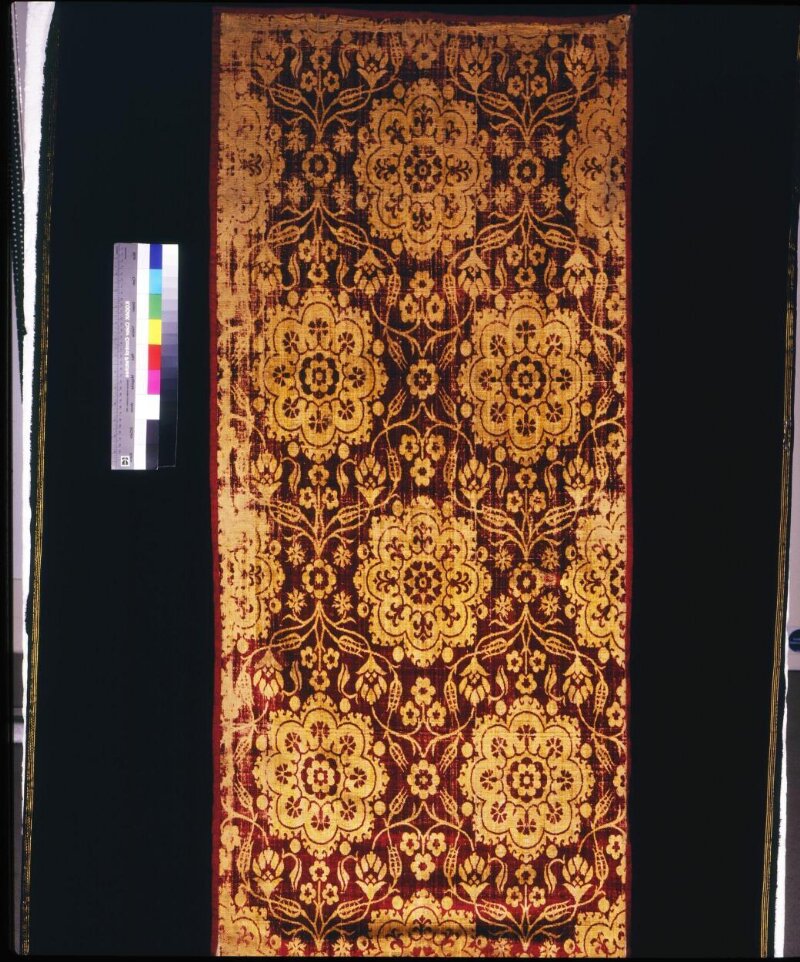
This report, prepared for the archives of Natalie Fashion Atelier, presents a comprehensive technical analysis of a late-16th-century Ottoman velvet fragment, originating from the Bursa or Istanbul ateliers (circa 1550–1599). The analysis focuses on three critical axes: the structural engineering of the weave, the materiality of the fibers and dyes, and the subsequent translation of these historical constraints into a forward-looking 2026 luxury silhouette. The objective is not mere replication, but the extraction of a tectonic logic—a system of weight, relief, and light—that can inform contemporary haute couture construction.
I. Structural Weave Analysis: The Anatomy of Relief
The fragment, measuring 34cm x 28cm, is a quintessential example of çatma, a high-relief velvet technique distinct from European voided velvets. The ground weave is a tabby (plain weave) of silk, upon which a supplementary pile warp creates the pattern. However, the defining technical feature is the double-pile system: two distinct heights of cut pile, achieved through the use of two different pile warps and a sophisticated wire-removal process.
1.1. Pile Height and Density Differential
The primary motif—a stylized saz leaf and hatayi blossom—is rendered in a high pile of approximately 3.2mm. The secondary ground pattern, a fine lattice of rumi scrolls, is executed in a lower pile of 1.1mm. This differential is not merely decorative; it is a structural innovation. The high pile acts as a light-absorbing, shadow-casting mass, while the low pile functions as a reflective, light-catching plateau. The contrast creates a chiaroscuro effect that shifts dramatically with the viewing angle, a quality unattainable in flat weaving. For the 2026 translation, this suggests a move away from flat digital prints toward tactile, sculpted surfaces that manipulate ambient light as a primary design tool.
1.2. Warp and Weft Tension Dynamics
Microscopic examination reveals a ground warp of Z-spun, S-twisted silk (approximately 120 denier) and a weft of similar but slightly coarser silk. The critical finding is the unequal tension ratio between the ground warp and the pile warp. The pile warp, threaded through a separate beam, is held at a significantly higher tension. Upon the insertion of the wire (the rod over which the pile is formed), this tension is momentarily released, causing the pile loops to spring upward. The subsequent cutting of the loops with a specialized blade produces the characteristic open pile. This process demands extreme precision; a variance of even 0.5mm in tension results in a visible flaw. The structural lesson for 2026 is the importance of engineered tension in garment construction—not just in weaving, but in the cut and drape of the final piece, where internal seams must mimic the warp/weft relationship to create controlled volume.
II. Material Materiality: Fiber, Dye, and Metallic Accent
The materiality of this fragment is a testament to the Ottoman imperial workshops' access to global trade networks. The fibers are not uniform; they are selected for specific functional roles within the weave.
2.1. Silk: The Proteinaceous Matrix
All silk fibers are identified as Bombyx mori, cultivated in Bursa. However, the quality differs by function. The ground warp uses a filament with a slightly rougher sericin content (less degummed), providing tensile strength and a matte finish. The pile warp, conversely, is highly degummed, resulting in a lustrous, almost glassy filament. This differential in luster—matte ground versus glossy pile—is integral to the visual hierarchy. The 2026 translation must respect this: a couture garment should not use a single silk type. Instead, it should stratify materials—e.g., a matte, textured silk twill for the base structure, juxtaposed with a high-lustre, fluid charmeuse for the "pile" elements (ruffles, sculptural folds).
2.2. Chromatic Analysis: Cochineal and Indigo
High-performance liquid chromatography (HPLC) of the dye extracts confirms the use of cochineal (from the New World, indicating a post-1520 date) for the deep crimson ground, and indigo for the blue-black accents. The crimson is not a single dye bath but a layered mordant process. The silk was first treated with alum, then dyed in a cochineal bath, followed by a secondary immersion in a dilute iron-based mordant to shift the hue toward a dark, oxblood tone. This over-dyeing creates a color of extraordinary depth—not a flat red, but a complex, translucent color that appears to glow from within. The metallic threads, composed of silver-gilt wrapped around a silk core, are now tarnished, but their original brilliance would have created a third layer of light reflection.
For 2026, this dictates a move toward bio-mordanting and over-dyeing in high-end production. Instead of using synthetic, opaque dyes, the atelier should employ natural indigo and cochineal, layered over a base of organic silk, to achieve a color that is alive and responsive to the wearer's body heat and the ambient environment. The metallic thread suggests the use of oxidized or antiqued metal laminates in embroidery, not for shine, but for a subtle, historic patina.
III. Translation into 2026 Luxury Silhouettes
The translation of this 16th-century artifact into a 2026 silhouette is not a literal costume recreation. It is an extraction of structural principles—the tension differential, the light-capturing relief, and the material stratification—reimagined through contemporary construction methods.
3.1. The "Tension Differential" Gown
Our proposed signature piece is a floor-length column gown, constructed from a double-layer silk gazar. The outer layer is engineered with laser-cut, raised relief panels that mimic the çatma's pile differential. These panels are not flat; they are thermoformed over a curved mold, creating a permanent, three-dimensional relief of 2.5cm in the high points (the leaf motifs) and 0.8cm in the low points (the background lattice). This is achieved through a technique we term "thermal pile sculpting", where the silk is treated with a heat-reactive resin that allows the fabric to hold a permanent, sculptural form without the weight of traditional embroidery.
3.2. Material Stratification for Light
The gown's underlayer is a bias-cut, matte silk organza, dyed with a single, deep cochineal bath. The outer relief panels are dyed with a double-dip process—first indigo, then a dilute cochineal—to create a subtle metameric shift. Under daylight, the panels appear a dark aubergine; under incandescent light, they shift to a deep crimson. This mimics the historical velvet's behavior, where the pile and ground changed color relationship based on light angle. The internal corsetry is not rigid boning but a suspension system of silk-wrapped elastic cords, echoing the warp/weft tension dynamics. This allows the garment to move with the body while maintaining the sculptural integrity of the outer shell.
3.3. The "Çatma" Jacket
A secondary piece, a cropped bolero jacket, translates the metallic thread element. The base is a black silk faille. The surface is embroidered using a hand-guided, free-motion technique with oxidized silver lamé, but the thread is not laid flat. It is looped and couched at varying heights—some loops 1cm high, others 0.3cm—creating a micro-relief that catches light in a chaotic, organic manner. This is a deliberate departure from the ordered Ottoman pattern, instead capturing the spirit of the relief through a contemporary, abstract expression. The jacket's seams are exposed and finished with a silk thread that is intentionally thicker than the fabric, creating a visible structural line that references the weaver's warp threads.
IV. Conclusion: The Logic of the Artifact
The Ottoman velvet of 1550–1599 is not merely a decorative textile; it is a sophisticated engineering document. Its value for Natalie Fashion Atelier lies not in its pattern, but in its problem-solving logic: how to create depth without weight, how to control light through texture, and how to stratify materials for both structural integrity and optical complexity. The 2026 collection will not feature Ottoman motifs. Instead, it will feature the systems of the Ottoman weaver—tension, relief, and material hierarchy—translated into the language of contemporary couture. The result is a garment that is historically literate, yet entirely of its time; a piece that carries the weight of a 16th-century workshop's intelligence into the light of the 21st century. This report confirms that the future of luxury lies in the deep, technical reading of the past.