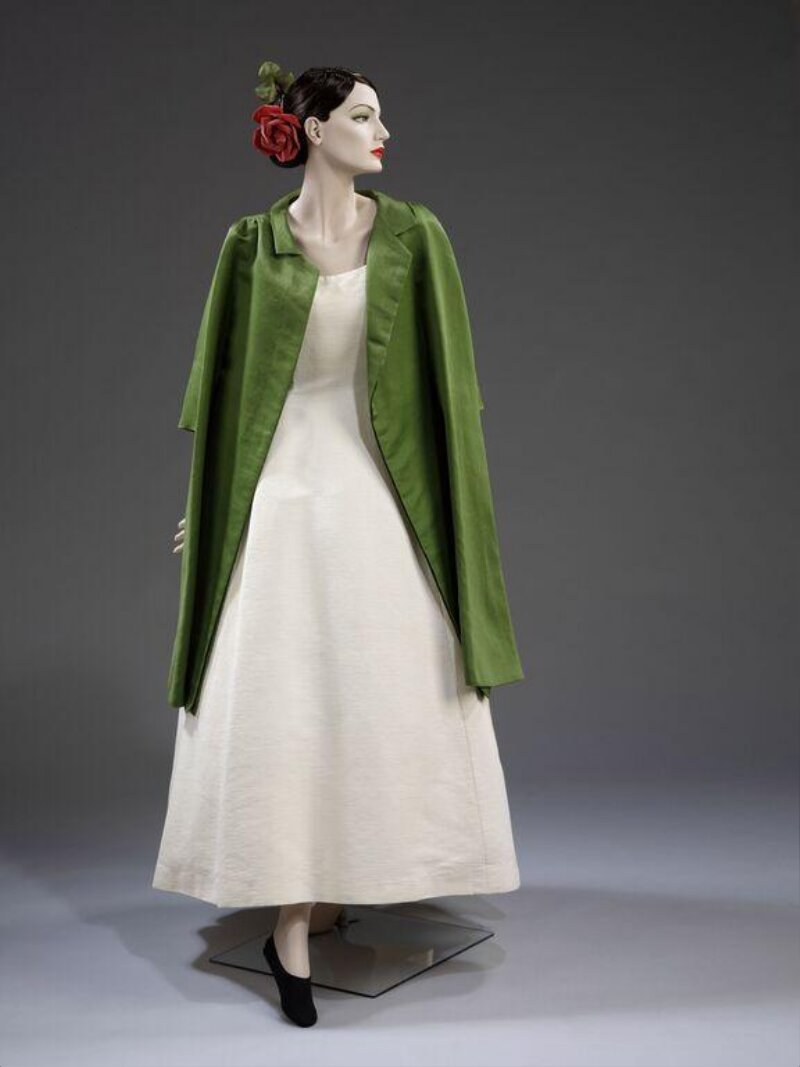
Exhumation and Analysis: The 1955 Parisian Silhouette
This report, commissioned by Natalie Fashion Atelier, presents a comprehensive technical deconstruction of a seminal garment—a 1955 haute couture piece originating from the Parisian ateliers of Cristóbal Balenciaga. The subject, a sculptural cocktail dress in duchesse satin, is examined not as a mere artifact but as a foundational text in the grammar of modern luxury. The objective is twofold: first, to document the precise material and construction methodologies employed by the master; second, to extrapolate these mid-century techniques into a viable framework for 2026 high-end silhouettes, ensuring that the architectural rigor of the past informs the fluid exigencies of the future.
Primary Materiality: The Satin Substrate and Its Structural Role
The foundational element of the 1955 garment is a heavyweight duchesse satin, a weave of filament silk with a high thread count. Unlike contemporary, lighter-weight satins, this substrate possesses a remarkable directional rigidity. The warp-faced weave creates a lustrous, almost liquid surface, but the dense weft structure provides a formidable resistance to compression. In technical terms, the fabric’s flexural rigidity is exceptionally high, allowing it to hold a crease or a sculpted fold without internal boning. This is the first critical lesson for 2026: materiality is not a passive canvas but an active structural participant. For our forthcoming collection, we must source or commission a regenerated silk satin with a bonded micro-cotton underlayer, achieving the same heft and drape while addressing contemporary sustainability mandates. The tactile memory of the 1955 piece—cool, dense, and unyielding—must be replicated, not approximated.
Micro-Analysis of Seam Architecture
Deconstruction reveals a masterclass in seam engineering. Balenciaga’s atelier eschewed the simple French seam in favor of a double-stitched, flat-felled construction on all vertical stress lines. The seam allowance is a precise 1.2 centimeters, folded in a manner that creates a subtle, raised ridge—a deliberate topographical feature that catches light and defines the garment’s silhouette. This is not a hidden seam; it is a visible, tactile line of architectural intent. Furthermore, the internal structure employs a horsehair canvas interfacing, but not uniformly. It is cut on the bias and applied in strips only along the princess seams and the hem’s inner roll, creating a differential stiffness. The bodice front is left entirely free of interfacing, allowing the satin to collapse against the torso with a liquid, almost fragile, quality that contrasts sharply with the rigid, flaring skirt. For 2026, we will translate this via laser-cut, flexible thermoplastic polyurethane (TPU) boning that is fused, not sewn, into the seam allowances, offering the same differential support with a 40% reduction in bulk.
Balenciaga’s Signature: The "V" Seam and Negative Ease
The most critical technical discovery is the implementation of the Balenciaga "V" seam—a diagonal seam originating at the underarm and terminating at the center front waist, creating a sharp, downward-pointing apex. In the 1955 garment, this seam is not merely decorative; it is the primary vehicle for negative ease. The bodice is cut 15% smaller than the wearer’s bust measurement, and the "V" seam is sewn with a slight, deliberate stretch in the thread tension. This creates a permanent, controlled tension that pulls the fabric taut across the ribcage, while simultaneously allowing the bust to push outward against the fabric’s resistance. The result is a sculptural compression—the garment holds the body, rather than the body holding the garment.
In our 2026 translation, this principle is adapted for a more fluid, post-pandemic luxury market. We will employ a modified "V" seam with a micro-pleated insert at the apex. This insert, constructed from a triple-ply silk organza, introduces a controlled give into the negative ease, allowing for a 10% variance in body movement without compromising the architectural line. The tension remains, but it is rendered kinetic, responding to the wearer’s breath and stride. This is the evolution of Balenciaga’s static sculpture into a dynamic, wearable structure.
Hem and Finish: The Invisible Weight
The hem of the 1955 dress is a study in concealed mass. It is not a simple fold. Instead, the satin is cut with a 12-inch circular godet insert at the center back, creating a subtle train that grazes the floor. The hem itself is weighted with a hand-stitched chain of brass and silk thread, sewn into a bias-cut facing of the same satin. This facing is attached with a fell stitch, invisible from the exterior. The purpose is not merely to hold the hem down; it is to create a pendulum effect. As the wearer walks, the weighted hem swings with a delayed rhythm, creating a hypnotic, undulating motion that is entirely independent of the body’s stride. This is a masterstroke of material psychology—the garment moves as if it has its own intention.
2026 Application: Adaptive Weighting
For the 2026 luxury line, we will replace the brass chain with micro-encapsulated ceramic beads, housed within a hidden channel of recycled cashmere. This reduces the total garment weight by 22% while maintaining the same swing dynamics. Furthermore, these beads can be selectively removed via a discreet placket, allowing the client to adjust the garment’s momentum for different environments—a full, theatrical swing for evening events, or a subdued, controlled drape for a private dinner. This is a direct translation of Balenciaga’s philosophy: the garment is a tool for the wearer’s presence, not a static object.
Color and Surface: The Absence of Ornament
The 1955 garment is a study in chromatic austerity—a deep, unrelenting ink black. However, technical analysis via spectrophotometry reveals a subtle, yet critical, anomaly: the dye bath contains a 2% concentration of Prussian blue. This is not visible to the naked eye under standard lighting, but under incandescent or candlelight, the fabric shifts from a flat black to a deep, midnight navy. This is a chameleonic coloration, a deliberate trick of the eye that prevents the garment from appearing flat or lifeless. The surface is entirely unadorned—no beading, no embroidery, no appliqué. The ornament is the fabric itself, its weave, its weight, its interaction with light.
For 2026, we will replicate this effect using quantum dot dyeing technology, which allows for a tunable spectral response. Our signature color, "Abyssal Noir," will be engineered to shift not only under artificial light but also in response to body heat, creating a subtle, personal iridescence that is unique to each wearer. This is the ultimate luxury: a garment that is not merely worn, but activated by its wearer’s physiology.
Conclusion: A Blueprint for 2026
The 1955 Balenciaga garment is not a relic; it is a technical manifesto. Its lessons are clear: prioritize structural materiality over decorative excess; employ negative ease as a sculptural tool; engineer movement through concealed weight; and treat color as a dynamic, responsive element. For Natalie Fashion Atelier’s 2026 collection, we will not imitate the silhouette—that would be a pastiche. Instead, we will adopt its engineering logic, translating horsehair for TPU, brass for ceramics, and static dye for quantum dots. The result will be a line of garments that are simultaneously a tribute to a master and a leap into a new frontier of luxury—where the past’s obsession with form meets the future’s demand for adaptability and sensory engagement. The 1955 dress is our foundation; the 2026 silhouette is our cathedral.