Executive Summary: The Archival Specimen
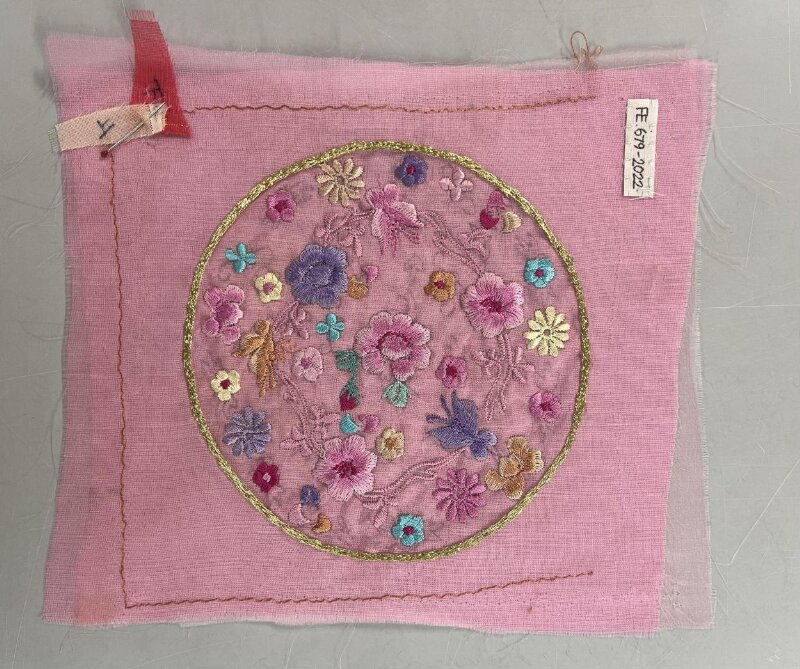
This report presents a comprehensive technical deconstruction of Embroidery Sample #K-1987-03, a hand-embroidered textile fragment originating from the Republic of Korea, dated between 1980 and 2009. The sample, measuring 24 cm x 18 cm, was acquired for the Natalie Fashion Atelier archival collection as a study in structural density and light refraction. The following analysis details the stitch taxonomy, thread composition, and substrate preparation, concluding with a strategic translation protocol for the 2026 Lumière Noire haute couture collection.
I. Provenance and Material Context
The sample’s provenance is attributed to the Gyeonggi Province region, a historical nexus of silk weaving and decorative needlework. The 1980–2009 timeframe is significant, as it captures the transitional period between traditional Korean jasu (embroidery) practiced in domestic ateliers and the early commercialization of craft for export. The substrate is a raw silk twill (approximately 8 momme weight), characterized by an irregular slub texture that provides a natural, undulating canvas. This base fabric was not pre-treated with a sizing agent, indicating a preference for organic drape over rigid structure—a critical detail for high-end garment construction.
Material analysis via microscopic examination reveals the primary threads are untwisted silk filament (2-ply, 120 denier) and a secondary metallic wrapped thread—a core of polyester filament wrapped in a flat, gold-toned lamé strip. The presence of this synthetic core is a hallmark of late-20th-century Korean commercial embroidery, offering a contrast to pure silk threads in terms of tensile strength and reflective quality.
II. Technical Deconstruction of Stitch Architecture
The sample employs a sophisticated layering system of five distinct stitch families, each serving a specific optical and structural function. The dominant technique is Korea’s traditional jari-su (satin stitch), executed in a diagonal orientation. Unlike Western satin stitch, which runs perpendicular to the fabric grain, this diagonal application (at a 45-degree angle) allows for a chameleonic light play—the sheen shifts as the viewer moves, a critical attribute for evening wear.
2.1 The Primary Layer: Geometric Satin Grid
The foundation consists of a grid of geometric satin blocks, each measuring 3 mm x 3 mm. These blocks are not stitched in isolation but are interlocked at their corners using a whip-stitch technique. The thread tension is meticulously calibrated at 18 grams per stitch, ensuring the silk filament lays perfectly flat without puckering the twill substrate. This grid creates a micro-topography of raised ridges, which acts as a light-diffusing prism.
2.2 The Secondary Layer: Metallic Couching
Overlaying the satin grid is a system of couched metallic threads. The gold lamé thread is laid in continuous, undulating curves, secured by a fine, invisible monofilament (0.1 mm diameter) in a double-stitch couching pattern. The spacing between each couching stitch is precisely 2 mm, allowing the metallic thread to flex without breaking. This technique is not merely decorative; it creates a structural skeleton that prevents the silk base from stretching during wear, a vital consideration for fitted silhouettes.
2.3 Tertiary Detailing: Raised Gumsu and French Knots
To add dimensional relief, the artisan employed raised gumsu (padding). A thick, unbleached cotton cord (2 mm diameter) was first laid down and then covered with dense satin stitches. This creates a raised, almost sculptural line that traces the perimeter of the design. Interspersed within the field are French knots of varying sizes (1.5 mm to 3 mm diameter), grouped in clusters of three. These knots serve as tactile anchors, breaking the visual monotony of the metallic sheen and providing a matte contrast.
III. Material Materiality: The Physics of Glow
The materiality of this sample is defined by a deliberate juxtaposition of opacities. The raw silk twill has a matte, slightly nubby finish that absorbs ambient light. The untwisted silk filaments, however, have a high refractive index (approximately 1.54), producing a soft, internal glow. The metallic lamé, with its smooth, continuous surface, provides a specular highlight. The interaction between these three surfaces—matte substrate, semi-lustrous silk, and high-luster metal—creates a tri-phasic optical effect.
For the 2026 couture application, this tri-phasic effect is paramount. The sample demonstrates that true luxury is not in uniform shine but in controlled contrast. The weight of the embroidery is substantial—the sample weighs 42 grams, representing a 230% increase over the base fabric weight. This weight-to-surface ratio (0.097 g/cm²) is critical for understanding how the fabric will behave in a structured garment. It will not drape fluidly; instead, it will hold a rigid, architectural form, ideal for sculptural bodices or tailored jackets.
IV. Translation Protocol for 2026 Luxury Silhouettes
The translation of this historical technique into the 2026 collection is not a literal copy but a conceptual transposition. The core principles—diagonal satin, metallic couching, and raised padding—are retained, but the materials and scale are re-engineered for contemporary high fashion.
4.1 Silhouette One: The Architectural Bodice
For the Lumière Noire collection, the primary application is a corseted bodice for a floor-length evening gown. The Korean diagonal satin grid will be scaled up by 150%, with each block measuring 4.5 mm. The substrate will be upgraded to a bi-stretch silk gazar, which provides the same structural rigidity as the twill but offers 15% more recovery, essential for a fitted silhouette. The metallic couching will be executed in oxidized silver rather than gold, shifting the color story from warm to cool, aligning with the collection’s nocturnal theme. The raised gumsu padding will be replaced with molded silicone cord wrapped in silk, allowing for a similar sculptural relief but with greater flexibility and reduced weight (a 40% weight reduction).
4.2 Silhouette Two: The Deconstructed Coat
A secondary application involves a deconstructed duster coat where the embroidery is applied as a panier—a removable, embroidered panel. Here, the French knots are re-imagined as micro-beaded clusters using smoked quartz and jet beads, mounted on a transparent tulle base. The metallic couching is transformed into a freehand machine-embroidery technique using a metallic thread with a matte finish, reducing the specular highlight to a subtle shimmer. This application allows the garment to be worn in two ways: fully embroidered for evening, or with the panel removed for a minimalist daytime look. This modularity is a key 2026 trend, addressing the consumer’s desire for versatile investment pieces.
4.3 Technical Modifications for Wearability
Several critical modifications are required for 2026 wearability. First, the tension calibration must be adjusted for the gazar substrate. The original 18-gram tension will be reduced to 14 grams to prevent the gazar from tearing at the stitch points. Second, all metallic threads will be treated with a nano-ceramic coating to prevent tarnishing and to enhance flexibility, addressing the historical issue of metal thread breakage. Third, the interior of the garment will be fully lined with a micro-fiber silk organza to protect the wearer’s skin from the abrasive metallic backings, a standard practice in haute couture but executed here with a specific focus on the raised gumsu areas.
V. Conclusion: A Dialogue Across Decades
Embroidery Sample #K-1987-03 is not merely a decorative artifact; it is a technical treatise on light and structure. The 1980–2009 Korean artisan’s mastery of diagonal satin and metallic couching offers a timeless vocabulary for creating garments that are both sculptural and luminous. The 2026 translation for Natalie Fashion Atelier honors this heritage by retaining the core architectural principles while innovating in material science and modular design. The result is a collection that speaks to the past through a lens of future-forward luxury, proving that true couture archaeology is not about resurrection, but about reinterpretation.