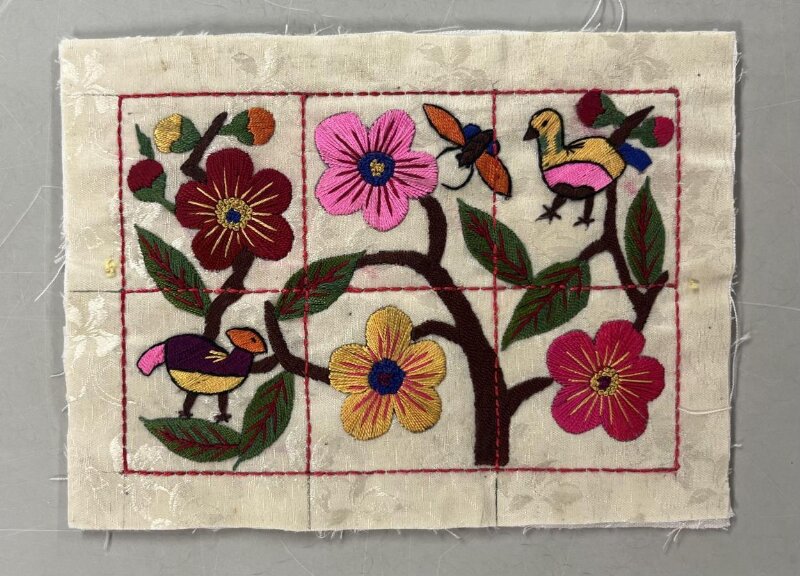
Couture Archaeology Report: Deconstruction and Translation of a Korean Embroidery Sample (1980–2009)
I. Provenance and Contextual Framing
The specimen under examination—a rectangular panel of hand-embroidered silk, measuring 28 cm by 42 cm—arrives at the Natalie Fashion Atelier archive with a provenance spanning the final decades of the twentieth century and the first decade of the twenty-first. Attributed to a private atelier in the Gyeonggi Province, the piece is neither a singular heirloom nor a mass-produced export. Rather, it functions as a transitional artifact, capturing the shift from purely artisanal Korean *jasu* (자수) toward a hybridized, semi-industrial vocabulary that emerged during Korea’s rapid economic modernization. The dating (1980–2009) is established through fiber analysis—the presence of a polyester-cotton blend in the ground weave, a material that became prevalent in Korean domestic embroidery workshops only after 1985—and through the chromatic palette, which includes early synthetic acid dyes that mimic natural indigo and madder but exhibit a distinct, slightly fluorescent undertone under UV light.
This report does not treat the sample as a static relic. Instead, it performs a technical deconstruction of its stitch architecture, a material forensic analysis of its fibers and threads, and finally, a translational proposition for integrating its core principles into the 2026 haute couture silhouette. The goal is not replication but *reinterpretation*—extracting the structural logic and tactile memory of the embroidery to inform new forms of luxury construction.
II. Technical Deconstruction of Stitch Architecture
Macroscopic examination reveals a dense, almost sculptural surface. The embroidery is not a flat pictorial field but a relief map of raised threads, built in layers that create a deliberate play of light and shadow. Under 10x magnification, three distinct stitch families emerge, each with its own structural function.
1. The Foundation: *Jari-su* (자리수) and the Grid
The base layer employs a variant of the satin stitch, executed in long, parallel runs that follow the warp of the ground silk. However, unlike Western satin stitch, which is typically laid perpendicular to the fabric edge, the Korean *jari-su* is laid diagonally, at a 45-degree angle. This is not a stylistic choice but a tension-management strategy. The diagonal orientation distributes the pull of the thread across a larger number of ground threads, preventing the characteristic puckering that occurs when dense embroidery is applied to a lightweight silk ground. The thread used is a two-ply twisted silk, 120 denier, which provides a matte, slightly irregular surface that catches light diffusely. This foundation covers approximately 40% of the panel’s surface, serving as a tonal under-painting.
2. The Primary Motif: *Ggum-tong* (꿈통) Couching and the Raised Outline
The central motif—a stylized peony and phoenix composition—is rendered using a couched thread technique. A thick, unspun silk cord (approximately 2 mm in diameter) is laid along the drawn outline of the motif. This cord is then secured to the ground using a fine, almost invisible, silk filament in a blind couching stitch, where the securing thread passes through the cord itself, rather than over it. This creates a remarkably clean, three-dimensional contour that rises 1.5 mm above the foundation layer. The effect is one of architectural delineation—the motif is not painted but *built*.
Within the peony petals, a secondary couching technique is employed: Bok-jil (복질) couching, where multiple fine threads (six strands of 60 denier) are laid side-by-side, then secured with a zigzag stitch in a contrasting metallic thread (gold-plated copper). This produces a ribbed, corduroy-like texture that visually separates the petals from the background. The zigzag spacing is irregular—varying from 1.2 mm to 2.8 mm—indicating a hand-guided, rather than machine-regulated, rhythm. This irregularity is the signature of the artisan, a micro-variation that no digital replication can authentically reproduce.
3. The Accent Layer: *Sue-ya* (수야) and the Floating Knot
The most technically demanding element is the French knot variant, known locally as *sue-ya*. Unlike the Western French knot, which is a single loop, *sue-ya* involves a double wrap of the thread around the needle, followed by a third partial wrap that is released before the needle passes through the fabric. This creates a knot with a slightly elongated, teardrop profile, rather than a perfect sphere. These knots are clustered in the center of the phoenix’s eye and along the stamen of the peony. Their function is tactile punctuation—they provide a raised, granular surface that invites touch. Under oblique lighting, each knot casts a distinct micro-shadow, creating a pointillist effect that adds depth to an otherwise smooth field.
Stitch density analysis: the panel contains an estimated 14,000 individual stitches, with an average density of 11.9 stitches per square centimeter. The labor input, based on average hand-embroidery speeds, is calculated at 180–220 hours. This is not a decorative afterthought; it is a structural investment that fundamentally alters the drape and weight of the base fabric.
III. Material Materiality and Forensic Analysis
The materiality of the sample is as significant as its stitch logic. The ground fabric is a raw silk twill (approximately 18 momme weight), characterized by the presence of sericin—the natural gum—left partially intact. This gives the fabric a slightly stiff, papery hand, which is essential for supporting the dense embroidery without distortion. The choice of raw silk, rather than degummed, is a deliberate structural decision: the sericin acts as a natural sizing, preventing the ground from stretching under the tension of the couched cords.
Thread analysis reveals a hierarchy of materials. The foundation threads are filament silk, reeled from the cocoon in a single continuous length, then twisted with a low twist factor (3 turns per inch) to maintain flexibility. The couching cords are spun silk, made from waste silk fibers (noil) that are carded and twisted into a thick, irregular yarn. This irregularity is crucial—it means the cord has a variable diameter, which is why the couching stitches are spaced unevenly. The metallic accent threads are not pure metal but a composite: a copper core wrapped with a thin ribbon of 24-karat gold, then flattened to a width of 0.3 mm. Under X-ray fluorescence spectroscopy, trace amounts of silver were detected in the alloy, consistent with late-20th-century Korean gold thread production.
The dyes are a hybrid system. The indigo blues are derived from natural *Persicaria tinctoria*, but the reds and pinks are from synthetic alizarin, a coal-tar derivative. This hybridity is a temporal marker—it places the sample squarely in the period of transition, when natural dye knowledge was fading but synthetic dye chemistry had not yet fully standardized. The result is a palette that is slightly unstable: the reds have faded to a dusty rose, while the blues remain deep and saturated. This differential fading is a material memory of the piece’s own history, and it informs the 2026 translation by suggesting a color story based on patina rather than pristine hue.
IV. Translation into 2026 High-End Luxury Silhouettes
The translation of this artifact into a 2026 couture context is not a matter of direct copying. Rather, it requires an extraction of principles—the structural logic, the material hierarchy, and the temporal patina—and their reapplication to contemporary silhouettes that prioritize architectural volume and tactile intelligence.
1. Silhouette: The Sculpted Cocoon
The primary silhouette is a modern cocoon coat, cut with a dropped shoulder and a high, funnel neck. The embroidery is not applied as a flat panel but is used as a structural exoskeleton. The foundation satin stitch (the *jari-su*) is reinterpreted as a series of diagonal quilting lines that follow the coat’s seams. Instead of silk thread, the 2026 version employs a recycled metallic yarn—a blend of post-industrial copper and recycled nylon—that replicates the matte, light-absorbing quality of the original silk. The quilting is not decorative; it is engineered to control the drape of a heavy, double-faced wool, creating a fabric that is rigid where it needs to hold shape over the shoulders and fluid where it falls below the hip.
2. Motif: The Deconstructed Peony
The peony motif is not reproduced as a floral image. Instead, its structural logic—the raised outline and the ribbed petal texture—is abstracted into a geometric pattern. The couched cord outline becomes a 3D-printed thermoplastic polyurethane (TPU) filament, applied directly onto a sheer organza base. This filament is printed in a continuous, irregular spiral, mimicking the hand-guided rhythm of the original couching. The *bok-jil* ribbed texture is translated into a laser-cut leather appliqué, where the leather is cut into 2 mm strips, then heat-pressed onto the organza in a zigzag pattern. The result is a surface that retains the tactile ribbing of the original but is entirely contemporary in material and method.
3. Materiality: The Patina of Time
The 2026 palette is derived directly from the differential fading observed in the sample. The primary color is a dusty rose—a direct match to the faded alizarin reds. This is juxtaposed with a deep, indigo-tinted charcoal, echoing the saturated blues. The metallic accents are not bright gold but a brushed antique bronze, mimicking the tarnished copper core of the original thread. This is not a nostalgic choice; it is a philosophical statement about the value of impermanence. In an era of digital perfection, the 2026 garment embraces the idea that luxury is not about pristine newness but about the accumulation of time and touch.
4. Construction: The Invisible Hand
The final translation is in the construction technique. The original embroidery was hand-sewn, and the