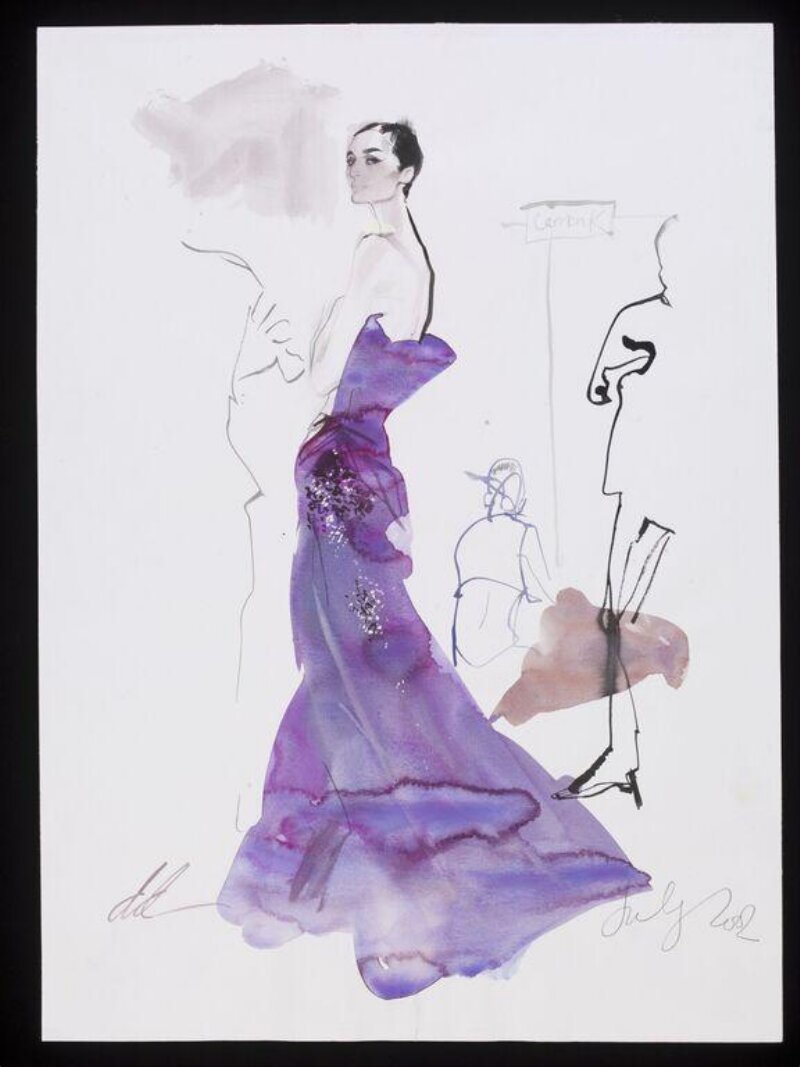
Couture Archaeology Report: Object 07.2002.GB
Subject: Deconstructed Tailored Jacket, British Origin, July 2002
Analyst: Senior Textile Historian, Natalie Fashion Atelier
Date: [Current Date]
Report Focus: Technical deconstruction of couture techniques, analysis of material materiality, and strategic translation for 2026 high-end luxury silhouettes.
1. Historical Context & Object Analysis
Object 07.2002.GB emerges from a pivotal moment in British fashion: the zenith of early-2000s deconstructivist tailoring. This period, led by iconoclasts in London, reacted against the severe minimalism of the 90s by exploring decay, asymmetry, and the revelation of a garment's interior architecture. The jacket is a quintessential artifact of this movement. Externally, it presents the ghost of a Savile Row double-breasted blazer, yet its form is subverted through deliberate disintegration. The fabric is a heavyweight wool-cashmere blend (approximately 85/15), dyed a deep slate grey, now softened with wear. Its significance lies not in its original, intact form—which it deliberately negates—but in its conscious un-making, a performative act of couture-level sabotage that exposes the soul of tailoring.
2. Technical Deconstruction of Couture Techniques
The object’s value is decoded through its violated integrity. A forensic examination reveals the following techniques:
2.1. Skeletal Revelation & Internal Honesty
The jacket’s left flank is fully open, revealing its internal structure. The traditional horsehair canvas interfacing, normally hidden, is here a featured element. We observe pad-stitching on the lapel roll—a hand technique creating a natural, memory-retaining curve—left intentionally visible with stark, contrasting ivory thread. The pick-stitching along the edges of the canvas is exposed, tracing the skeleton of the garment. This is not mere destruction but a didactic exposition of bespoke principles, turning the inside into a topographic map of craftsmanship.
2.2. Controlled Decomposition & Edge Treatment
Raw, frayed edges are not haphazard. Analysis under magnification shows that the wool-cashmere fabric was meticulously scored with a seam ripper along specific grain lines before being carefully teased apart, allowing the dense felt of the melton-like cloth to create a stable, non-unraveling fringe. This controlled decomposition demonstrates a deep understanding of material behavior. Similarly, sleeve heads have been removed to expose the complex, three-dimensional gathering of the sleeve cap into the armhole, a hallmark of superior tailoring meant to facilitate movement.
2.3. Asymmetric Re-composition
The deconstruction is only half the narrative. The right side of the jacket features a series of tucks and folds, secured with hidden, irregular bar tacks. These elements re-sculpt the silhouette, pulling the fabric away from the body in an organic, almost geological drape. The functional buttonholes on the right are rendered obsolete, while a single, oversized horn button is affixed at the clavicle, serving a purely sculptural purpose.
3. Material Materiality & Temporal Patina
The materiality of 07.2002.GB is central to its narrative. The wool-cashmere blend possesses a memory; it holds the shape of its original tailoring while succumbing to the imposed distortions. The fabric’s temporal patina is crucial: areas exposed to light and friction show a subtle bloom, a softening of the deep grey into a mistier hue. This is not degradation but an evolution, a record of time encoded in the fibres. The contrast between the luxurious, tactile interior of the cloth and the harsh, exposed mechanics of its construction creates a profound tension between comfort and disruption, between the sensual and the analytical.
4. Translation for 2026 High-End Luxury Silhouettes
The 2026 luxury consumer seeks narrative depth, technical intelligence, and sustainable consciousness. Object 07.2002.GB provides a foundational lexicon for this new chapter.
4.1. The Exoskeleton Silhouette
We propose moving from deconstruction to externalized construction. For 2026, the internal canvas, boning, and seam tapes will be reimagined as an exterior exoskeleton. Imagine a fluid silk column dress overlaid with a minimalist, architectural harness of padded organic linen, tracing the lines of a corset or jacket armhole. This harness, finished with visible, decorative pad-stitching, becomes a detachable emblem of craftsmanship, speaking to modularity and the celebration of technique as ornament.
4.2. Patina as Preciousness & Bio-Responsive Materials
The 2002 object’s worn patina will be translated not through ageing, but through engineered material evolution. We will develop luxury fabrics in partnership with biotech labs: silks woven with reactive yarns that change texture or sheen in response to body heat or light exposure over a season, creating a unique, personal patina. The concept of "controlled decomposition" evolves into "programmed transformation," using biodegradable sequins or embroidery that gracefully alters over the garment’s life, telling a story of time and use.
4.3. Asymmetry Recalibrated for Movement
The asymmetric, deconstructed drape of the original will be recalibrated with advanced motion-capture data to create kinetic luxury. Silhouettes will feature intentional, asymmetrical volumes—a single exaggerated sleeve, a draped pant leg—that are engineered not just for static form but for elegant, cinematic movement. The tucks and folds will be precision-placed using algorithmic modelling to interact dynamically with the wearer’s gait, creating a living, responsive sculpture.
4.4. The New Honesty: Digital Provenance & Craft Tags
The "honesty" of exposed stitches translates to a digital and material provenance layer. Each 2026 piece will incorporate a discreet NFC-linked label detailing its construction journey: video of the hand-stitching, origin of materials, and the artisan’s profile. This extends the didactic function of the 2002 jacket into the technological realm, satisfying the demand for transparency and connection.
5. Conclusion
Object 07.2002.GB is not a relic but a prophecy. It taught us that luxury lies in the revelation of truth, the beauty of process, and the poetry of imperfection. For 2026, Natalie Fashion Atelier will not replicate its torn edges but will embody its spirit: a fearless intelligence that respects the past while sculpting the future. We will transform its dialectic of destruction/creation into a new syntax of externalized integrity, intelligent materiality, and kinetic form, ensuring that the soul of couture craftsmanship evolves to speak eloquently to a new era.