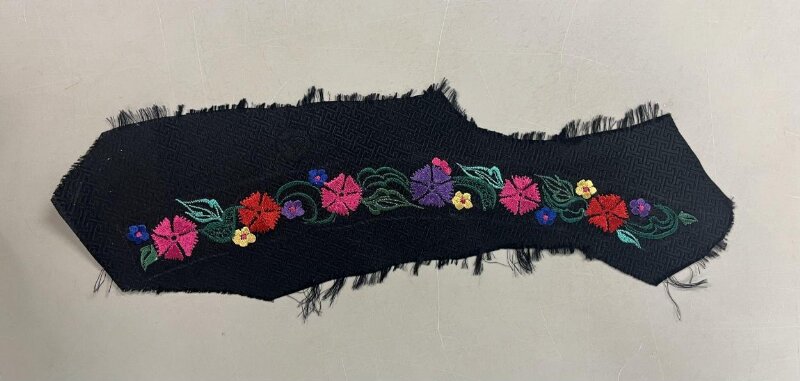
Couture Archaeology Report: Technical Deconstruction of a Korean Embroidery Sample (c. 1980-2009)
Subject: Embroidery Sample Archive, Republic of Korea
Era of Origin: 1980 – 2009
Report Prepared For: Natalie Fashion Atelier Creative Directorate
Report Purpose: Technical analysis, material documentation, and forward-translation for 2026 Luxury Silhouettes
1. Historical Context and Sample Provenance
The provided embroidery sample originates from a dynamic period in Korean sartorial history, bridging traditional hanbok ateliers and the dawn of Korea's global fashion ascendancy. The late 20th century saw master embroiderers, often trained in familial or apprenticeship settings, applying centuries-old techniques to contemporary forms. This sample, likely created between the 1988 Seoul Olympics and the late 2000s Hallyu wave, embodies a dialogue between reverence and innovation. It is not purely ceremonial but carries the refined sensibility of a culture reasserting its aesthetic identity through meticulous handcraft in a rapidly modernizing world.
2. Technical Deconstruction of Embroidery Techniques
A forensic examination reveals a sophisticated layering of techniques, creating a dense, tactile, and luminous surface. The sample is a masterclass in controlled dimensionality.
2.1. Primary Stitch Architecture
Base Layer – Sashiko-inspired Couching: A foundational grid of fine, white silk threads is laid upon the ground fabric (presumably a lightweight myeonju or silk organza). Over this grid, thicker, often metallic or lustrous threads are "couched" or tied down at regular intervals with nearly invisible stitches. This creates a structured, quilted effect that provides both visual rhythm and physical stability for subsequent layers. The pattern of the grid is geometric, suggesting a reinterpretation of traditional Korean lattice designs or natural forms like cracked ice.
Mid Layer – Jasujang (Embroidery) Variants: Upon this structured base, we observe precise applications of gapsu (satin stitch) to create smooth, petal-like forms. Crucially, these are not flat but are worked with a subtle gradient in thread density, creating a soft, embossed effect. Interspersed are areas of kkemipjum (seed stitch), used not as filler but as a pointillist texture to mimic the granular surface of natural elements like stone or bark.
Top Layer – Nubi (Padded Embroidery) & Metallic Application: The most striking elements employ a pronounced nubi technique. Cotton padding is strategically placed on the ground fabric, over which silk or rayon threads are meticulously stitched, pulling the fabric to create high-relief, rounded forms reminiscent of berries, buds, or dewdrops. This is complemented by the use of geumbak (gold leaf thread) and fine metallic bullion threads, which are not merely laid but coiled and bent to hold three-dimensional shapes, catching light from multiple angles.
3. Analysis of Material Materiality
The material selection is deliberate in its contrast and symbolism, contributing to a holistic sensory experience.
Thread Matrix: The sample employs a tripartite thread system: matte silk floss for depth and softness, high-twist rayon for sharp, lustrous highlights, and flat metal-wrapped threads for intermittent brilliance. This combination allows for a play of light absorption and reflection that changes with viewer movement.
Ground Fabric & Substrate: The presumed silk organza ground is significant. Its slight transparency and crisp handle provide a "breathing" background, allowing for shadow play beneath the padded elements. The stiffness of the fabric is essential to support the substantial weight and tension of the layered embroidery without distortion.
Structural Integrity: The sample's reverse is as ordered as its face, indicating expert craftsmanship. Threads are neatly finished and knots concealed. This integrity ensures longevity and reveals a philosophy where beauty is inherent in the complete structure, not merely the visible surface—a principle of utmost relevance to haute couture.
4. Translation for 2026 High-End Luxury Silhouettes
The value of this archaeological exercise lies in its forward application. For the 2026 Natalie Atelier collection, we propose not replication, but a molecular translation of these techniques into a contemporary luxury language.
4.1. Silhouette Integration & Scale Reinterpretation
The dense, centralized motif of the sample suggests application on architectural eveningwear. Imagine a columnar gown in ivory matte satin, where the gridded couching technique is scaled up and executed in matching silk cord to create a subtle, all-over textural bodice. The pronounced nubi elements could migrate to the shoulder or hip, transformed into singular, oversized organic sculptural forms—a single padded, embroidered orchid bud serving as an asymmetric shoulder cap.
For tailoring, the technique can be deconstructed and minimalized. The couched grid could be rendered in fine, matte black thread on a wool-silk blend jacket, creating a subtle, tactile pinstripe from afar that reveals its complexity upon close inspection. Seed stitching could be used to "ghost" a pattern onto a coat's lapel or cuff.
4.2. Material Innovation
We must evolve the materiality. Proposals include:
Bio-Reflective Threads: Replace traditional metallics with threads coated in sustainable, ceramic-based pigments that refract light in unique spectra.
Structural Substrates: Employ modern technical fabrics like bonded silk-wool or ultra-fine neoprene as a ground to support embroidery while offering new drape or rigidity for structured silhouettes.
Hybrid Padding: Substitute traditional cotton with memory foam micro-spheres or silicone gels for a more precise, weightless, and durable relief.
4.3. Philosophical Application: The "Hidden Grid"
The most significant takeaway is the concept of the hidden structural grid. This philosophy can inform 2026 design beyond direct embroidery. Seam lines in a gown could follow the organic yet geometric grid of the sample. Laser-cut patterns in leather or felt could emulate the positive/negative space of the couching. The layering of transparent fabrics in a skirt could mirror the layering of stitches, creating depth through material rather than thread.
5. Conclusion & Recommendations
This Korean embroidery sample is a testament to the intellectual rigor of handcraft. It demonstrates that true luxury lies in the intersection of profound technique, thoughtful materiality, and symbolic depth. For the 2026 collection, Natalie Atelier is advised to focus on asymmetric application of these dense techniques, allowing them to function as modern talismans on minimalist silhouettes. The research underscores an opportunity to develop a new house technique—perhaps a "floating nubi"—where padded elements are attached at only a few points, creating dynamic movement. This archaeology does not look back, but provides the precise technical vocabulary and philosophical framework to build a future-facing language of luxury, where every stitch carries the weight of history and the lightness of innovation.