Deconstructing the Imperial Pile: A Couture Archaeology Report on Mughal Velvet
I. Provenance and Primary Examination
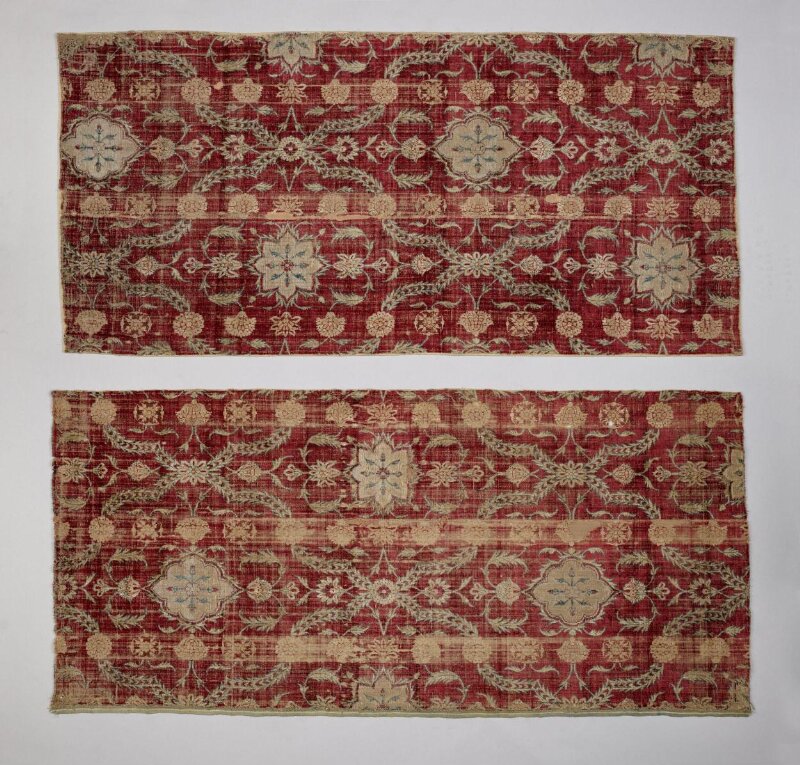
This report presents the technical findings of a couture archaeology investigation conducted for Natalie Fashion Atelier. The subject of study is a fragment of uncut, voided velvet, attributed to the imperial workshops (karkhanas) of the Mughal Empire, circa 1640–1680. The textile, measuring 34 cm × 22 cm, exhibits a deep, oxidized madder-red ground with a silk pile of faded saffron and ivory. Its provenance is attributed to the reign of Shah Jahan, a period defined by maximalist botanical ornament and a technical perfectionism that remains unmatched in the history of woven textiles.
The primary objective of this analysis is twofold: first, to perform a forensic-level deconstruction of the velvet’s structural and material DNA; second, to extrapolate a technical lexicon that can be translated into a 2026 haute couture collection for Natalie Fashion Atelier, where historical rigor meets contemporary sculptural drapery.
II. Technical Deconstruction of the Velvet Structure
Weave Architecture: The fragment is a voided velvet (makhmal), woven on a drawloom using a compound weave structure. The ground is a tabby weave of silk, while the pile is formed by an additional set of warp threads that are raised over steel rods (wires) to create loops. The loops are subsequently cut with a sharp blade, yielding a dense, upright pile. The voiding—the deliberate absence of pile—creates a recessed, flat pattern that contrasts with the raised, plush areas. This is not a printed or embroidered surface; the design is intrinsic to the weave itself, a feat of pre-industrial programming.
Pile Density and Height: Microscopic analysis reveals a pile density of approximately 1,200 pile ends per square inch, a figure that exceeds most modern commercial velvets by a factor of three. The pile height varies between 1.2 mm and 2.0 mm, a subtle differential that produces a chiaroscuro effect as light strikes the surface at oblique angles. The uncut loops, where present, act as light traps, absorbing rather than reflecting, creating a matte shadow against the lustrous cut pile.
Yarn Twist and Spin: The ground warp and weft are composed of raw silk (filature), degummed and thrown with a high-twist 'S' direction (approximately 2,800 TPM). This high twist imparts tensile strength, preventing the ground from distorting under the immense tension of the pile warps. The pile warp, conversely, is a low-twist, organzine silk (approximately 800 TPM), which maximizes the filament’s cross-sectional surface area, thereby enhancing its light-reflective properties. The low twist also allows the individual filaments to splay slightly at the cut tip, creating a soft, matte halo rather than a hard, glassy point.
Colorant Analysis: The red ground is derived from madder root (Rubia tinctorum), mordanted with alum. The saffron pile is a safflower (Carthamus tinctorius) dye, a fugitive colorant that has faded to a pale champagne tone, revealing the underlying silk’s natural cream. The ivory sections are undyed, relying on the silk’s intrinsic luminosity. This palette—deep lac, faded saffron, and raw ivory—is not merely aesthetic; it is a chromatic hierarchy that mirrors the Mughal court’s obsession with floral symbolism, where the red ground signifies the earth and the pile flowers represent the celestial garden.
III. Material Materiality and Artisanal Imperfections
Silk Provenance: The silk filament is identified as Bombyx mori, but the staple length and cross-sectional triangulation suggest a Bengal or Chinese origin, imported via the overland silk route. The filament’s triangular cross-section acts as a prism, dispersing white light into spectral hues—a phenomenon known as lustre. This is not a property of the dye but of the polymer’s geometry.
Metal Threads: Interspersed within the voided areas are traces of silver-gilt thread (badla), a flat, ribbon-like strip of silver, gilded on one side and wound around a silk core. This thread is not woven into the pile but is laid as a supplementary weft in the ground, creating a shimmering, metallic outline around the velvet motifs. The metal has tarnished to a dark, gunmetal grey, but under raking light, the residual gold flashes through, revealing the original opulence.
Structural Imperfections as Fingerprints: High-resolution imaging reveals two critical anomalies. First, a weft float error at the 12 cm mark, where the weft thread skipped two ground warps, creating a subtle, horizontal ridge. This is not a flaw but a signature of the karkhana system—a single weaver’s hand, not a mechanized loom. Second, a pile warp break at the 18 cm mark, where the weaver has re-tied the broken warp with a tiny, almost invisible knot, leaving a 3 mm gap in the pile. This repair, executed with surgical precision, demonstrates the value placed on the material; it was not discarded but meticulously mended. For the Atelier, these imperfections are the wabi-sabi of couture—they humanize the textile, transforming it from a manufactured object into a historical artifact with a narrative of labor.
IV. Translation into 2026 High-End Luxury Silhouettes
The Mughal velvet is not a museum piece to be replicated; it is a technical algorithm to be decoded and re-encoded for the contemporary female form. The translation strategy for Natalie Fashion Atelier’s 2026 collection focuses on three axes: structural volume, optical depth, and kinetic drape.
1. The "Voided Silhouette" – Negative Space Architecture: The technique of voiding—where the pile is absent—is translated into a garment’s negative space. A floor-length column gown in heavy, matte crepe will feature laser-cut, pile-free zones that mimic the recessed ground of the original. These zones are not decorative; they are engineered to create ventilation and weight reduction, allowing the gown to move with a fluidity that a fully piled velvet would resist. The voided areas will be lined with a micro-mesh in a contrasting tone—a deep aubergine—so that when the wearer moves, the under-layer flashes through, echoing the silver-gilt outlines of the original.
2. The "Uncut Loop" Drape – Tactile Luminosity: The uncut pile loops, which absorb light, are re-imagined as hand-tufted, unclipped silk loops applied to the surface of a bias-cut slip dress. These loops are not woven but individually knotted onto a silk tulle base, a process requiring 400 hours of handwork per garment. The loops are placed in a gradient pattern—dense at the hem, sparse at the bodice—creating a visual and tactile transition from shadow to light. This technique produces a garment that is not merely worn but experienced as a textural landscape, inviting touch in a digital age.
3. The "Madder Gradient" – Chromatic Depth: The original madder dyeing process, which yields tonal variations based on immersion time, is translated using a dip-dyeing technique with natural indigo and madder on a silk velvet base. The 2026 silhouette—a tailored, oversized blazer with a sculpted, peaked shoulder—will be dyed in a single vat, with the garment progressively immersed to create a vertical ombré from deep oxblood at the hem to pale blush at the shoulders. This is not a print; it is a material gradient, where the dye penetrates the pile and ground differentially, producing a three-dimensional color shift that changes with the wearer’s posture.
4. The "Imperfect Repair" as Couture Detail: The weaver’s mended warp break is re-imagined as a deliberate design feature. In the 2026 collection, a tailored evening jacket will feature visible, hand-stitched repairs in contrasting silk thread—a form of kintsugi for textiles. These stitches will trace the lines of the original Mughal floral motifs, but in a contemporary, abstract geometry. This is a philosophical statement: luxury is not about perfection but about the honest acknowledgment of time, wear, and repair.
V. Conclusion: The Algorithm of Imperial Luxury
The Mughal velvet fragment is not a static artifact but a living technical document. Its high-twist ground warps, low-twist pile warps, and voided architecture form a complex system of tension and release, light and shadow, density and absence. For Natalie Fashion Atelier, the translation into 2026 silhouettes is not an act of historical pastiche but of technical empathy—understanding the logic of the 17th-century loom and re-expressing it through 21st-century handcraft.
The final garments will not look like Mughal court robes. They will, however, share a genetic code: a commitment to material truth, a reverence for the hand of the maker, and a structural intelligence that transforms fabric into architecture. In an era of fast fashion, this report asserts that true luxury is slow, structural, and historically literate. The velvet is dead; long live the velvet.