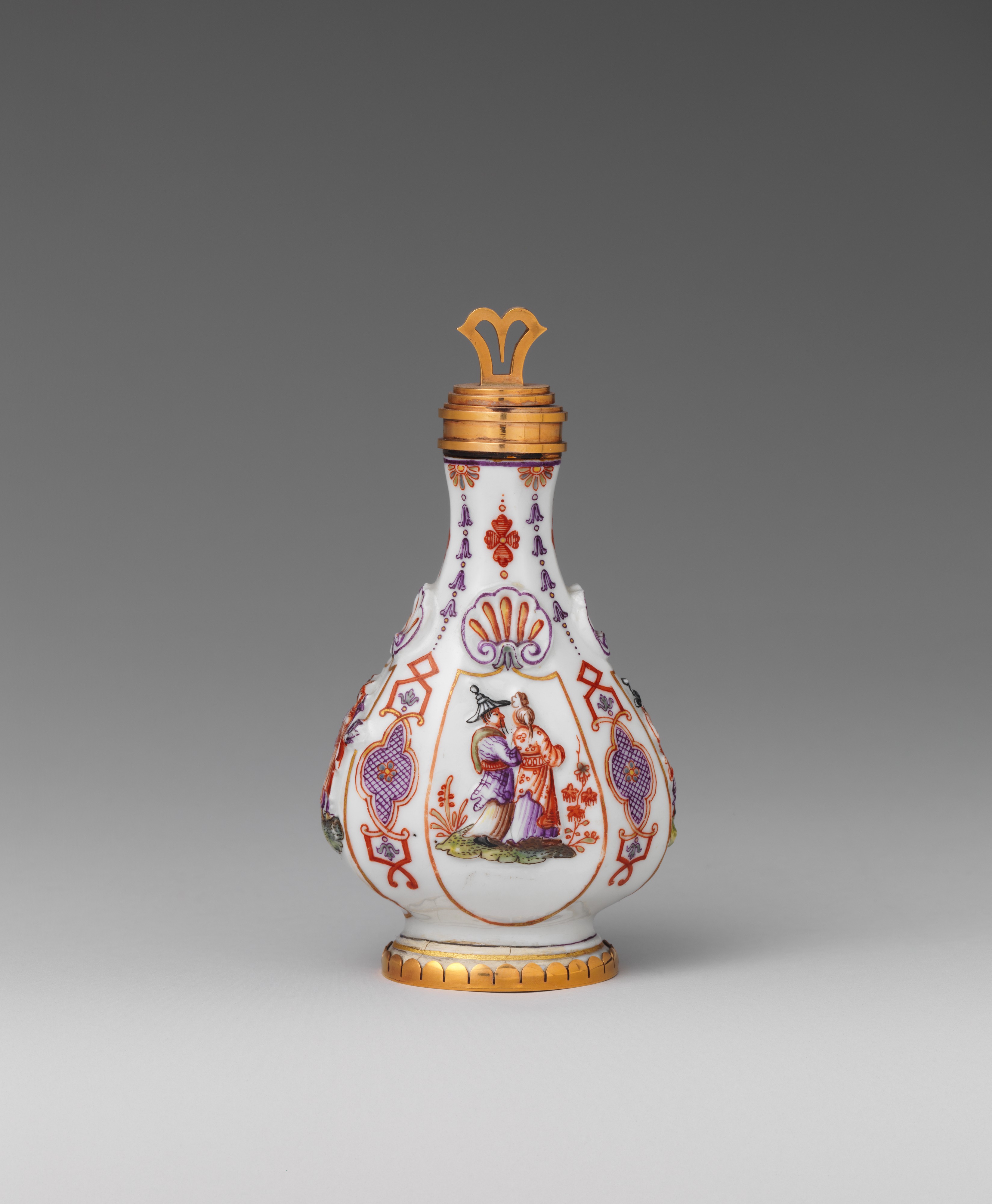
The Scent Bottle as Architectural Genesis: Porcelain, Gilding, and the 2026 Silhouette
The scent bottle, often dismissed as a mere vessel for olfactory pleasure, stands as a profound artifact of material culture—a micro-architecture of desire, restraint, and opulence. Within the context of Natalie Fashion Atelier’s aesthetic archaeology, the isolated study of a hard-paste porcelain and gold scent bottle reveals a lexicon of form that transcends its utilitarian origins. This artifact, plucked from the continuum of global heritage, offers a blueprint for the 2026 haute couture silhouette, not through literal mimicry, but through a transposition of its core structural and textural principles. The bottle’s rigid exterior, its luminous gilded accents, and its hermetic closure become metaphors for a new sartorial language—one that prioritizes sculptural integrity, precious interruption, and the quiet drama of containment.
Material Dialectics: The Rigidity of Porcelain and the Fluidity of Gold
The foundational tension within this artifact lies in the marriage of hard-paste porcelain and gold. Porcelain, fired at temperatures exceeding 1,300 degrees Celsius, achieves a vitreous, almost bone-like hardness. It is a material of absolute certainty, offering no drape, no give, and no compromise. Conversely, gold, in its applied form as gilding, is a material of surface—a liquid light that adheres to the porcelain’s contours, celebrating its curves while simultaneously asserting a separate, luminous identity. This dialectic is the primary driver for the 2026 silhouette.
For the atelier, this translates into a construction philosophy of “structured exterior, luminous interruption.” The primary garment—a column dress, a tailored bustier, or a severe coat—must be executed in a fabric that mimics porcelain’s uncompromising nature. We look to bonded technical silks, dense wool crepes, and even experimental bio-ceramic coated textiles that offer a tactile sensation of hardness. The silhouette is not soft or flowing; it is architectural, standing away from the body with the confidence of a glazed vessel. The shoulder line becomes a sharp, unyielding rim; the waist, a cinched neck of the bottle; the hip, a voluminous belly that tapers decisively to the hem.
The gold, however, refuses to be subordinated. It does not appear as trim or piping. Instead, it manifests as “gilded cartography”—strategic, laser-cut metallic appliqués that trace the seams of the garment, or as embroidered filigree that mimics the intricate chinoiserie patterns often found on such bottles. These gold elements are not decorative afterthoughts; they are structural signifiers, outlining the points of tension and release within the silhouette. A gold line may trace the collarbone, drawing the eye to the porcelain-like expanse of the chest, or it may form a rigid corset-like cage over a fluid underlayer, creating a visual and physical dialogue between the hard and the soft.
Proportions of Containment: The Neck, the Belly, and the Base
The scent bottle’s anatomy—its narrow neck, its swelling belly, and its stable base—offers a radical re-proportioning of the female form for 2026. This is not a celebration of the natural body, but a deliberate, intellectual reshaping of it. The “neck” of the silhouette is elongated and columnar, achieved through high, standing collars that encase the throat in a porcelain-like sheath. This is not a restrictive gesture, but a ceremonial one, framing the face as the precious stopper of the vessel.
The “belly” of the garment becomes the site of maximal volume. We move away from the deconstructed, oversized silhouettes of recent seasons. Instead, we propose a controlled, spherical volume—a peplum, a bubble hem, or a structured bustle that references the bottle’s corpulent base. This volume is engineered with internal boning and horsehair canvas to maintain its perfect, almost mathematical curvature. It is a volume of containment, suggesting that the body within is a precious essence, held and protected by the outer shell.
The “base” of the silhouette is its foundation—a wide, unwavering hem that grounds the entire composition. This is achieved through heavy, weighted fabrics and a hidden internal structure that creates a slight train, reminiscent of the bottle’s foot ring. The garment does not move with the wearer; it moves with its own architectural logic, creating a powerful, statuesque presence. This is a silhouette that demands space and commands attention, a direct counterpoint to the ephemeral, fleeting trends of fast fashion.
Surface as Narrative: Glaze, Patina, and the Gilded Trace
The surface treatment of the 2026 couture pieces draws directly from the ceramicist’s art. The porcelain’s glaze—its smooth, impermeable, and slightly reflective quality—is translated into a fabric finish. We employ high-shine technical satins, lacquered organzas, and patent leathers that possess a similar, almost unnatural luminosity. The color palette is derived from classic porcelain glazes: the pristine white of Blanc de Chine, the deep cobalt of Ming, the celadon greens, and the oxblood reds. These are not muted or pastel; they are saturated, confident, and deeply historical.
However, the true innovation lies in the treatment of the gold. We move beyond simple metallic thread. The atelier explores “patina embroidery”, where gold threads are intentionally oxidized or combined with dark, matte beads to create a sense of age and archaeological depth. This is not a shiny, ostentatious gold, but a “gilded memory”—a gold that feels excavated, as if the garment itself has been unearthed from a forgotten vault. This technique is applied to the seams and edges, creating a worn, yet luxurious, outline that mimics the wear patterns on a centuries-old gilded surface.
Furthermore, the concept of the bottle’s stopper—the point of access and release—is reinterpreted as a closure system. Instead of conventional zippers or buttons, we propose “ceremonial closures”: large, sculptural brooches, obi-style sashes, or articulated gold metalwork that fasten the garment at the neck, waist, or shoulder. These closures are not merely functional; they are the focal point of the garment, the moment where the gold asserts its dominance over the porcelain field. They are the jewelry of the silhouette, but they are also its structural keystone.
Conclusion: The Vessel as a Manifesto
The hard-paste porcelain scent bottle, in its isolated glory, is not a relic but a directive. For the 2026 collection, it informs a silhouette that is at once ancient and futuristic, rigid and luminous, contained and expressive. It is a manifesto against the ephemeral, a return to the principles of haute couture as a form of architectural sculpture. The garments are not worn; they are inhabited, like a precious vessel holds its essence.
The Natalie Fashion Atelier client of 2026 is not seeking comfort or casual ease. She is seeking “aesthetic permanence”—a garment that possesses the weight, the presence, and the historical gravitas of a museum artifact. The scent bottle teaches us that true luxury is not about volume or excess, but about the perfect, disciplined relationship between material, form, and surface. It is about the quiet power of a perfectly sealed line, the opulent whisper of a gilded edge, and the profound statement of a silhouette that stands as a monument to the craft of creation. This is the new elegance, born not from novelty, but from a deep, scholarly, and passionate re-reading of the past.