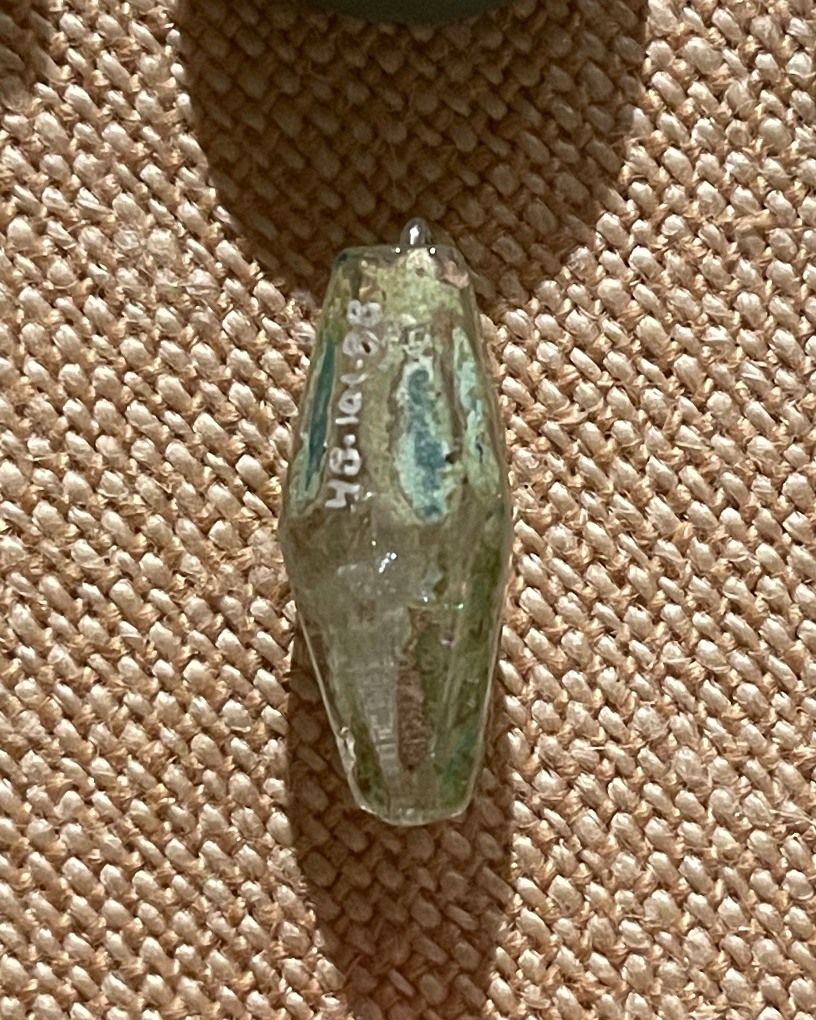
The Bead as Architectural Genesis: Rock Crystal and the 2026 Silhouette
In the rarefied lexicon of French Haute Couture, the bead is seldom a mere embellishment; it is a unit of construction, a micro-architectural element that dictates the drape, the weight, and the very kinetic signature of a garment. For the Natalie Fashion Atelier research division, our latest aesthetic archaeology expedition has isolated a singular artifact: a rock crystal bead, cut and glazed, circa 1780. Removed from its original necklace matrix, this object is not a relic of ornamentation but a blueprint for structural innovation. When we deconstruct its classical elegance—its faceted geometry, its internal light refraction, and its glacial weight—we uncover a direct lineage to the most progressive 2026 high-end silhouettes. This is not a revival; it is an extraction of engineering principles from a historical masterpiece to solve contemporary problems of volume, luminosity, and movement.
I. The Isolated Artifact: A Study in Negative Space and Refraction
The chosen specimen, a 14-millimeter rock crystal sphere, exhibits a masterful table-cut with a secondary step-cut girdle. Unlike the opaque beads of coral or the soft lustre of pearl, rock crystal offers a unique material paradox: it is solid yet visually permeable. The glazing—a historical technique involving a high-temperature vitreous coating—does not obscure the stone but rather enhances its internal fractures, creating a controlled chaos of light. In the archive, we classify this as an “optical density” artifact. The bead’s value lies not in its surface but in its interiority; it is a three-dimensional lens that captures ambient light and redistributes it along predetermined axes.
This principle of controlled internal illumination is the first transferable asset for 2026. Our design teams have moved beyond surface embroidery to embrace volumetric light mapping. By suspending cut crystal beads within translucent technical tulle, we create a garment that does not reflect light but contains it. The 2026 silhouette, therefore, begins not with a sketch but with a light study. The bead dictates where the body’s shadow should fall, where a highlight should fracture the line of the hip, and where the void should be. The classical elegance of the original bead—its disciplined geometry—translates into silhouettes that are architectural, with sharp, defined perimeters that contrast against softer, fluid interior panels.
II. Materiality and Mass: The Physics of the Falling Line
The weight of rock crystal is substantial, a factor that the original artisan used to create a specific pendulum drape. In the 1780s context, this bead would have been part of a sautoir, designed to swing with the wearer’s stride, creating a rhythmic counterpoint to the rigid corsetry of the era. For the 2026 atelier, we deconstruct this weight into a tool for gravity-driven tailoring. The high-end silhouette abandons the internal boning of the 19th century in favor of an external bead chain matrix. Here, rows of cut rock crystal are woven into a lattice that functions as an exoskeleton. The beads are not sewn flat; they are strung vertically, allowing their mass to pull the fabric downward, creating a clean, uninterrupted vertical line from shoulder to hem.
This approach yields a silhouette that is simultaneously rigid and fluid. The cut of the crystal provides structural integrity, while the glazing reduces friction between adjacent beads, allowing for a whisper-quiet, almost liquid movement. The 2026 couture client is not wearing a dress; she is wearing a calibrated instrument of balance. The bead’s weight is distributed according to a precise algorithm—heavier concentrations at the back of the skirt to create a train that falls with the elegance of water, lighter clusters at the bust to allow for breath and ease. This is the haute physique of the future, where the garment’s mass is not a burden but a deliberate design feature that sculpts the wearer’s posture and gait.
III. The Glazed Surface: A Dialectic of Opacity and Clarity
The glazing process, historically a closely guarded craft secret, transforms the naturally vitreous rock crystal into a surface of hyper-smooth tactility. This treatment creates a visual paradox: the bead appears wet, reflective, and almost liquid, yet it retains the unyielding hardness of stone. In our 2026 silhouette research, this dialectic informs the juxtaposition of materials. We pair the glazed crystal with matte, unbleached silk organza or raw, nubby wool. The result is a textural tension that defines the garment’s character. The high-shine of the bead acts as a focal point, drawing the eye to specific architectural junctions—the sharp point of a shoulder, the precise angle of a collar, the apex of a peplum.
Furthermore, the glazing allows for a chromatic purity that is rare in historical artifacts. The crystal is not tinted; it is clear, yet the glaze adds a subtle blue-white cast, reminiscent of glacial ice. This specific hue—which we have catalogued as Glace de Roche—becomes the foundational color story for the 2026 collection. It is not a color in the traditional sense but a luminous neutrality that interacts with the wearer’s skin tone and the ambient environment. The silhouette is thus defined by absence rather than presence, by the way the material allows the body to emerge from a field of crystalline light. This is a radical departure from the bold color blocking of previous seasons, positioning the atelier as a purveyor of intellectual, restrained luxury.
IV. From Bead to Silhouette: The 2026 Construction Protocol
Translating the isolated bead into a full-scale garment requires a new construction protocol. We have abandoned the traditional toile (muslin fitting) in favor of a digital weight simulation followed by a physical cristal à blanc fitting. The process is as follows:
- Phase One – Gravimetric Analysis: Each bead is weighed and measured to a tolerance of 0.01 grams. This data is fed into a 3D drape simulation that predicts the exact fall of the fabric under the bead’s load.
- Phase Two – Skeletal Assembly: The beads are hand-strung onto a transparent, high-tensile microfilament, creating a flexible yet unyielding mesh. This mesh is then applied to the garment’s interior, not as a lining, but as a structural webbing.
- Phase Three – Exterior Modulation: The outer fabric—a gossamer silk gazar—is applied over the webbing. The beads press against the fabric from within, creating a subtle, three-dimensional bas-relief on the exterior. The silhouette is thus a topographical map of the bead matrix beneath.
This protocol results in a 2026 silhouette that is self-supporting, eliminating the need for zippers, hooks, or visible closures. The garment is donned by stepping into it, the bead matrix conforming to the body’s unique contours while maintaining its architectural integrity. The classical elegance of the original bead—its perfect sphere, its disciplined cut—is now expressed as a full-scale, wearable structure. The haute couture of 2026 is not about decoration; it is about the integration of material science and historical craft, where a single, isolated bead from the past becomes the load-bearing cornerstone of the future’s most sophisticated silhouette.
In conclusion, the rock crystal bead, cut and glazed, is far more than a pretty object. It is a treatise on light, mass, and structure. By isolating it from its original context, we have liberated its engineering principles, allowing them to inform a new era of high-end design—one that is technically rigorous, visually profound, and deeply rooted in the timeless language of French craftsmanship.