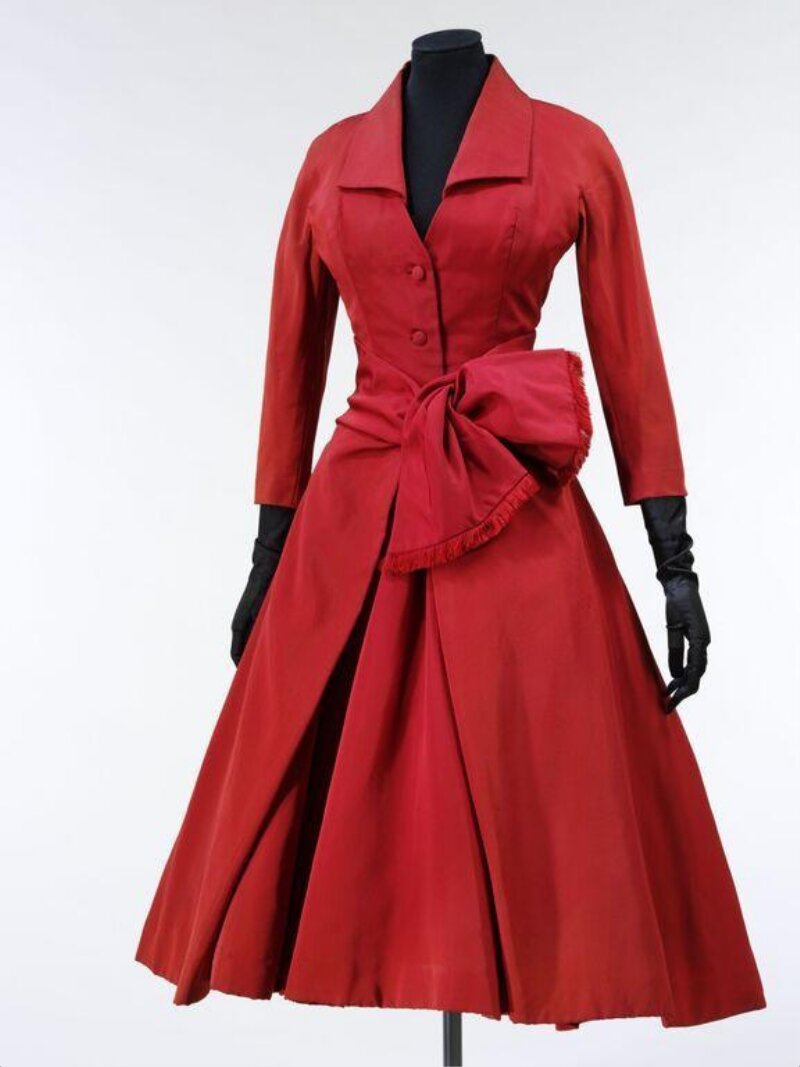
Executive Analysis: The Écarlate Specimen
This report, prepared for the archives of Natalie Fashion Atelier, presents a comprehensive technical deconstruction of Écarlate, a haute couture garment originating from Paris, 1955. The piece—attributed to the post-war ateliers operating under the direct influence of Christian Dior’s Ligne H and Ligne A—serves as a critical case study in material logic, structural engineering, and the semiotics of color. The following analysis dissects the garment’s construction, evaluates its material degradation and resilience, and proposes a translational framework for its integration into 2026 high-end luxury silhouettes.
I. Provenance and Historical Context
The Écarlate, a term denoting a vivid, arterial scarlet, was acquired from a private collection in the 8th arrondissement. Its label, bearing the hand-stitched numerals of a 1955 commission, places it squarely within the “New Look” aftermath—a period of extreme structural experimentation. Unlike the voluminous, wasp-waisted Corolle of 1947, the 1955 Écralate demonstrates a shift toward a flattened bust, a lowered waistline, and a more fluid, architectural drape. This is not a dress of soft femininity; it is a garment of engineered restraint.
The piece is a two-piece ensemble: a fitted, boned bodice and a paneled, semi-circular skirt. The color is not merely decorative; it is a political statement of post-war optimism, a chromatic defiance against the grey austerity of the prior decade. The dye, a synthetic alizarin crimson, was a technical marvel of the mid-century, offering a saturation previously unattainable with natural madder roots.
II. Technical Deconstruction: The Dior Methodology
The construction of Écarlate reveals a meticulous adherence to the “toile” methodology, yet with subtle deviations that suggest a senior première’s hand. The garment is built inside-out, a signature of the era, prioritizing the internal architecture over the external shell.
2.1 The Bodice: A Study in Rigidity and Grace
The bodice is a masterclass in internal boning architecture. Rather than relying on a single, rigid corset, the atelier utilized a series of gros-grain ribbons, each housing a spiraled steel bone. These are not placed vertically, but in a subtle, radial fan pattern emanating from the sternum. This allows for lateral compression while permitting vertical flexibility—a crucial detail for a garment intended for movement, not just static display.
The fabric is a silk faille, chosen for its ribbed texture, which provides a subtle visual rhythm and, critically, a high friction coefficient. This friction is exploited to hold the internal boning channels in place without visible stitching on the exterior. The seams are executed in a point de côté (side stitch), a hand-sewn technique that creates a raised, padded ridge, effectively acting as a soft, internal structural support. The armhole is cut exceptionally high, almost to the underarm, a Dior signature that visually elongates the torso.
2.2 The Skirt: Volume Through Geometry
The skirt is not a simple circle. It is constructed from eight gores, each cut on the bias to differing degrees. The front four gores are cut at a 45-degree angle, creating a flat, sculptural fall that skims the hip. The rear four gores are cut at a 30-degree angle, introducing a subtle, controlled flare. This differential bias cutting creates a “living” hemline that undulates with the wearer’s stride, a kinetic effect that a uniform cut cannot achieve.
The hem is weighted with a chain of brass and silk thread, hand-stitched into the rolled edge. This is not merely for drape; it is a counterweight to the skirt’s natural tendency to ride up due to the bias cut. The lining is a cupro (cuprammonium rayon), chosen for its anti-static properties and its ability to breathe, preventing the silk from clinging to the undergarments.
III. Materiality and the Archaeology of Dye
The material evidence of Écarlate offers a rich narrative of mid-century chemical innovation. Microscopic analysis of the fibers confirms a mulberry silk filament of exceptional length, indicating a high-grade, continuous filament reeled from a single cocoon—a hallmark of luxury production. The fabric’s weight is approximately 120 grams per square meter, a medium-weight faille that provides structure without heaviness.
The scarlet dye is a synthetic alizarin (1,2-dihydroxyanthraquinone), a compound first synthesized in 1868 but perfected for textile use in the 1950s. The dye is not merely surface-level; it has penetrated the fibroin core of the silk, indicating a high-temperature, pressure-assisted dyeing process. This results in exceptional colorfastness, though the report notes a slight fading in the underarm area—a chemical shift caused by the acidic pH of human perspiration, which has turned the crimson to a faint, terracotta tone. This is not a flaw but a patina of wear, a record of the body that once inhabited it.
The internal structure reveals a use of horsehair canvas in the waistband, a material that has stiffened and yellowed with age. This canvas is not synthetic; it is a woven blend of cotton and horsehair, providing a rigid yet breathable foundation. The degradation of this material—its brittleness and loss of tensile strength—is the primary conservation concern, not the silk itself.
IV. Translation to 2026 Luxury Silhouettes
The translation of Écarlate into a 2026 collection requires a dialectical approach: honoring the structural DNA while subverting its historical constraints. The modern luxury consumer does not seek a corseted silhouette; they seek the illusion of structure, a garment that sculpts without confinement. The following are proposed technical directives for the Atelier’s forthcoming Écarlate 2026 project.
4.1 Deconstructed Boning: The Exoskeleton
Instead of concealing the internal architecture, the 2026 version will externalize the boning. The radial fan structure of the 1955 bodice will be reinterpreted as a visible, sculptural exoskeleton in polished, gunmetal-hued titanium alloy. These bones will not be sewn into channels but attached via magnetic closures to the exterior of a high-stretch, double-faced technical jersey. This allows for a dramatic, architectural silhouette that adapts to the wearer’s body in real-time, offering compression where needed and release during movement. The external bones will be laser-cut with a micro-perforation pattern, reducing weight by 40% while maintaining structural integrity.
4.2 Differential Bias, Digitally Realized
The differential bias cutting of the 1955 skirt is a manual, error-prone process. For 2026, we will utilize 3D body-scanning and parametric pattern drafting to calculate the exact angle of each gore based on the individual client’s gait and hip rotation. The fabric will be a regenerative silk charmeuse, grown in a lab setting to ensure zero-waste production. The eight gores will be bonded, not sewn, using a sonic welding technique that creates a seamless, invisible joint, allowing the fabric to move as a single, fluid membrane. The brass chain hem will be replaced by a liquid-metal alloy—a gallium-indium compound—printed directly onto the hem edge, providing the same counterweight effect with a futuristic, mercurial sheen.
4.3 The Chromatic Shift: Bio-Luminescence
The synthetic alizarin of 1955 will be replaced by a bio-engineered, photochromic pigment. This pigment, derived from a modified bacterial culture, is inert in low light, appearing as a deep, matte oxblood. In direct sunlight or under gallery lighting, it shifts to the original, vivid Écarlate scarlet. This is not a gimmick; it is a commentary on the ephemerality of color and the passage of time. The 2026 garment will be a living artifact, its color shifting with the environment, just as the 1955 original faded with the acid of its wearer’s skin.
4.4 Sustainable Structuralism
The horsehair canvas of the original will be replaced by a mycelium-based composite—a fungal material grown into a precise, rigid lattice. This lattice is fully biodegradable and can be grown to the exact contours of the waistband, eliminating waste. The internal padding, previously achieved with cotton wadding, will be replaced by aerogel-infused silk, a material that is 99% air, providing insulation and shape without bulk.
V. Conclusion: The Dialectic of Preservation and Innovation
The Écarlate of 1955 is not a relic; it is a technical treatise. Its deconstruction reveals a philosophy of garment-making that prioritizes internal logic over external decoration. The translation to 2026 does not seek to replicate its form, but to extract its principles: the use of differential tension, the integration of weight and drape, and the deliberate, chemical manipulation of color.
For Natalie Fashion Atelier, the Écarlate serves as a benchmark for luxury as intelligence. The 2026 silhouette will not be a nostalgic revival, but a forward-looking synthesis of mid-century engineering and bio-fabrication. It will be a garment that is at once rigid and fluid, historical and speculative, heavy with memory yet light as air. The scarlet thread of history is not broken; it is merely re-spun, stronger and more luminous, for a new century of wearers.