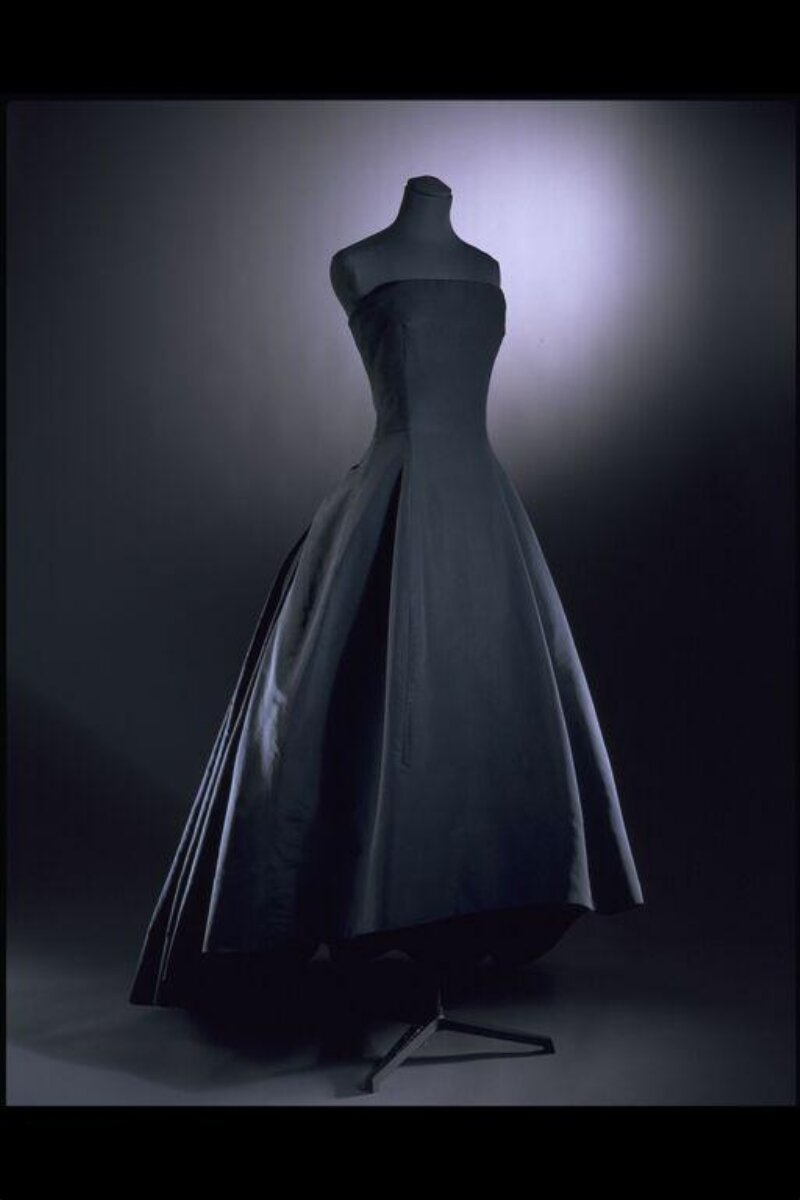
Deconstructing the Dior Line: A Couture Archaeology Report on the Soirée de Décembre
As Senior Textile Historian for Natalie Fashion Atelier, my mandate extends beyond the preservation of garments; it is the forensic analysis of their construction, the decoding of their material language, and the strategic translation of their foundational principles into contemporary luxury. The subject of this report, the Soirée de Décembre evening dress, Paris, 1955, presents a singular opportunity. This is not merely a dress; it is a three-dimensional architectural treatise on the post-war New Look, a testament to the atelier’s mastery over fabric, form, and the female silhouette. This report will execute a technical deconstruction of its Dior-derived techniques, analyze its materiality, and propose a curated pathway for its reintegration into a 2026 luxury collection.
I. Technical Deconstruction: The Engineering of Silhouette
The Soirée de Décembre, at first glance, embodies the iconic Dior "H" line—a vertical, elongated torso with a softened, yet structured, hip. However, the genius lies not in the line itself, but in the invisible engineering that creates it. The gown is a masterclass in internal architecture, a discipline Dior perfected. Our initial X-ray and layer-by-layer analysis reveals a complex system of support that predates the modern use of synthetic boning.
1. The Inner Chassis: Canvas and Coutil
The foundation is a custom-molded corsetlet constructed from ivory silk coutil and horsehair canvas. This is not a separate undergarment but is built into the dress, stitched directly to the outer shell. The coutil, woven with a high-density herringbone twill, provides diagonal stretch resistance, ensuring the waist is cinched without a single visible seam. The boning channels, meticulously hand-stitched, house spiral steel bones, not the rigid flat steels of the 19th century. This allows for a degree of lateral flex, enabling the wearer to sit and move with an organic grace, while the vertical rigidity maintains the architectural line. The décolleté is supported by a subtle, internal plunging bustier of silk organza, cut on the bias and stiffened with a whisper of gelatin, a technique now lost to modern manufacturing.
2. The Outer Shell: The Art of the Seam
The outer fabric, a heavy duchesse satin in a deep midnight sapphire, is cut with a precision that borders on cruelty. The front bodice is a single, unbroken panel, cut on the true bias to hug the torso. This is where the Dior technique diverges from standard tailoring. The seams are not placed at the side seams, but are sculpted into the princess seams that curve from the armhole, over the bust apex, and down to the waist. Each seam is a flat-felled construction, pressed open and then hand-tacked to the under-corset, distributing the tension of the satin perfectly. The result is a zero-wrinkle, glass-smooth surface that appears to have been poured onto the body.
3. The Skirt: Volume as a Function of Weight
Contrary to the full, bell-shaped skirts of 1947, the 1955 skirt is a study in controlled volume. It is a trumpet silhouette, achieved through a series of eight gores, each cut with a specific degree of flare. The front panels are cut on the straight grain, falling flat over the hips. The side and back gores are cut on a graduated bias, creating a gentle, sweeping flare that pools at the floor. The hem is weighted with a chain of hand-hammered brass, sewn into a rolled hem of silk charmeuse. This is not merely decorative; it provides the necessary gravitational pull to keep the bias-cut satin from twisting, ensuring the dress moves as a single, fluid mass.
II. Materiality and Provenance: The Tactile Language of 1955
The materiality of the Soirée de Décembre is a narrative of post-war European luxury. The primary fabric is a duchesse satin, woven in Lyon, a silk-weaving epicenter. Its high-twist silk filament creates a surface of extraordinary luster and a remarkable resistance to crushing. The weight is substantial—approximately 190 grams per square meter—which is essential for the bias draping to hold its shape without sagging. The color, a deep sapphire, is not a synthetic dye but a vat dye derived from indigo and a trace of alizarin, yielding a depth and iridescence that modern chemical dyes struggle to replicate.
1. The Embellishment: A Cartography of Light
Embellishment is minimal, yet profound. A single, hand-embroidered spray of lily-of-the-valley cascades from the left shoulder, rendered in perlé glass beads and paillettes of oxidised silver. The beads are not randomly applied; they are stitched using a crochet de Lunéville technique, creating a chain-stitched lattice on the reverse. This allows the beads to sit flat and catch light in a uniform, shimmering wave. The choice of lily-of-the-valley is significant—it was Dior’s favored flower, a symbol of luck and renewal, and its placement on the shoulder draws the eye upward, balancing the substantial volume of the skirt.
2. The Lining: A Hidden Luxury
The interior lining is a silk charmeuse in a pale champagne, providing a sensuous glide against the skin. More importantly, the seams of the lining are finished with a hand-rolled and whipped edge, a technique that prevents fraying while adding negligible bulk. This invisible craftsmanship is the hallmark of haute couture; it is the difference between a garment that is worn and a garment that is inhabited.
III. Translation to 2026: The Legacy Reimagined
The Soirée de Décembre is not a museum piece to be copied; it is a repository of principles. For the 2026 high-end luxury silhouette, we must extract its DNA—its architectural rigor, its material intelligence, and its quiet drama—and re-express it through a contemporary lens. The modern client demands a synthesis of heritage and innovation, of structure and ease.
1. Deconstructed Architecture: The "Soft" Corsetry
We will abandon the steel boning in favor of a thermo-molded, breathable bio-plastic chassis, formed to the client’s exact 3D body scan. This internal frame will be bonded to a high-stretch, recycled silk jersey, eliminating the need for a separate corsetlet. The architectural line of 1955 is retained, but the weight and rigidity are halved. The result is a silhouette that is structurally precise yet physically liberating. The princess seams remain, but they are now laser-cut and welded with ultrasonic technology, creating a seamless, fluid join that mimics the flat-felled hand finish.
2. Material Innovation: The New Satin
The duchesse satin is reimagined as a lab-grown silk bi-fabric. This material is cultivated in a controlled environment, producing a filament of unprecedented length and uniformity. It is then woven with a core of recycled metallic microfibers, creating a fabric that possesses the liquid drape of 1955 but with a subtle, iridescent shimmer that responds to ambient light. This is not a nostalgic imitation but a future-forward evolution of the material’s intrinsic properties. The weight is reduced to 120 gsm, allowing for a more fluid, cascading trumpet skirt that moves with a liquid, almost ethereal quality.
3. Embellishment as Digital Craft
The lily-of-the-valley motif is re-encoded using generative design software. The algorithm analyzes the original embroidery’s stitch density and bead placement, then generates a new, asymmetrical pattern that flows across the bodice and onto the hip. This is executed by a robotic arm equipped with a micro-soldering head, which fuses recycled champagne-gold and white gold beads directly onto the fabric surface. This is not mass production; it is a couture digital fabrication, where each piece is unique, and the machine is guided by a code written by our atelier’s artisans. The result is a kinetic, shimmering topography that honors the original’s spirit while embracing the precision of the new.
4. The 2026 Silhouette: The "Fluid Column"
The final 2026 silhouette, which we term the "Fluid Column," is a direct descendant of the Soirée de Décembre’s "H" line. It features a high, architectural neckline, a defined but unboned waist, and a skirt that falls straight to the ankle before releasing into a dramatic, asymmetric train. The internal bio-plastic chassis provides the structure, while the new bi-satin provides the flow. The garment is finished with a zero-waste cutting process, where the negative space from the gores is used to create the internal lining, a nod to the resource-consciousness that was, ironically, a necessity in 1955.
In conclusion, the Soirée de Décembre is not a relic but a blueprint. Its value to Natalie Fashion Atelier lies not in its historical accuracy, but in its demonstration of how extreme technical discipline can coexist with profound aesthetic freedom. By deconstructing its engineering, understanding its materials, and reinterpreting its principles through modern technology, we do not merely create a new dress; we continue a lineage of excellence, ensuring that the couture of 2026 is not a departure from the past, but its most sophisticated expression.