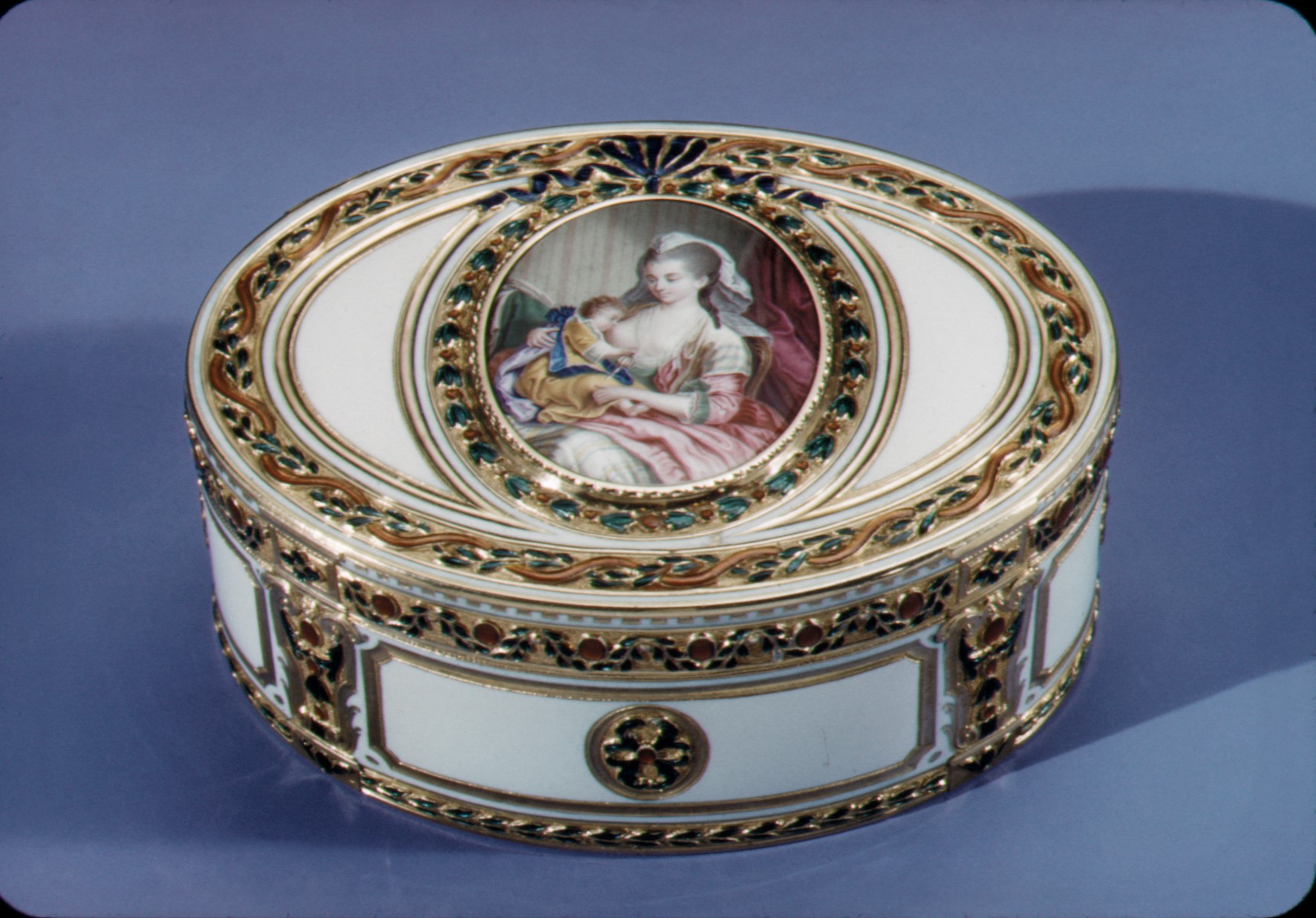
From Miniature to Monument: The Snuffbox as a Blueprint for 2026 Couture
The snuffbox, a diminutive vessel of aristocratic ritual, often escapes the critical gaze of contemporary fashion theory. Yet, within the isolated aesthetic archaeology of the Natalie Fashion Atelier archive, this particular artifact—a gold and enamel case bearing a miniature of a mother nursing a child—functions as a profound architectural and philosophical precedent. It is not merely a relic of 18th-century intimacy; it is a compressed manifesto of material hierarchy, spatial tension, and emotional engineering. For the 2026 haute couture season, this object offers a radical departure from digital noise, re-centering the silhouette around the principles of enclosed softness, lacquered luminosity, and micro-narrative detailing. We deconstruct the classical elegance of this snuffbox to reveal a technical lexicon that will define the atelier’s forthcoming collection.
I. Material Dialectics: The Structural Logic of Gold and Enamel
The primary technical lesson from this snuffbox lies in its dialectical materiality. The gold, typically a warm, malleable alloy, provides the skeletal rigidity—the unseen armature that dictates the object’s final form. Conversely, the enamel, a vitreous substance fused under intense heat, offers a surface of immaculate permanence, a frozen liquid that captures light without refraction. In translating this to 2026 silhouettes, we abandon the concept of fabric as a singular entity. Instead, we propose a dual-system construction.
The gold translates into a new generation of structural interliniings—not the stiff horsehair of historical corsetry, but a precision-engineered, metallic-infused mesh that is laser-cut to create a flexible exoskeleton. This "gold" layer is invisible to the eye but dictates the drape with mathematical certainty. The enamel, in turn, informs the outer shell. We are developing a proprietary finish—a liquid metal coating applied to silk gazar and organza—that mimics the depth of enamel. This is not a simple laminate; it is a molecular fusion that allows the fabric to hold a crease as sharp as a cast edge while retaining a fluid, almost liquid, movement. The 2026 silhouette will thus be defined by this tension: a rigid, golden logic beneath a luminous, enamel-like skin.
II. Spatial Compression: The Silhouette as a Private Chamber
The snuffbox’s genius is its micro-architecture. It is a private chamber, a world contained within a palm. The miniature painting inside is not a decoration; it is the soul of the object, visible only upon intimate engagement. This informs a radical shift in 2026 outerwear and evening wear: the concept of the reveal is replaced by the enclosure.
We are designing silhouettes that are deliberately closed at the front—high, mandarin collars that rise to the chin, and sleeves that terminate in tight, gold-beaded cuffs. The volume is pushed to the back, creating a reverse bustle or a sculptural peplum that extends behind the wearer. This is not about provocation; it is about protection. The wearer becomes the custodian of a private narrative. The interior of these garments—the lining—becomes the canvas for the "miniature." We will employ hand-painted micro-scenes on the silk interiors, depicting moments of nurturing and quietude, directly referencing the maternal subject of the snuffbox. The 2026 silhouette is thus a wearable reliquary, where the exterior is a monochromatic, enamel-like shell, and the interior is a burst of intimate, colorful artistry.
III. The Maternal Line: Soft Geometry and the Nursing Curve
Contrary to the hard, metallic exterior, the iconographic content of the snuffbox—the nursing mother—dictates the internal geometry of the garment. The curve of the mother’s arm, the gentle incline of the child’s head, and the protective arc of the shoulder form a specific, non-linear geometry. We term this the Maternal Line. For 2026, this translates into a series of seams and darts that do not follow the conventional vertical or horizontal axes of tailoring.
Instead, we introduce spiral draping—a technique where panels of enamel-coated silk are cut on the bias and wrapped around the torso in a continuous, logarithmic spiral. This creates a silhouette that appears to have no entry point, no zipper, and no visible closure. The garment is woven onto the body, echoing the all-encompassing nature of the maternal embrace. The shoulder line is softened into a dropped, rounded cap, reminiscent of the mother’s bent head. The waist is not cinched but suggested through negative space, as the spiral draping creates an optical illusion of compression without physical constriction. This is a silhouette of empathy, not control—a direct response to the cold, architectural severity of previous seasons.
IV. Chromatic Restraint and Luminous Accents
The snuffbox’s palette is one of extreme restraint: the deep, warm yellow of the gold and the translucent, milky whites and soft blues of the enamel. This is a lesson in chromatic economy. The 2026 collection will be anchored in a monochrome spectrum of ivory, bone, and champagne, allowing the material's inherent luminosity to perform. However, the miniature painting introduces a disruptive element: the flush of pink on the infant’s cheek, the deep umber of the mother’s hair.
We translate this into surgical accent placement. A single, oversized bow of gold-lamé at the nape of the neck. A cluster of enamel-like resin beads, mimicking the miniature’s frame, placed at the hip. A panel of deep, burnt sienna silk that emerges from a slit in an ivory column dress. This is not decoration; it is narrative punctuation. Each accent is a direct quotation from the snuffbox’s internal scene, serving as a visual anchor that draws the eye to the specific zones of the garment that hold the most significant structural innovation.
V. Craft as Archaeology: The 2026 Imperative
Finally, this snuffbox forces a reconsideration of production itself. The object’s value lies not in its utility but in its obsessive craftsmanship. The gold is hand-chased; the enamel is fired in multiple layers. For 2026, Natalie Fashion Atelier will adopt a slow-couture protocol. Each garment will require a minimum of 300 hours of handwork. The "gold" exoskeleton will be hand-set with micro-rivets. The "enamel" finish will be applied by artisans using a brush, layer by layer, allowing for subtle variations in light absorption. This is an explicit rejection of mass production and digital printing.
We are not creating clothes; we are creating wearable heirlooms that carry the same weight of history and intimacy as the snuffbox itself. The 2026 silhouette is thus not a shape but a process—a testament to the fact that true luxury is the ability to hold a private, beautiful world within a protective, luminous shell. The past is not being copied; it is being metabolized into a new, technically superior, and emotionally resonant form of dress.