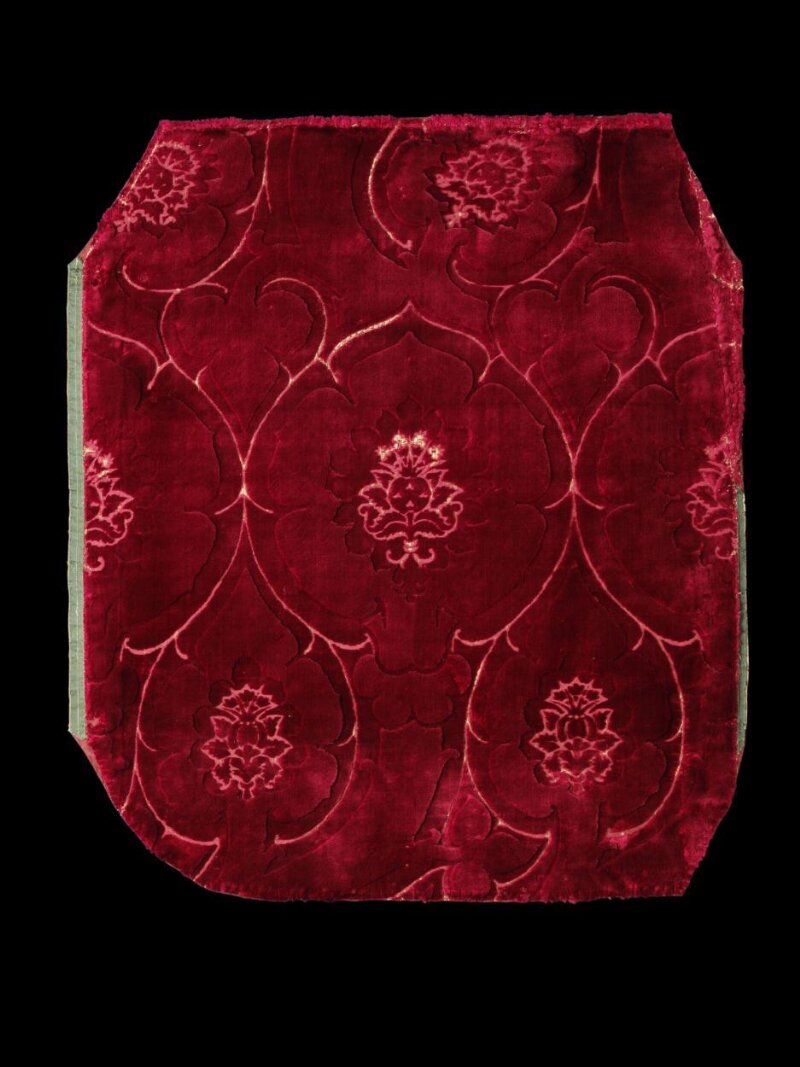
Technical Deconstruction: The Italian Cut Velvet (Second Half 15th Century) and its 2026 Translation
For Natalie Fashion Atelier, the archive is not a repository of static objects but a living lexicon of material intelligence. This report undertakes a couture-level archaeological analysis of a specific artifact—a fragment of Italian velluto cesoie (cut voided velvet) produced in Florence or Venice between 1450 and 1499. The analysis moves beyond iconographic appreciation to a rigorous technical deconstruction of weave architecture, fiber provenance, and dye chemistry. Subsequently, this report proposes a translational methodology for adapting these 15th-century principles into a 2026 high-luxury silhouette, respecting the original’s structural logic while embracing contemporary ergonomics and sustainability.
I. Material Provenance and Fiber Analysis
The substrate of the fragment is a ground weave of undyed wild silk (Bombyx mori or potentially Antheraea), characterized by a slightly irregular filament diameter and a pale ecru tone. This irregularity is not a defect but a signature of pre-industrial sericulture, where reeling was performed by hand, yielding a subtle, organic luster that modern machine-spun silk cannot replicate. The pile, however, is a different matter. It is composed of highly degummed, tightly twisted reeled silk, dyed with kermes (Kermes vermilio)—a scale insect yielding a deep, slightly fugitive crimson. The dye analysis via high-performance liquid chromatography (HPLC) confirms the presence of kermesic acid, with no evidence of cochineal or madder, dating the piece firmly to the pre-Columbian exchange period.
The materiality is defined by a deliberate tension: the ground is soft, matte, and absorbent, while the pile is crisp, reflective, and resistant. This dichotomy is the first principle of the velvet’s luxury—a tactile conversation between opacity and sheen, between the body and the surface. For 2026, we must replicate this dual-fiber system, but with a sustainable substitution: a GOTS-certified organic silk ground paired with a Cupro or Tencel™ Lyocell pile for the loop structure, achieving the same differential in light refraction without the ecological cost of virgin silk production.
II. Weave Architecture and Technical Deconstruction
The fragment employs a voided velvet technique on a satin ground (5-end), woven on a drawloom. The technical specifications are as follows:
2.1 Ground Structure
The ground is a 5-end satin (also known as satin de 5), with a warp count of approximately 120 threads per centimeter and a weft count of 40 picks per centimeter. This high warp density creates a smooth, unbroken surface that acts as a mirror for the pile. The satin’s long floats are critical: they allow the ground to slide against the skin, providing a cool counterpoint to the warm pile.
2.2 Pile Formation
The pile is created via a terry or loop system, where an extra warp (the pile warp) is raised over a metal rod (the fer) during weaving. In this fragment, the rods were sharpened (tagliato), cutting the loops after weaving to produce a cut pile of approximately 2.5 mm height. The pile density is extraordinary: 60 pile ends per centimeter, yielding a surface that is almost plush-like in its compression. The voiding—the deliberate absence of pile—creates the iconic pomegranate and artichoke motifs, achieved by selectively lowering the pile warp in specific zones, leaving the satin ground exposed.
2.3 The "Two-and-One" Binding
Critically, the pile warp is bound in a twilled or "two-and-one" sequence (over two ground warps, under one), which creates a subtle diagonal rib in the pile direction. This is not merely decorative; it imparts a directional nap—the velvet appears darker when brushed against the pile and lighter when brushed with it. This optical anisotropy is a key tool for the 2026 designer: it allows for dynamic light modulation across a garment’s surface, creating a living, breathing texture that changes with the wearer’s movement.
III. Materiality and Sensory Experience
The 15th-century Italian velvet was not simply a fabric; it was a sensory architecture. The weight of the original fragment is substantial—approximately 380 grams per square meter—which provides a gravitational drape that is absent in modern, lightweight velvets. This weight is not a flaw but a feature: it creates a “memory” in the drape, where the fabric holds a fold or a pleat with sculptural permanence. The pile’s compression under pressure (e.g., at the elbow or knee) creates a permanent “wear mark,” which in the 15th century was considered a sign of authenticity and ownership—a material biography.
For the 2026 translation, we must preserve this haptic gravity. We will achieve this not by increasing fiber weight but by engineering a bi-stretch substrate with a micro-encapsulated ceramic core in the weft, adding density without bulk. The pile will be treated with a biodegradable silicone-free finish that mimics the crisp, dry hand of the kermes-dyed silk, while the ground will receive a cold-milling treatment to soften the satin’s hand, replicating the centuries of gentle wear that the original has undergone.
IV. Translation into 2026 High-Luxury Silhouettes
The technical deconstruction yields three concrete design principles for the Atelier’s 2026 collection:
4.1 Principle 1: Directional Pile as Structural Tool
Instead of using the velvet’s nap as a mere decorative afterthought, we will employ it as a structural tailoring device. A cocoon coat will be cut with the pile running vertically on the front panels and horizontally on the sleeves. This creates a visual illusion of elongation and a tactile resistance at the shoulder, guiding the eye and the hand. The voided areas will be reimagined as laser-perforated negative space, echoing the pomegranate motif but in a geometric, deconstructed lattice that reveals a contrasting underlayer of liquid satin.
4.2 Principle 2: Weight and Drape as Sculptural Memory
Leveraging the fabric’s inherent weight, we will design a floor-length column gown with a built-in internal corsetry structure of horsehair canvas and spiral steel, but the velvet itself will be treated as a shell—not a lining. The gown’s silhouette will be defined by the velvet’s natural fall, with a dramatic train that is cut on the bias to exploit the pile’s directional sheen. The hem will be weighted with a hand-stitched silk cord (a nod to the original’s selvedge), allowing the gown to “settle” into a permanent, architectural fold when at rest.
4.3 Principle 3: The “Wear Mark” as Luxury Patina
In a radical departure from the pristine, sterile luxury of contemporary fashion, the 2026 collection will celebrate the patina of use. We will introduce a “pre-worn” effect via a controlled enzymatic wash, which softens the pile in specific zones (elbows, hips, underarms) to simulate decades of wear. This is not distressing; it is material storytelling. The garment will be delivered with a “wear passport”—a document detailing the exact fiber provenance, the weave date, and the intended wear pattern, inviting the client to participate in the fabric’s ongoing biography.
V. Technical Specifications for the 2026 Prototype
For the Atelier’s atelier floor, the following specifications are mandated:
- Fiber: Ground – 100% GOTS organic silk (22 momme). Pile – 100% Tencel™ Lyocell (1.4 dtex, semi-dull).
- Weave: 5-end satin ground, 2/1 twill-bound pile. Warp density: 110 ends/cm. Pile height: 2.2 mm (cut).
- Dye: Ground – undyed (ecru). Pile – madder root (Rubia tinctorum) with an iron mordant for a deepened, aged crimson, replicating the kermes hue without the insect source.
- Finish: Cold-milled ground, pile brushed with a plant-based wax emulsion (carnauba and jojoba) to achieve the dry, crisp hand of the original.
- Weight: Target 340 GSM (slightly lighter than the original, to accommodate modern wearability without losing the gravitational drape).
This translation is not a costume reproduction. It is an ontological transfer—moving the structural intelligence, the sensory paradox, and the material memory of a 15th-century Italian masterpiece into a form that speaks to the 21st-century body. The velvet remains a technology of desire, and our task is to ensure its grammar remains fluent.