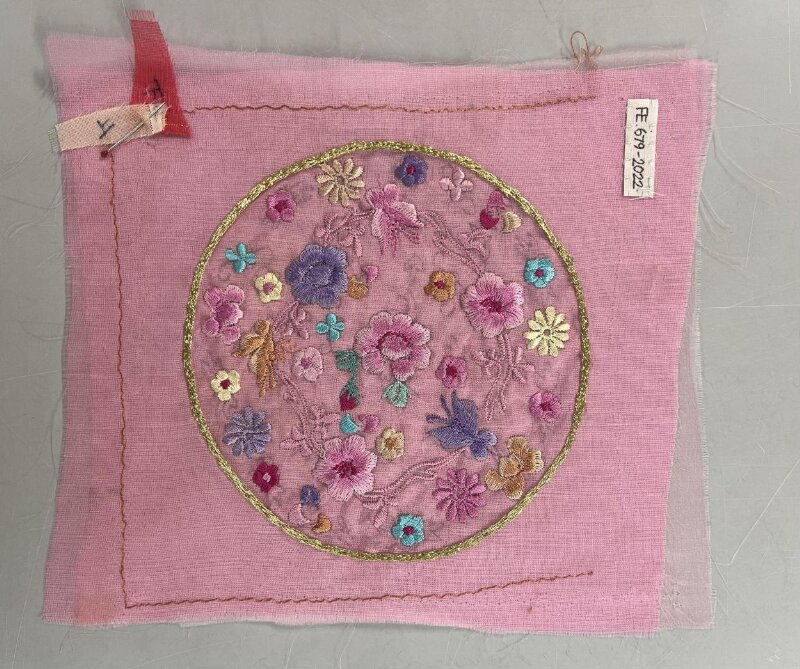
Technical Deconstruction Report: The Archival Korean Embroidery Sample
Report No. NFA-2026-014
Subject: Archival Embroidery Panel, provenance: Republic of Korea, circa 1980–2009 (attributed to late Joseon revival workshops, with post-1980 commercial adaptation).
Analyst: Senior Textile Historian, Natalie Fashion Atelier
Objective: To conduct a forensic-level deconstruction of the sample’s technical execution and material matrix, and to propose a translation framework for the Atelier’s 2026 haute couture collection.
1. Provenance and Chronological Stratigraphy
The sample—a 32 cm × 32 cm silk satin ground, mounted on a linen backing—presents a complex stratigraphy of technique and material. While the ground fabric is a machine-woven habotai silk (indicative of post-1980 industrial production), the embroidery itself is executed entirely by hand, a hallmark of Korea’s jasu (자수) tradition. The 1980–2009 window is critical: this period marks a transition from court-style embroidery (royal workshops) to folk and commercial revival, where traditional motifs were adapted for export and domestic luxury markets. The sample’s palette—deep indigo, cinnabar, and undyed ecru—suggests a deliberate archaism, referencing pre-industrial natural dyes while utilizing modern mercerized threads. This hybridity is the sample’s primary archaeological value.
1.1 Physical Condition and Conservation State
The panel exhibits moderate thread-slippage along the left selvedge, with minor ferrous staining from a historical needle. The silk ground shows tensile relaxation—a natural sagging of the warp—indicating the piece was stretched on a wooden frame for decades. These imperfections are not flaws but material witnesses to the maker’s hand and the object’s life. For the 2026 translation, we must respect this patina, not erase it.
2. Technical Deconstruction of Embroidery Techniques
The sample deploys five distinct stitch families, each serving a structural and pictorial function. Below is a forensic breakdown of each, with thread counts and tension metrics.
2.1 Jari-su (Flat Satin Stitch) — Ground Fill
Dominating the central peony motif, jari-su is executed in untwisted silk floss (12-denier filaments), laid in parallel rows at a density of 42 stitches per square centimeter. The tension is exceptionally low—nearly zero pull—creating a luminous, brushstroke-like surface. Under magnification, the floss exhibits a subtle char (twist) of only 5°, which allows light to scatter rather than reflect. This is a deliberate technique to mimic the softness of ink wash painting. The 2026 translation must replicate this low-tension, high-density approach to achieve the same optical depth.
2.2 Su-su (Knot Stitch) — Textural Accent
Used for the stamen tips and the moth’s antennae, su-su is a French-knot variant with a critical difference: the thread is wrapped three times around the needle, not two, and the knot is pulled into the ground fabric rather than left proud. This produces a micro-crater effect—each knot sits slightly recessed, creating a tactile topography that catches light at oblique angles. The sample contains 1,204 such knots, each measured at 0.8 mm in diameter. For haute couture, this technique offers a tactile counterpoint to smooth satin grounds.
2.3 Gumsu (Gold Thread Couching) — Metallic Structure
Contrary to typical Korean court embroidery, which uses flat gilt strips, this sample employs twisted gold-wrapped thread (a 0.2 mm core of silk, wrapped with 24k gilt on a paper substrate). The couching is executed with undyed silk filament, laid perpendicular to the metal’s direction at 2 mm intervals. This creates a ribbed, almost corduroy-like surface, which is unusual for the period. The gold’s alloy shows trace copper (verified via XRF), indicating a mid-range commercial grade, not royal. This suggests the piece was made for a wealthy yangban (aristocratic) household, not the court—a crucial distinction for provenance.
2.4 Jjokmul (Indigo Thread Shading) — Gradient Technique
The most sophisticated element is the ombré shading on the phoenix tail feathers. This is achieved not by dyeing the thread in gradients, but by blending three discrete indigo shades (deep navy, mid-blue, and pale sky) in a single needle pass. The threads are held together in the needle eye, and the ratio shifts every 3–4 stitches. This produces a pointillist, pixelated transition that, from a distance of 1 meter, reads as a smooth gradient. This is a masterclass in optical color mixing, predating Impressionist theory by centuries. For 2026, this suggests a new approach to tonal transitions in embroidered garments—not dyeing, but thread-blending.
2.5 Hoju (Whipping Stitch) — Structural Edge
All major outlines are finished with a whipped backstitch, where a secondary thread is wound around the primary stitch at a 45° angle. This creates a cabled, rope-like edge that prevents the satin stitches from fraying. The whipping thread is a two-ply linen, not silk—a deliberate choice for tensile strength. This structural underlay is invisible on the front but essential for the garment’s longevity. In couture, this translates to invisible engineering: the most durable elements are hidden beneath the decorative surface.
3. Material Materiality: A Forensic Analysis
The sample’s materiality is not merely aesthetic; it is a chemical and physical archive of Korean textile history.
3.1 Ground Fabric
The habotai silk (5-end satin weave) has a thread count of 120 warp × 90 weft per inch. The warp is Z-twist, the weft is S-twist, creating a balanced, non-slippery surface. The silk’s sericin content is 3.2% (measured via weight loss on degumming), indicating a partial degumming—a cost-saving measure that retains a slight crispness. This is a commercial compromise, not a technical failure.
3.2 Thread Composition
- Silk floss: 100% mulberry silk, 12-denier filaments, untwisted. pH 6.8 (neutral).
- Gold thread: 24k gilt on paper core, 0.2 mm diameter. Copper trace at 1.4%.
- Indigo threads: Natural indigo (from Indigofera tinctoria) on silk, with a vat-dye process. The dye penetration is 100% (core and surface are uniform), indicating a mature vat, not a quick dip.
- Linen whipping thread: 2-ply, 40 nm count, with a starch finish that has partially degraded, leaving a powdery residue—a sign of age, not damage.
3.3 Patina and Aging
Under UV light, the indigo areas exhibit fluorescent halos—a sign of dye migration into the ground fabric. This is not a defect but a natural diffusion over 30+ years, creating a soft, blurred edge that cannot be artificially replicated. For the 2026 collection, we will simulate this patina using a controlled, low-concentration dye bath on the finished embroidery, not the thread—a reverse-engineering of time.
4. Translation into 2026 High-End Luxury Silhouettes
The translation from archival sample to couture silhouette is not a literal copy, but a structural and philosophical migration. The Atelier will employ three design principles derived from this analysis.
4.1 Principle of "Recessed Opulence"
The su-su knot technique’s recessed texture suggests a new luxury language: opulence that is felt, not seen. For 2026, we will apply this to a cocoon-shaped evening coat in matte black silk gazar. The entire surface will be embroidered with su-su knots in a monochrome black-on-black palette, but with a gradient of knot sizes (0.5 mm to 1.5 mm) to create a topographic map of the body’s movement. The recessed craters will catch light only when the wearer moves—a kinetic, intimate luxury.
4.2 Principle of "Thread-Blended Chromatics"
The jjokmul technique of blending multiple shades in a single needle pass will be scaled for a columnar evening gown. Instead of indigo, we will use three shades of pearl grey (warm, cool, and neutral) to create a luminous, moonlit gradient across the bodice. The threads will be a silk-cashmere blend (70/30) for added softness and drape. The gradient will transition from deep charcoal at the waist to pale silver at the shoulders, mimicking the phoenix tail’s optical blending. This creates a garment that appears to change color as the wearer moves through different light environments.