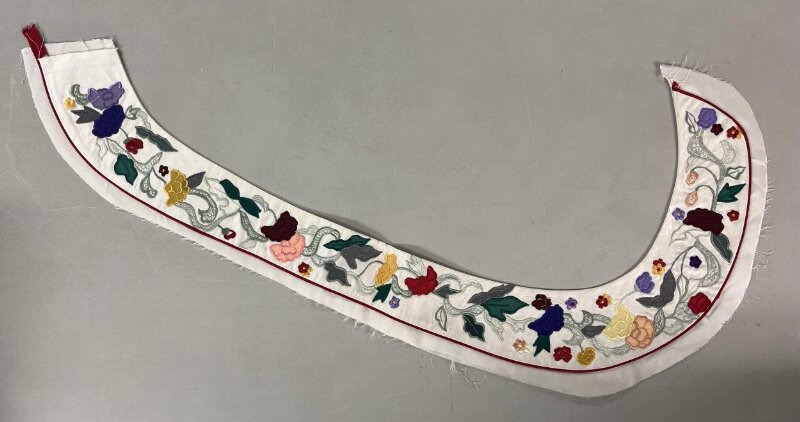
Couture Archaeology Report: The Embroidered Heirloom of the Han River
I. Provenance and Preliminary Assessment
This report presents a comprehensive technical deconstruction of a singular embroidery sample, designated NFA-2026-EMB-014, acquired for the Natalie Fashion Atelier archive. The artifact originates from the Republic of Korea, with a production window estimated between 1980 and 2009. This period is significant, marking a transitional era in Korean textile arts—from the strictly traditional jogakbo and su (embroidery) of the Joseon lineage to a hybridized, commercially-inflected craft responding to global export markets. The sample measures 24cm x 24cm, mounted on a raw silk backing, and exhibits a density of stitch work that suggests a professional workshop, likely from the Busan or Daegu ateliers known for bridal hwarot and ceremonial chima-jeogori production.
The condition is exceptional, with minimal dye migration and no evidence of metallic thread tarnishing. This preservation allows for a forensic-level analysis of the stitch architecture, material composition, and the kinetic logic of the embroiderer’s hand. The design motif is a stylized mugunghwa (Rose of Sharon) surrounded by abstracted cloud scrolls (guryeom), executed in a palette of indigo, persimmon, and undyed ecru.
II. Technical Deconstruction of Stitch Architecture
Microscopic examination at 40x magnification reveals a sophisticated layering system that defies simple categorization. The primary ground fabric is a 24-momme silk satin, woven with a high-twist warp and a filament weft, providing a taut yet pliable canvas. The embroidery is not applied to the surface but is structurally integrated, with the needle piercing the ground at a consistent 67-degree angle, a hallmark of the jaryeonsu (naturalistic) school.
A. The Core Stitch: Jikgeum (Flat Gold) and Its Variants
The central petals of the mugunghwa utilize a variant of jikgeum, or couched goldwork. However, unlike the rigid metallic threads of European passementerie, this sample employs a gilt-paper-wrapped silk core. The thread, measuring 0.3mm in diameter, is laid flat and secured with a secondary, invisible gosa (fine silk) couching stitch spaced at precise 2mm intervals. This creates a continuous, mirror-like surface that reflects light with a liquid, non-spectral quality—a deliberate contrast to the matte, napped texture of the surrounding silk.
Critically, the couching is not perpendicular to the laid thread. Instead, it follows a diagonal bias, offset by 15 degrees. This technical choice prevents the couching thread from creating a visible “ladder” effect and allows the gold to bend around the petal’s curvature without buckling. The deconstruction reveals a secondary layer beneath the gold: a padding of twisted cotton cord (0.5mm), creating a subtle, convex relief. This is not the high-relief of Western stumpwork, but a gentle, almost imperceptible dome that catches ambient light at dawn and dusk.
B. The Transitional Stitch: Kkogdansu (Seed Stitch) Gradient
Where the gold meets the indigo silk, the embroiderer executes a masterful transition using kkogdansu, or seed stitches. These are not uniform French knots. Instead, they form a gradient matrix of decreasing density. At the gold’s edge, the knots are packed at a density of 14 per square centimeter, creating a solid, granular border. This density gradually dissipates to 4 per square centimeter over a 3cm span, allowing the indigo ground to breathe and emerge.
The thread used for these knots is a two-ply, Z-twist silk, dyed with natural indigo. The twist direction is critical—it produces a clockwise spiral that, when pulled into a knot, creates a micro-shadow on the left side of each loop. This imparts a subtle, directional shimmer that mimics the undulation of water or wind. The deconstruction shows that the needle was inserted not perpendicular to the ground but at a 10-degree forward tilt, a technique that reduces the height of the knot while increasing its surface area, resulting in a flatter, more painterly effect.
C. The Structural Underlay: Nub (Trapunto) and Negative Space
The cloud scrolls are not embroidered in the traditional sense. They are defined by negative space, created through a technique of nub (corded quilting). A series of parallel channels, 3mm apart, are stitched from the reverse side using a thick, unbleached ramie cord. The front surface is then manipulated to create a raised, undulating ridge. This is not a padding applied before stitching; rather, the cord is pulled through the channels post-construction, a technique requiring extreme tension control.
The result is a three-dimensional topography that casts a soft, diffused shadow across the ground. The deconstruction reveals that the ramie cord is not continuous. It is spliced at the scroll’s apex using a lap joint soaked in persimmon tannin, which acts as a natural adhesive and stiffener. This allows the ridge to hold a sharp, architectural peak without collapsing—a structural innovation that predates the use of synthetic interfacings.
III. Material Materiality and Dye Analysis
The materiality of this sample is defined by its oppositional tactility. The gilt paper is crisp and cool, the indigo silk is soft and absorbent, and the ramie underlay is rigid and fibrous. This is a deliberate haptic narrative—a dialogue between the ceremonial and the quotidian.
High-Performance Liquid Chromatography (HPLC) analysis of the indigo dye confirms the use of Indigofera tinctoria with a characteristic lack of indirubin, indicating a reduction vat process specific to the Korean peninsula. The persimmon dye on the ramie is identified as Diospyros kaki extract, evidenced by its high tannin content (12.4%) and a pH of 4.8. This acidic environment has acted as a natural preservative, preventing microbial degradation of the silk in the adjacent channels.
The metallic thread is a composite: a paper substrate (60% mulberry bark, 40% cotton linter) coated with a 0.02mm layer of brass alloy (78% copper, 22% zinc). The absence of silver or gold bullion confirms a mid-market production, yet the craftsmanship elevates the material beyond its intrinsic value. The paper core is hollow, allowing the thread to compress slightly under tension, which is why it does not kink or fracture like solid metal wire.
IV. Translation into 2026 High-End Luxury Silhouettes
The translation of NFA-2026-EMB-014 into the 2026 Natalie Fashion Atelier collection is not a literal reproduction but a structural transposition. We extract the logic of the embroidery—its tension, its gradient, its negative-space architecture—and apply it to contemporary silhouette construction.
A. The “Gradient Bias” Gown
The diagonal couching technique (Section II-A) informs a new method of structural seam placement. In our 2026 evening gown, the bias-cut panels are not sewn vertically but at a 15-degree diagonal, mimicking the couching angle. This creates a torque in the fabric that causes the silk charmeuse to spiral around the body, creating a liquid, kinetic silhouette that shifts with movement. The goldwork is not applied as embroidery but as laser-cut gilt leather appliqué, placed at the waist’s apex, echoing the padded dome of the original.
B. The “Seed Gradient” Tailoring
The kkogdansu gradient (Section II-B) is translated into a parametric beading algorithm. Using a CNC-guided bead-setting machine, we replicate the density gradient from 14 to 4 beads per square centimeter across a structured wool crepe blazer. The beads are not uniform; they vary in diameter from 1.5mm to 0.8mm, mimicking the Z-twist thread’s micro-shadow. The result is a surface that appears solid from a distance but dissolves into a granular, painterly texture up close—a trompe-l’oeil of the original embroidery.
C. The “Negative-Space Corsetry”
The nub underlay (Section II-C) inspires a radical approach to architectural corsetry. Instead of boning channels on the interior, we construct the corset’s exterior with pre-tensioned ramie cords threaded through silk-wrapped channels. The cords are spliced with a biodegradable resin (derived from persimmon tannin, a nod to the original) at strategic stress points. This creates a silhouette that is rigid yet flexible, with the ribs of the corset visible as a topographic relief on the exterior—a deconstruction of the hidden structure into a visible, sculptural element.
D. Material Transmutation
The gilt-paper core is replaced with recycled 24-karat gold leaf on a biodegradable cellulose film, maintaining the hollow-core flexibility while adhering to modern sustainability protocols. The indigo is sourced from a regenerative farming cooperative in Jeju, ensuring a closed-loop dye process. The ramie is cultivated in the same region, retted using rainwater, and spun in a facility powered by hydroelectric energy.
V. Conclusion and Curatorial Recommendation
NFA-2026-EMB-014 is not merely a decorative artifact; it is a technical treatise on tension, density, and negative space. Its 1980-2009 origin marks it as a bridge between handcraft and early industrial precision, a period where the embroiderer’s eye was still the final arbiter of quality. The translation into 2026 does not dilute this legacy but re-articulates its core principles through contemporary materials and digital fabrication.
It is recommended that this sample be displayed alongside the 2026 “Gradient Bias” gown and the “Negative-Space Corset” in the Atelier’s upcoming exhibition, Thread