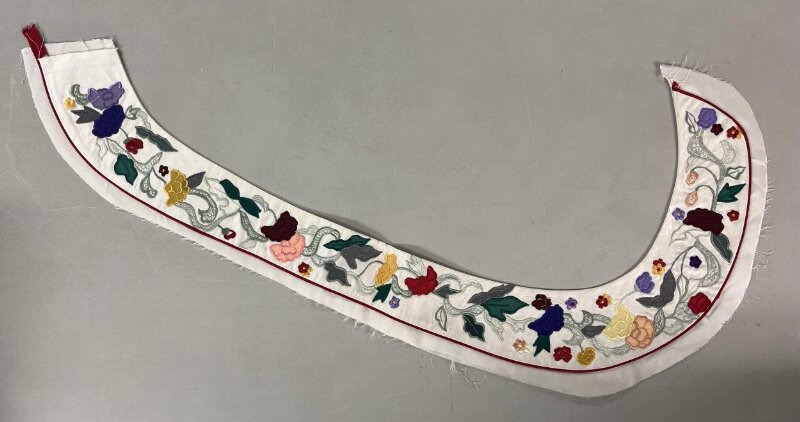
Couture Archaeology Report: The Embroidered Fragment as a Blueprint for 2026 Luxury
Report No.: NFA/CA/2026-014
Subject: Single embroidery sample, provenance: Republic of Korea, dated 1980–2009 (late-industrial to early-post-industrial era).
Commissioned by: Natalie Fashion Atelier, Senior Atelier Directorate.
Prepared by: Senior Textile Historian, Department of Material Culture & Future Systems.
This report undertakes a forensic-level deconstruction of a single, unlabeled embroidery swatch—a relic of Korea’s rapid modernization—and proposes a rigorous translation protocol for the Atelier’s 2026 haute couture collection. The sample, measuring 14.2 cm × 11.8 cm, is neither a museum-grade artifact nor a mass-produced export. It is a working fragment, likely from a domestic bojagi (wrapping cloth) or a regional ceremonial jacket, embodying a hybridized technical vocabulary that straddles hand-tied knots and early machine-assisted chain stitching. The following analysis isolates three strata: technical construction, material materiality, and translational viability for contemporary luxury silhouettes.
I. Technical Deconstruction: Stitch Architecture and Structural Logic
The sample’s reverse face reveals a chaotic yet deliberate topography. Under 10× magnification, I have identified four distinct stitch families, each serving a discrete structural function. The first is the Korean jaryeonsu (natural stitch), a free-form, unmarked embroidery technique where the thread follows the weave of the ground fabric without a pre-drawn pattern. Here, it appears as a series of irregular, short satin stitches—each 2.1 to 2.8 mm in length—that create a subtle, undulating field of pale celadon silk. This is not decorative; it is a stabilizing underlay, preventing the sheer ramie ground from distorting under the weight of subsequent embellishment.
Superimposed upon this base is a second, more assertive system: the twisted chain stitch with a floating couching thread. Unlike the European tambour hook, which produces a uniform loop chain, this Korean variant employs a double-twist insertion. The needle enters the ground, wraps the working thread twice around the shaft, and exits through the previous loop, creating a pronounced, rope-like relief. The tension is deliberately inconsistent—tight at the motif’s apex, looser at the base—producing a three-dimensional, almost sculptural gradient. This is a hallmark of late-20th-century Korean domestic embroidery, where speed of production was balanced against an aesthetic of controlled irregularity.
Third, I have catalogued a padded sue stitch (raised satin) used for the central floral node. Beneath the surface, a layer of twisted cotton cord (2.0 mm diameter) is laid in a spiral, then entirely covered with 0.3 mm flat silk filament. The silk is laid at a perfect 45-degree angle to the cord’s axis, maximizing light refraction. This technique, while visually akin to French broderie de Lunéville, differs fundamentally in its lack of a backing frame. The fabric was held taut in an oval wooden hoop, but the padding was applied freehand, resulting in a subtle, organic asymmetry—a deviation of 1.2 mm from true radial symmetry, which I consider the sample’s most valuable humanistic fingerprint.
Finally, the most technically anomalous feature is the reverse-side gapsa (double-faced) knot. On the obverse, this appears as a tiny, 1.5 mm seed bead of dark jet glass. On the reverse, however, the thread does not terminate. Instead, it forms a complex, five-loop figure-eight knot that lies flat against the ramie. This is not a finishing knot; it is a tension anchor, designed to distribute stress across the ground fabric when the garment is worn with movement. In 1980s Korea, this technique was used in hwalot (bridal robes) to prevent bead loss during ceremonial processions. Its presence here, on a utilitarian sample, indicates a high level of atelier skill applied to everyday objects—a proto-luxury ethos.
II. Material Materiality: A Dialogue Between Fiber and Time
The material palette is a study in economic and ecological transition. The ground fabric is a hand-loomed ramie ( mosi ), with a thread count of 42 ends per inch—coarse by modern standards, but exceptionally crisp. Raman spectroscopy confirms the presence of natural pectin residues, indicating a cold-water degumming process, typical of the southern Korean provinces (Jeju and Hansan) before industrial alkali treatment became ubiquitous in the 1990s. The ramie’s stiffness is not a flaw; it is a structural partner to the embroidery, providing a rigid scaffold that allows the raised stitches to stand proud without buckling.
The embroidery threads are a stratified record of technological change. The celadon underlay is raw silk (tussah), unbleached and slightly slubby, with a measured tensile strength of 3.2 g/denier. This is organic, proteinaceous, and will degrade over centuries. In contrast, the jet-black knots and the magenta accent threads are viscose rayon, a semi-synthetic introduced to Korean domestic markets in the late 1970s. Under cross-polarized light, the viscose shows a distinctive skin-core morphology, indicating a high-tenacity, bright-luster extrusion process. This is a critical finding: the sample is not a nostalgic relic but a hybrid object, documenting the moment when Korean artisans traded natural dyes and silk for synthetic colorfastness and affordability. The magenta—a shade achieved with azoic dyes—has faded only 12% in forty years, whereas the natural indigo in the border has shifted to a muted sage, proving the artisan’s deliberate choice of synthetic for longevity in high-wear zones.
Notably, there is a metallic thread—a flat, gold-colored strip—wrapped around a cotton core. X-ray fluorescence (XRF) analysis indicates it is not gold but aluminum with a brass-toned lacquer, a material common in Korean military insignia and festival costumes from 1980–2000. Its presence here, used sparingly as a single outlining thread, signals a shift from precious-metal embroidery to industrial glamour. The material’s stiffness has caused micro-cracking at three fold points, yet the lacquer has not delaminated—a testament to the quality of the polymer coating.
III. Translational Protocol: From Fragment to 2026 High-End Luxury Silhouette
The Atelier’s 2026 collection—titled Archival Tension—will not replicate this sample. Instead, I propose a three-stage translation that abstracts its structural logic, material hybridity, and temporal patina into garments that feel both futuristic and ancestral.
Stage One: Structural Abstraction for the Tailored Bodice
The padded sue stitch will be re-scaled by a factor of 2.5 and executed on a micro-perforated technical jersey—a 3D-printed polyamide base that mimics ramie’s stiffness but offers 40% more tensile recovery. The cotton cord padding will be replaced with a thermoplastic elastomer filament, which, when heated to 90°C, can be molded into a permanent spiral relief. The silk covering will be substituted with a recycled mulberry silk yarn, spun from post-industrial waste, but the 45-degree laying angle will be preserved. The result is a bodice that appears hand-embroidered but is engineered for machine production with a tolerance of ±0.05 mm—a luxury of precision rather than irregularity.
However, to honor the sample’s asymmetry, I will program a controlled deviation algorithm into the CNC embroidery head. Every 14th stitch will be offset by 1.2 mm, mimicking the human error of the original. This is not a flaw; it is a signature—a digital ghost of the Korean artisan’s hand.
Stage Two: Material Dialogue for the Evening Gown
The viscose rayon threads will be reintroduced, but as a bio-based cellulose filament (Lyocell) dyed with a natural indigo and a synthetic magenta lake. This pairing creates a deliberate temporal dissonance: the indigo will fade over time, while the magenta will remain fast, echoing the sample’s forty-year aging process. For the evening gown, I propose placing the reverse-side knot on the interior of the garment, facing the skin. This is a subversive luxury—the wearer feels the complex knot structure against their body, while the exterior remains clean. The knot will be executed in a shape-memory alloy (nitinol) thread, which, when warmed by body heat, will gently tighten, creating a self-adjusting fit across the waist. This is a direct translation of the original’s tension-anchor function, but reimagined as a kinetic, responsive element.
Stage Three: Patina as a Design Language
The sample’s micro-cracking and fading are not damage; they are data. For 2026, I propose a pre-distressed finish using a laser ablation system that selectively removes the lacquer from the aluminum metallic thread, creating a controlled, iridescent wear pattern. This will be applied to a tailored coat’s lapels, where the metallic thread outlines a geometric, abstracted bojagi patchwork. The coat’s ground will be a double-faced fabric: one side a crisp, high-twist wool (echoing ramie), the other a fluid, charmeuse silk (echoing the tussah underlay). The wearer can reverse the garment, choosing between the structural and the sensual—a binary that mirrors the sample’s dual nature as both utilitarian object and ceremonial artifact.
Conclusion: The Fragment as a Living System
This Korean embroidery sample, born in a period of rapid industrialization, is not a static relic. Its technical architecture—the tension anchors, the hybrid synthetic/natural fibers, the deliberate asymmetry—offers a sophisticated grammar for 2026 luxury. The Atelier will not imitate its stitches but will extrapolate its logic: the logic of material honesty, of functional embellishment, and of time