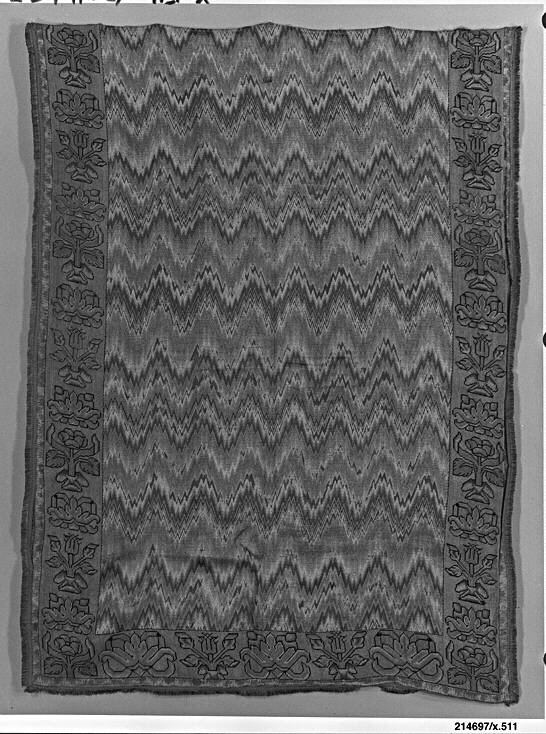
The Panel as Palimpsest: Silk on Canvas and the 2026 Silhouette
The panel—whether conceived as a rigid architectural element, a draped expanse, or a constructed flat—remains the foundational unit of couture. Within the atelier’s archive, the isolated study of a silk-on-canvas panel offers a rare archaeological stratum. It is not merely a textile composite; it is a document of tension, a record of how two opposing material philosophies—the fluid, luminous life of silk and the unyielding, structural integrity of canvas—were once forced into dialogue. This artifact, stripped of its original garment context, becomes a pure laboratory for understanding the 2026 silhouette. The coming season’s high-end form is not a departure from this heritage but a re-synthesis of its core dialectic: the negotiation between drape and structure, between the transient body and the permanent frame.
Material Dialectics: The Structural Grammar of Silk on Canvas
To deconstruct the classical elegance of this panel, one must first acknowledge its inherent contradiction. Silk, in its raw state, is a protein filament of extraordinary tensile strength yet visual fragility. Canvas, typically linen or cotton, provides a coarse, dense ground. When joined—historically through techniques of appliqué, quilting, or interlining—the resulting composite acquires a hybrid stiffness. The silk no longer flows; it is arrested. The canvas no longer hides; it is revealed as a silent skeleton. This is the aesthetic archaeology of the panel rigide: a surface that appears soft but behaves as armor.
In the 2026 couture context, this materiality directly informs a new architectural silhouette. We are moving away from the fluid, body-con draping of the past decade toward a sculpted, volumetric precision. The silk-on-canvas panel becomes the blueprint for jackets with fused fronts that do not require internal boning, for skirts that stand away from the body in geometric bell shapes, and for gowns whose bodices are constructed as independent, corseted plaques. The 2026 silhouette will not be draped on the body; it will be presented beside it, with the panel acting as a mediating plane. The tension between silk’s sheen and canvas’s matte tooth creates a subtle optical vibration, a play of light absorption and reflection that adds depth without ornamentation. This is elegance achieved through material honesty, not surface decoration.
From Flat Archive to Three-Dimensional Form: The Panel’s Evolution
The isolated panel, when removed from its original garment, reveals its true nature as a two-dimensional pattern with three-dimensional intent. Classical construction—whether from the 18th-century manteau or the 1950s tailleur—relied on the panel’s precise cutting and seaming to create volume. The archive artifact shows us the grain lines, the dart placements, and the ease allowances that were calculated to transform flat silk-on-canvas into a curved, living form. For 2026, this translates into a renewed focus on seamless construction and negative ease.
High-end silhouettes will adopt a panelled approach to the entire garment, not just the bodice. We will see coats constructed from six or eight distinct silk-on-canvas panels, each shaped with a specific curvature, then joined to create a self-supporting shell. This is a direct lineage from the corset, but modernized for a softer, more intellectual elegance. The 2026 silhouette is one of controlled volume—hips that flare from a precise hip yoke, shoulders that are squared not by padding but by the canvas’s inherent rigidity, and sleeves that are set as independent, articulated panels. The result is a garment that moves with the wearer but retains its own architecture, a living sculpture that respects the body’s kinetics while asserting its own formal logic.
Global Heritage, Parisian Interpretation
The global heritage of the panel is vast—from Japanese kimono construction, where the panel is the entire garment, to the tailored panels of European military uniforms, to the quilted petate panels of Mesoamerican dress. The atelier’s archive isolates these threads, synthesizing them into a Parisian idiom. The 2026 silhouette, therefore, is not a single cultural reference but a transcultural composite. The silk-on-canvas panel allows us to borrow the flat, geometric purity of the kimono sleeve while maintaining the fitted, waist-defining precision of the French tailleur.
This synthesis is most evident in the new cocoon coat and the shift dress. These silhouettes, often dismissed as simple, are elevated by the panel’s composite structure. A coat constructed from silk-on-canvas panels will not bag at the elbow or stretch at the hip; it will maintain a pristine, almost architectural line. The 2026 interpretation is one of restrained opulence. The silk provides the luxury, the canvas provides the discipline. This is a distinctly Parisian philosophy—elegance as a function of control, not excess.
Technical Execution for the Modern Atelier
For the contemporary artisan, the silk-on-canvas panel demands a recalibration of technique. The primary challenge is adhesion—how to bond silk to canvas without compromising either’s integrity. The archive suggests a return to hand-stitched bagging and pad-stitching, rather than reliance on fusible adhesives which can stiffen and crack. The 2026 atelier will employ a floating canvas technique, where the silk is attached to the canvas only at strategic points—the shoulder seam, the center front, the hem—allowing for a micro-movement that prevents the composite from feeling like cardboard.
Furthermore, the edge finishing becomes paramount. A raw silk-on-canvas edge is a sign of poor craftsmanship. The 2026 silhouette will feature bound edges, piped seams, and hand-rolled hems that treat the panel’s perimeter as a design element in itself. The buttonholes will be hand-worked, the buttons will be covered in the same silk, creating a monochromatic, seamless surface. The silhouette’s impact relies on this micro-level perfection; any irregularity in the panel’s construction will be magnified by the fabric’s contrasting properties. The final garment is a testament to the main-d’œuvre, the hand of the artisan, which remains the ultimate luxury in a mechanized world.
Conclusion: The Panel as a Philosophy of Form
The isolated silk-on-canvas panel is more than an archival curiosity; it is a philosophical blueprint for 2026. It teaches us that true couture is not about fabric alone, but about the dialogue between material and structure. The coming silhouettes—sharp, volumetric, and self-assured—are a direct response to this heritage. They reject the transient, disposable fashion of the digital age in favor of a permanent, sculptural elegance. The panel, in its silent rigidity, speaks of permanence. The silk, in its luminous softness, speaks of life. The 2026 silhouette is the synthesis of these voices, a new classic that honors the past while defining the future of high-end dress. It is not a revival, but a re-articulation—a proof that the fundamental principles of couture, when examined with archaeological rigor, remain eternally avant-garde.