Anatomy of Restraint: The Fauchard as a Blueprint for 2026 Structural Silhouettes
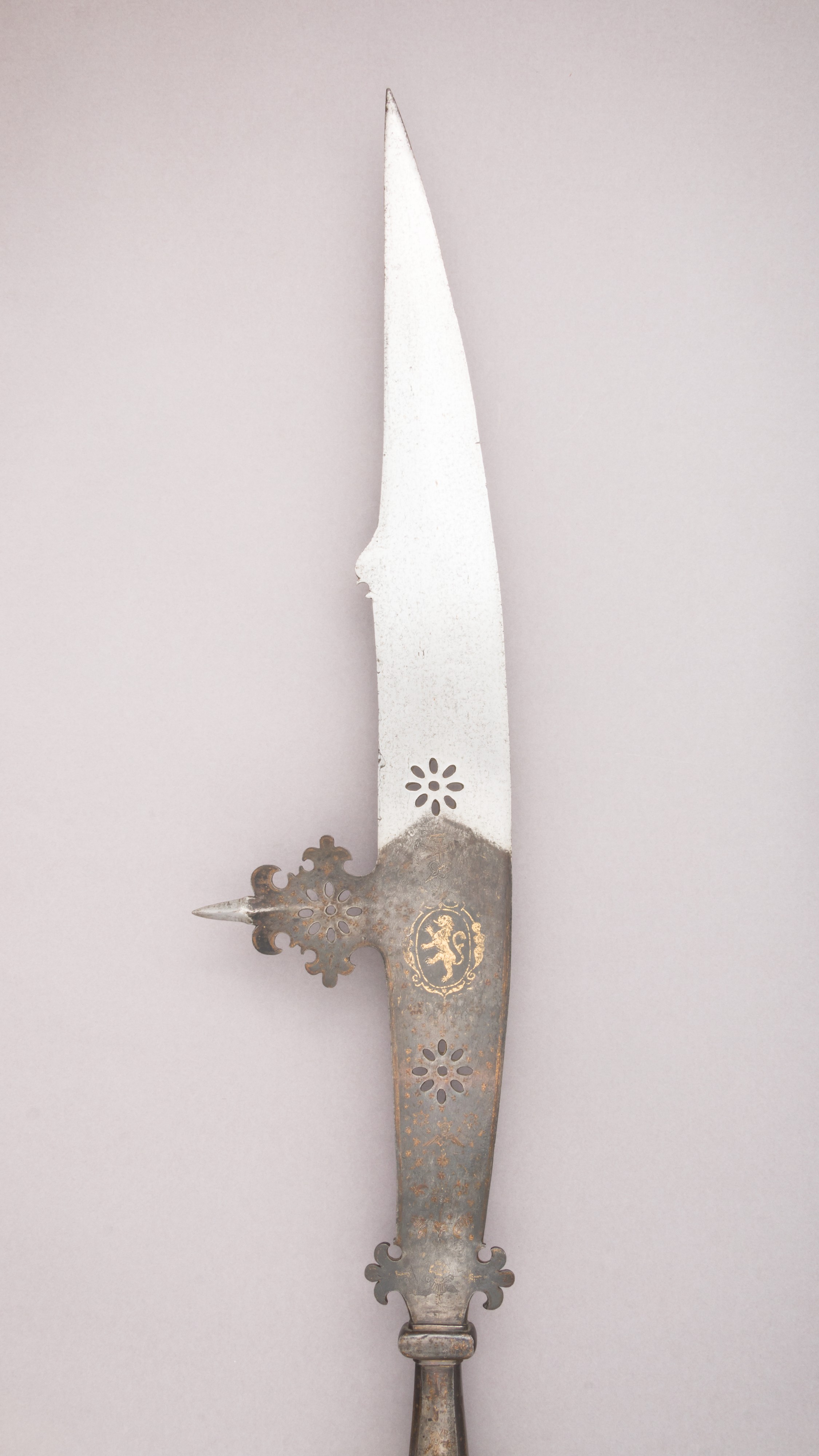
The Fauchard, a weapon of Venetian origin, is frequently misclassified within the broader taxonomy of polearms. Yet, for the aesthetic archaeologist, it represents a singular convergence of agricultural pragmatism and aristocratic flourish. Its long, curved blade—often resembling a sickle mounted on a staff—was not merely a tool of conflict but an extension of the Venetian lagoon’s mercantile and martial spirit. For Natalie Fashion Atelier, the Fauchard offers a profound departure from the soft, fluid drapery that has dominated recent seasons. It is a study in controlled tension, where the raw utility of steel and wood is tempered by the opulence of gold and the intimacy of textile. This artifact dictates that the 2026 haute couture silhouette must pivot from passive elegance to an active, architectural defiance.
Material Dialectics: Steel, Wood, Gold, and Textile
The genius of the Fauchard lies not in its individual components but in their violent, yet harmonious, juxtaposition. The steel blade is forged for a singular purpose: a clean, sweeping arc of force. In couture terms, this translates to razor-sharp seam lines and the strategic use of boning that does not merely shape the body but creates a new, external skeleton. The wooden shaft provides the grounding—a vertical, unyielding axis that anchors the entire composition. This informs the 2026 silhouette through the reintroduction of the high, structured collar and the elongated, columnar torso that visually severs the body from its pedestrian reality.
Conversely, the gold inlay—often etched into the steel or wrapped around the grip—serves as a moment of pure, unapologetic luxury. It is not decorative in a superfluous sense; rather, it is a strategic highlight that draws the eye to points of articulation. For our atelier, this translates to metallic micro-embroidery placed precisely at the shoulder joint or the hip bone, acting as a cartographic guide to the wearer’s movement. Finally, the textile wrapping on the grip—typically leather or velvet—introduces the only element of tactile softness. This is the critical lesson for 2026: the hard silhouette must be negotiated by softness. We see this in the use of liquid silk charmeuse that spills from beneath a rigid, sculpted bodice, mimicking the way a worn grip softens the harshness of the wood beneath.
Deconstructing the Line: From Arc to Axis
The classical elegance of the Fauchard is defined by its asymmetrical crescent. Unlike the symmetrical sword, the Fauchard’s blade creates a dynamic imbalance that suggests motion even at rest. The 2026 silhouette must adopt this asymmetric bias. We are moving away from the symmetrical two-piece tailoring that has been the bedrock of power dressing. Instead, we propose a single-shoulder construction where the sleeve on one side is a fully structured, metallic mesh sculpture, while the opposite side is a fluid, floor-sweeping panel of wool crepe. This is not a stylistic quirk; it is a direct translation of the weapon’s kinetic potential.
Furthermore, the shaft’s verticality demands a reconsideration of the waist. The Fauchard does not cinch; it extends. Therefore, the 2026 couture client will see a deliberate de-emphasis of the natural waist in favor of a dropped, elongated hip line. This creates a silhouette that is less about the hourglass and more about the obelisk—a form that is stable, powerful, and visually uninterrupted. The hemline, in this context, becomes the blade’s edge. It should be cut on a severe, bias angle, falling from a high point at the front to a dramatic, sweeping point at the back, echoing the blade’s curvature without ever becoming literal.
The Art of the Grip: Tactile Contrast in Construction
In the Fauchard, the grip is where the wielder connects with the instrument. It is a site of friction and intimacy. For haute couture, this translates to the interior architecture of the garment. While the exterior may appear as cold and precise as polished steel, the interior—the grip—must be a revelation of luxury. We are implementing full silk-satin linings that are hand-quilted to provide a micro-layer of cushioning against the structural boning. This is the "textile wrapping" of the 2026 garment. The wearer will feel the rigidity of the shell, but their skin will only ever know the softness of the silk. This dichotomy is the essence of modern couture: power on the outside, tenderness within.
This principle extends to the closures. The Fauchard’s goldwork is not merely surface-level; it is integral to the function. We apply this logic through the use of gilded metal grommets and lacing systems that replace traditional buttons and zippers. These are not hidden but celebrated, running along the spine or the outer seam of the sleeve. They serve as visible engineering, allowing the wearer to adjust the tension of the garment, much like a warrior adjusting their grip. This interactive element adds a performative layer to dressing, positioning the client not as a passive mannequin but as an active participant in the construction of their own silhouette.
Chromatic Restraint and Surface Treatment
The palette for this 2026 direction is dictated by the patina of age and the gleam of the forge. We are eschewing bright, saturated hues in favor of a metallurgical spectrum: gunmetal grey, oxidized bronze, tarnished silver, and deep, ink-like blacks. These are punctuated by the only permissible warmth—the buttery yellow of 24-karat gold thread used sparingly for embroidery that traces the skeletal structure of the garment. The surface treatments must mimic the process of forging. Fabrics will be treated with a metal-plating technique that gives silk and wool a subtle, reflective sheen, not unlike the burnished edge of a well-maintained blade. Conversely, we will employ heavily brushed and felted wools to represent the matte, aged wood of the shaft, creating a textural rhythm that is both tactile and visually sophisticated.
In conclusion, the Fauchard is not a relic; it is a directive. It instructs us that elegance in 2026 is not about ease, but about mastery. The silhouette will be defined by its architectural audacity, its asymmetric tension, and its luxurious restraint. By deconstructing this Venetian artifact, Natalie Fashion Atelier redefines the modern wardrobe as a collection of wearable instruments—each piece a testament to the wearer’s own formidable, elegant force.