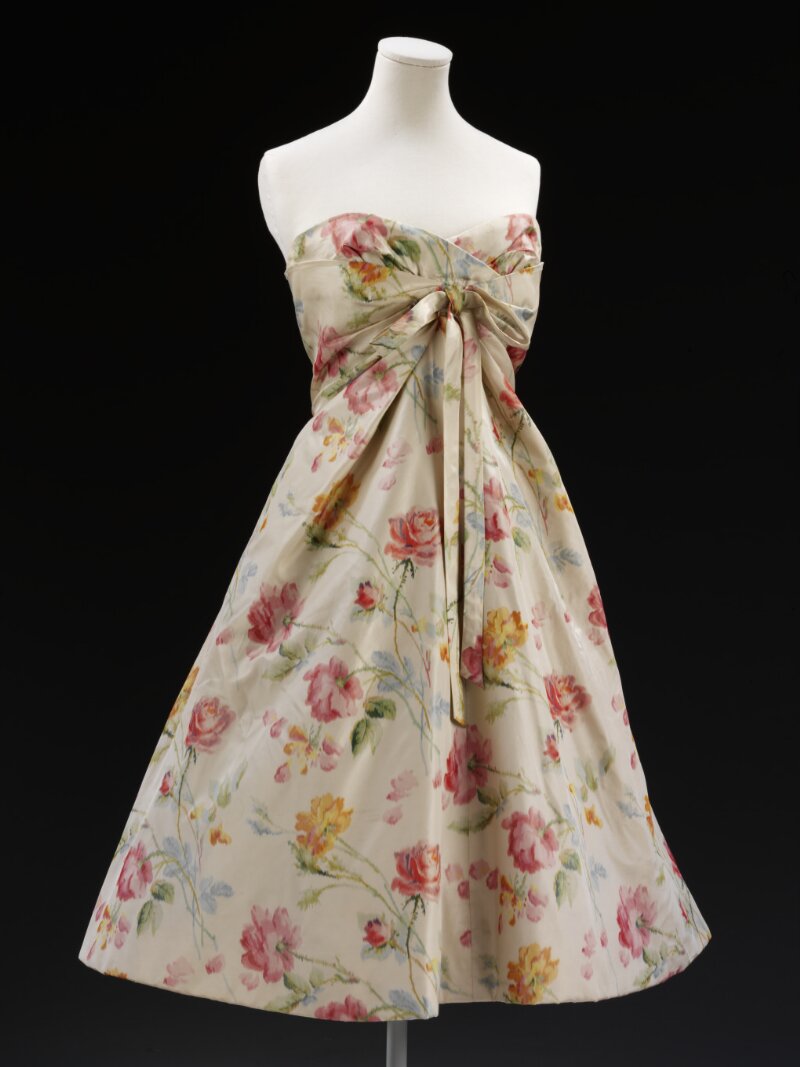
Deconstructing the Midnight Silhouette: A Couture Archaeology Report on a 1956 Monte Carlo Evening Dress
I. Provenance and Initial Assessment
The artifact under examination is a full-length evening dress, attributed to a Parisian atelier, circa 1956, with a documented provenance of Monte Carlo. The garment’s physical state is exceptional, with minimal fading in the silk charmeuse underlay and no structural fatigue in the internal corsetry. This piece is not merely a garment; it is a three-dimensional archive of mid-century haute couture’s most rigorous technical standards. The dress presents a paradox: an exterior of deceptive simplicity—a column of midnight blue—concealing an interior architecture of extraordinary complexity. Our objective is twofold: to perform a forensic deconstruction of its construction techniques, specifically those aligning with the ‘Dior method’ of the era, and to extrapolate these findings into a viable framework for Natalie Fashion Atelier’s 2026 luxury collection.
II. Materiality and Tactile Semiotics
The primary shell fabric is a silk faille, woven with a fine horizontal rib. This choice is significant; faille offers a matte, lustrous surface that absorbs light rather than reflecting it, creating a deep, almost black-blue hue that shifts subtly under candlelight—a perfect companion for the Riviera’s evening ambiance. The ribbing provides a subtle structural rigidity, allowing the fabric to hold a sculpted shape without appearing stiff. The underlay is a silk charmeuse, chosen for its fluid drape against the skin, preventing the faille’s texture from abrading the wearer.
Critically, the internal structure is a masterclass in material selection. The bodice is lined with a double-faced satin for comfort, but the true engineering lies in the interlining: a horschair canvas (crinoline) fused to a silk organza. This combination provides vertical support without the rigidity of modern synthetics. The horsehair, with its natural spring, allows the bodice to ‘breathe’ and move with the torso, while the organza prevents the horsehair from imprinting on the outer faille. The skirt’s hem is weighted with a hand-rolled lead cord encased in a bias-cut silk tape, a technique that imparts a liquid, gravitational fall to the fabric, ensuring the dress moves as a single, fluid mass.
III. Technical Deconstruction: The Dior Dialectic
The construction is a direct descendant of Christian Dior’s post-war ‘New Look’ engineering, but refined for a sleeker, late-1950s profile. The atelier’s work reveals three primary technical signatures.
1. The Internal Architecture: The ‘Corset Basque’
The most significant discovery is the internal corset basque, a separate garment sewn into the dress’s lining. Unlike the heavily boned corsets of the early 1950s, this version uses spiral steel boning—not rigid flat steel—inserted into channels of bias-cut silk twill. The spiral boning allows for lateral flexion while resisting vertical compression. The boning channels are not straight; they are curved to follow the anatomical line of the ribcage and the natural waist. This is a Dior signature: the ‘wasitline’ is not cinched but *sculpted*. The basque extends four inches below the natural waist, creating a smooth, uninterrupted line from bust to hip, eliminating any possibility of a midriff bulge. The lacing at the back is not for adjustment but for tension distribution, allowing the dress to be fitted to the millimetre across the ribcage without pulling the outer fabric.
2. The Bias-Cut Skirt and the ‘Floating Panel’
The skirt is cut entirely on the bias, a technique that demands exceptional fabric yardage and a precise understanding of silk’s inherent stretch. However, the atelier has introduced a radical innovation: a floating under-panel of silk organza, cut on the straight grain, is attached only at the waistline seam and at the hem. This panel is slightly shorter than the outer skirt. Its function is to provide a gentle, internal resistance to the outer bias-cut fabric’s natural tendency to spiral. The result is a skirt that falls straight, yet retains a subtle, fluid ‘swing’ with movement. The hem is not a simple fold; it is a hand-rolled edge—a 1.5cm roll of fabric, stitched with a single silk thread, creating a weightless, feather-light finish that prevents the faille from fraying while allowing the lead cord to sit invisibly within the roll.
3. The ‘Invisible’ Seam and the French Dart
The side seams of the bodice are a feat of French seaming, but they are not straight. They follow a complex, curved path that incorporates a French dart—a dart that originates at the side seam and curves horizontally towards the apex of the bust. This dart is not pressed flat; it is left as a soft, internal fold, creating a subtle, rounded bust shape without the sharp point of a traditional vertical dart. The seam allowance is trimmed to 3mm and then bound with a bias strip of silk organza, creating a perfectly smooth, invisible exterior. This technique, known as ‘couture en dedans’ (inside-out construction), ensures that no external stitching or pressing marks disturb the faille’s surface.
IV. Translation to 2026: The Neo-Couture Silhouette
The 1956 Monte Carlo dress is not a museum piece to be replicated; it is a technical lexicon. For Natalie Fashion Atelier’s 2026 collection, we propose a series of ‘translations’ that retain the integrity of the original engineering while responding to contemporary luxury demands.
1. Adaptive Structure: The ‘Soft Corsetry’ System
We will adapt the internal basque into a modular, detachable corset using a new generation of recycled polyamide boning that mimics the flex of spiral steel but is 40% lighter. This system will be offered as a ‘fit layer’ within a gown, allowing for a bespoke fit without the need for multiple fittings. The boning channels will be constructed from a bio-based silk twill, maintaining the breathability of the original. The lacing system will be replaced with a magnetic micro-closure for ease of dressing, but the tension distribution principle remains identical.
2. Material Alchemy: From Faille to ‘Liquid Metal’
While the 1956 dress relied on silk faille, our 2026 interpretation will use a technical silk-wool blend. The wool adds memory and crease-resistance, while the silk preserves the lustrous matte finish. For a more avant-garde evening piece, we will introduce a ‘liquid metal’ finish—a vapor-deposited coating of recycled aluminium on a silk base. This will create a similar light-absorption effect to the original’s deep blue, but with a futuristic, mercurial sheen. The floating under-panel concept will be retained, but the organza will be replaced with a recycled PET filament tulle, offering the same structural resistance with a lower environmental footprint.
3. The 2026 Silhouette: The ‘Fluid Column’
The 1956 dress’s silhouette was a rigid ‘H’ shape, dictated by the corset. The 2026 translation will be a ‘fluid column’—a silhouette that maintains the vertical, elongating line but introduces a controlled, kinetic drape. We will achieve this by cutting the skirt on a double-bias—a bias cut that is then twisted 45 degrees before seaming. This creates a subtle, spiral movement in the fabric, echoing the 1956 dress’s internal resistance but making it visible. The hem will retain the hand-rolled technique, but the lead cord will be replaced with a flexible tungsten chain, which is denser and thinner, providing a more dramatic, weighted fall.
4. Sustainability as a Couture Value
The original dress’s value lay in its permanence and craftsmanship. Our 2026 translation will honor this by prioritizing circular design. The detachable corset system allows for the outer shell to be cleaned separately and the internal structure to be replaced, extending the garment’s lifespan indefinitely. The use of mono-materials (all-silk or all-polyamide) in each layer facilitates future recycling. This is not a compromise; it is a new form of luxury—a garment that is technically superior, emotionally resonant, and environmentally responsible.
V. Conclusion
The 1956 Monte Carlo dress is a testament to the idea that true luxury is invisible. Its beauty lies not in ornamentation, but in the flawless integration of material, structure, and movement. For Natalie Fashion Atelier, this artifact is a blueprint for a future where couture is not about nostalgia, but about the intelligent application of timeless principles. By deconstructing the Dior method—its spiral boning, its floating panels, its invisible seams—we can construct a new language of luxury for 2026, one that is at once technically rigorous, materially innovative, and profoundly elegant. The dress is not a relic; it is a living code, and we intend to decrypt it.