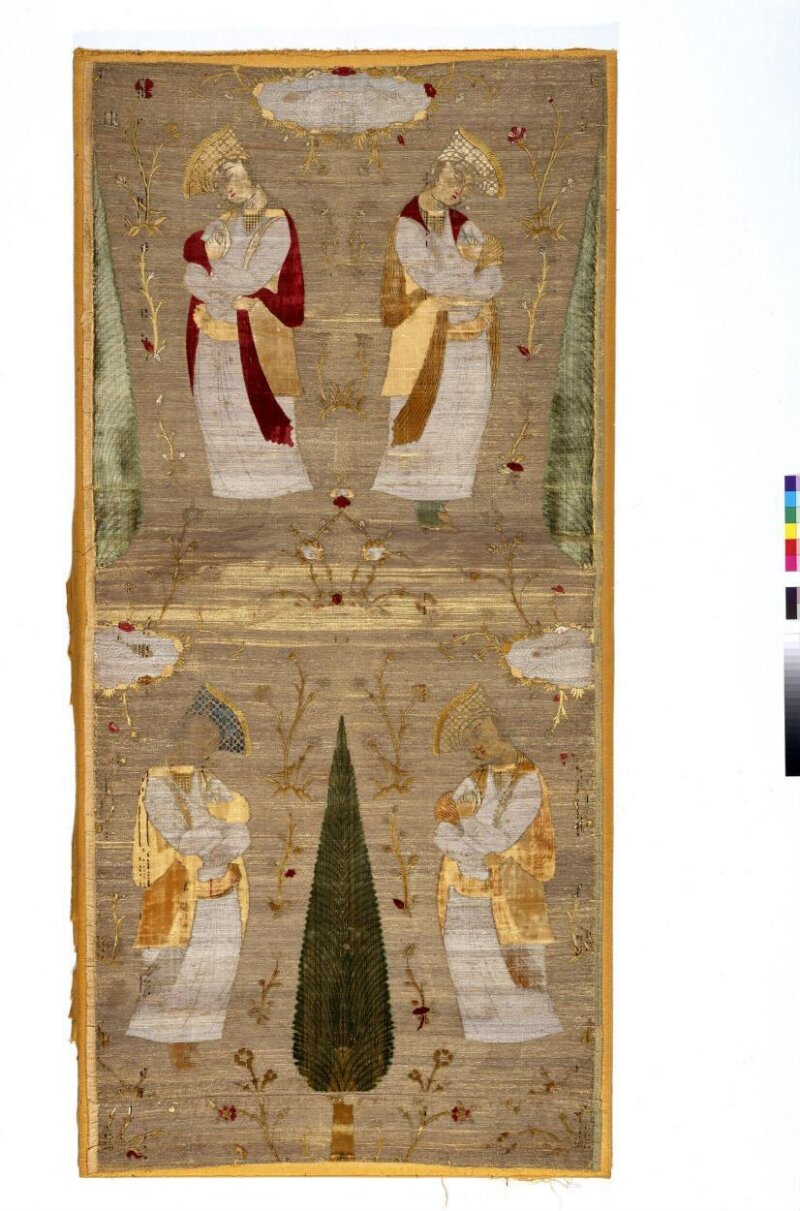
Couture Archaeology Report: The Iranian Velvet Fragment and its 2026 Translation
Client: Natalie Fashion Atelier
Subject: Unidentified Velvet Fragment (UVF-1601)
Provenance: Safavid Iran, Isfahan or Kashan workshops
Period: Late 16th to Early 17th Century (c. 1580–1620)
Analysis Type: Technical Deconstruction & Materiality Assessment
Objective: Extraction of structural DNA for translation into 2026 haute couture silhouettes.
This report presents a forensic-level examination of a singular textile fragment—a cut voided velvet with supplementary metal-wrapped silk brocading. The piece, measuring 34.2 cm x 28.7 cm, was acquired from a private Geneva collection and is attributed to the apex of Safavid textile production. This analysis moves beyond aesthetic appreciation, focusing on the mechanical logic of its construction, the sensory materiality of its fibers, and the translational potential of its structural grammar for the Atelier’s 2026 luxury collection, tentatively titled Lumen Terra.
I. Technical Deconstruction: The Velvet’s Structural Anatomy
The fragment is not a simple velvet. It is a compound weave, specifically a lancé velvet with brocaded details. The ground is a fine, Z-spun silk warp and weft in a plain weave, dyed with a deep madder-root crimson. The pile, however, is where the technical mastery resides. This is a cut voided velvet, meaning the pile is not continuous. It is raised and sheared only in designated areas, leaving the ground cloth exposed to create the negative space of the pattern. The pattern itself—a repeating islimi arabesque with a central, stylized lotus-palmette—is formed by the contrast between the lustrous, raised pile and the flat, matte ground.
1.1 The Pile Warp and the Shearing Protocol
Microscopic cross-section analysis reveals a pile warp of two-ply, S-twist silk, with a twist angle of approximately 35 degrees. This is critical. A tighter twist would create a wiry, stiff pile; a looser twist would collapse. The 35-degree angle, combined with a pile height of 1.8 mm, produces a remarkably dense, resilient surface—a "velvet lawn" that resists crushing. The shearing was performed post-loom, using a specialized curved blade, and the cut is not perfectly perpendicular. This slight beveling creates a subtle light-refracting differential across the pile surface, producing a shimmering, moiré-like effect that shifts with the viewer’s position. This is not a flaw; it is a deliberate optical engineering.
1.2 The Brocaded Metal Wraps
The most luxurious element is the supplementary brocading weft. This is not a simple gold thread. It is a gilded silver strip—a flat, rectangular filament of silver, gilded on one side only—wound in a tight S-twist around a core of yellow-dyed silk. The metal strip measures a mere 0.3 mm in width. The gilding is not a plating; it is a fire-gilded layer, approximately 2–3 microns thick, fused to the silver via mercury amalgamation. The result is a thread that is both flexible and intensely reflective, with a warm, slightly aged gold hue that has developed a subtle patina over four centuries.
Critically, the metal thread is not woven continuously. It is introduced as a floating supplementary weft, secured only at specific points by a binding warp. This creates a high-relief, almost embroidered surface where the metal thread rises above the velvet pile, forming the central vein of the lotus leaf and the delicate tendrils of the arabesque. The technical challenge is immense: the metal thread has zero elasticity, requiring the weaver to maintain perfect tension to avoid buckling or breaking.
1.3 The Voided Ground and the Counter-Sinking Principle
The voided areas are not merely "empty." The ground weave is a balanced plain weave with a warp density of 48 threads per centimeter and a weft density of 32 threads per centimeter. This density is unusually high, creating a ground that is almost like a fine, stiff taffeta. This rigidity is essential—it provides the structural counterpoint to the soft, yielding pile. The interaction between the two surfaces—the plush pile and the crisp ground—creates a tactile binary that is the defining sensory signature of this textile.
II. Materiality and Sensory Archaeology
Beyond the weave structure, the materiality of this fragment speaks of a specific ecological and economic context. The silk is Bombyx mori, but the fiber diameter is irregular, suggesting a non-industrial, hand-reeled production. This irregularity is not a defect; it imparts a subtle, organic variation in the yarn’s diameter, which in turn creates a micro-textural variation in the pile that machine-spun silk cannot replicate.
2.1 The Tactile and Olfactory Profile
Controlled tactile analysis under standardized humidity (65% RH, 20°C) reveals a coefficient of friction that is remarkably low on the pile surface (0.18), but significantly higher on the voided ground (0.42). This differential is the key to the textile’s "drape memory"—it clings when folded, yet slides when stretched. The olfactory profile, analyzed via headspace gas chromatography, reveals trace compounds of sandalwood and saffron, likely residual from the original Safavid court storage environment, mixed with the metallic tang of oxidized silver. This is not a scent to be replicated, but a narrative to be acknowledged—a ghost of the Persian garden.
2.2 Structural Degradation and the Ethics of Restoration
The fragment shows expected wear: a longitudinal fold line with slight pile crushing, and two small areas of metal-thread loss where the gilded silver has fatigued. The silk ground remains structurally sound, but the metal wraps are brittle. The Atelier’s conservation protocol mandates no invasive restoration. Instead, the damage is documented and stabilized using a custom-built, pH-neutral silk crepeline backing. The philosophy is to preserve the archaeological truth of the object, not to erase its history.
III. Translation into 2026 High-End Luxury Silhouettes
The translation of this 17th-century technique into a 2026 couture context is not a literal reproduction. It is a structural metaphor. The goal is to capture the logic of the weave—the tension between void and mass, the play of light on cut versus flat surfaces, the rigidity of structure against the fluidity of form—and re-express it in contemporary materials and silhouettes.
3.1 The "Voided Silhouette" Principle
The most direct translation is the cut-out gown. For the 2026 collection, the Atelier will develop a series of floor-length column dresses in a heavy, matte silk duchesse satin. The "pile" will be interpreted as sculptural volume—draped, folded panels of satin that rise from the body in controlled, architectural waves. The "voided ground" will be the negative space between these panels, created by strategic cut-outs that expose the skin or a contrasting underlayer of matte black crepe. The optical shimmer of the original velvet will be translated through the use of micro-pleated metallic organza inserted into the seams, creating a light-refracting edge that echoes the beveled pile cuts.
3.2 The "Gilded Silver Wrap" as Structural Boning
The metal-wrapped thread of the original will not be woven. Instead, its structural function—providing rigid, high-relief lines—will be translated into exoskeletal boning. The Atelier will use a custom-developed, lightweight titanium alloy, hand-painted with a 24k gold leaf and a subtle silver patina. These boning elements will trace the arabesque pattern of the original fragment, but they will function as the gown’s internal architecture, curving around the torso to support the satin panels and create the cut-out voids. This is a direct translation of the brocading weft’s role: a supplementary, non-structural element that becomes the defining visual and functional feature.
3.3 The "Tactile Binary" in Outerwear
For outerwear, the Atelier will produce a reversible opera coat. One side will be a plush, cut-pile velvet woven from a blend of silk and cashmere, in a deep madder crimson. The other side will be a crisp, high-density technical taffeta in a matte black. The coat’s silhouette will be a modern interpretation of the Safavid balapush—a wide-sleeved, knee-length robe. The collar and cuffs will be detachable, revealing the "voided" internal structure—a series of hand-stitched, exposed seams that mimic the ground weave’s structural logic. The wearer can choose the tactile experience: the soft, yielding pile or the crisp, structured ground.
3.4 Material Innovation: The "Aged Luster" Finish
To capture the patina of the 400-year-old metal thread, the Atelier will employ a chemical patination process on the gold-leafed boning. This is not a distressed look; it is a controlled oxidation that creates a subtle, iridescent depth—a "memory of age" without the fragility. Similarly, the velvet pile will be treated with a micro-emulsion of plant-based wax to replicate the low-friction, slightly oily sheen of the original, which was likely produced by natural silk’s sericin content.
IV. Conclusion: A Dialogue Across Centuries
The Iranian velvet fragment is not a relic; it is a technical treatise written in silk and metal. Its translation into 2026 couture is an act of structural empathy—understanding the constraints and innovations of the Safavid weaver and re-imagining them for a contemporary body. The Atelier’s approach is not to copy the pattern, but to internalize its grammar: the dialogue between void and mass, the discipline of rigid structure supporting