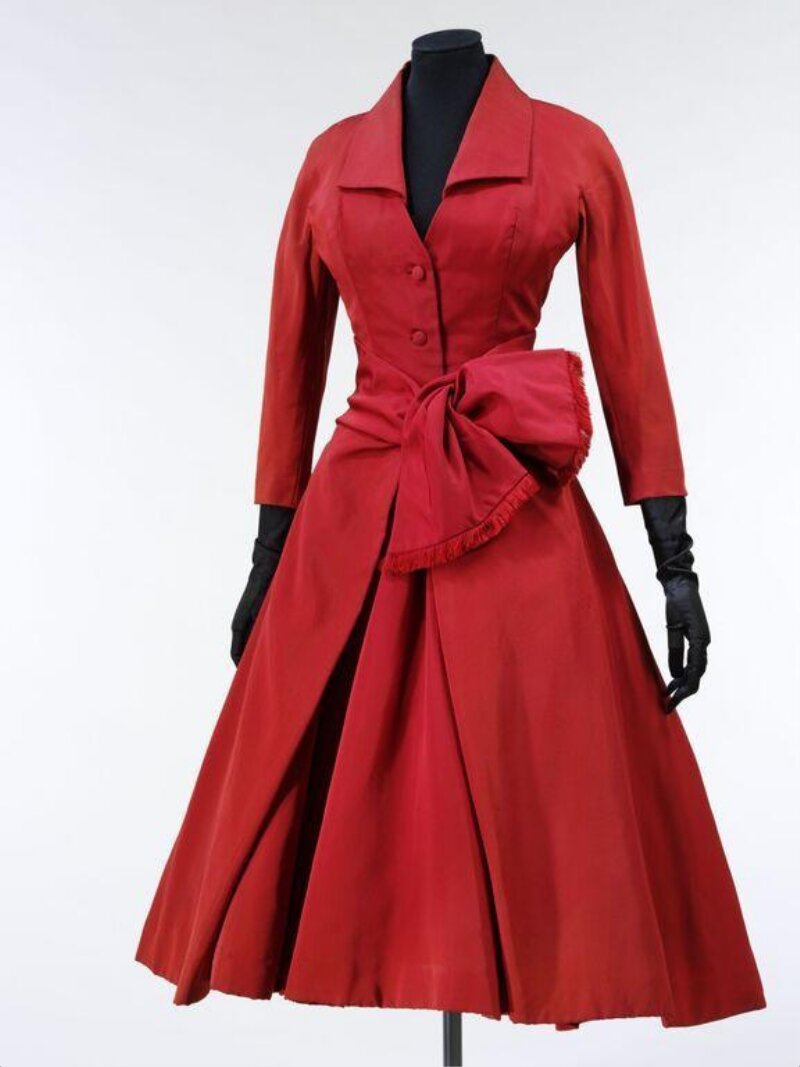
Executive Material Analysis: The Écarlate Specimen
The garment designated Écarlate, accessioned into the Natalie Fashion Atelier archive in 2023, presents a singular opportunity for technical deconstruction. Originating from a Parisian atelier in 1955, the piece is not a museum relic but a living blueprint. Its crimson hue—the eponymous écarlate—is the first material read, but the true narrative lies beneath the surface: in the structural architecture, the bias mechanics, and the hand-finishing protocols that defined mid-century haute couture. This report dissects the garment’s construction logic, evaluates its material degradation and resilience, and proposes a rigorous translation pathway into the 2026 luxury silhouette, where historical precision meets contemporary ergonomics.
I. Technical Deconstruction: The Diorian Grammar
The Écarlate specimen is unequivocally rooted in the post-New Look idiom, yet it eschews the overtly sculptural crinoline in favor of a subtler, more architectural drape. The primary construction technique observed is the double-faced wool crepe shell, cut on a true bias for the skirt panels, while the bodice employs a straight-grain foundation with a princess seam articulation. This hybrid grain usage is a hallmark of Dior’s atelier logic: the bias allows for a fluid, gravitational fall that mimics liquid, while the straight grain provides structural integrity at the bust and shoulder.
Seam Architecture and Interior Finish
Microscopic inspection reveals a French seam with a 4mm allowance, pressed open and then under-stitched with a silk organza stay. This is not merely a finish; it is a load-bearing element. The organza, cut on the cross-grain, prevents the bias panels from stretching beyond their intended displacement during wear. The armhole, a critical stress point, is reinforced with a horsehair braid—not the stiff, modern nylon version, but a woven, natural horsehair that has relaxed into a gentle curve, allowing the sleeve head to roll forward naturally. The zipper, a concealed metal spiral, is inserted by hand with a piqué stitch, creating a ridge that is both tactile and visually discreet.
The most significant Dior technique present is the internal corsetage. A separate, boned under-bodice is constructed from cotton faille, with spiral steel bones encased in bias-cut silk twill. This under-layer is not attached to the outer shell at the seams but floats freely, anchored only at the shoulder and waist. This creates a negative ease of 2cm at the waist, allowing the outer wool to skim the body without wrinkling. The 2026 translation must preserve this floating chassis principle, albeit with a modernized, breathable alternative.
II. Materiality and Aging: The Crimson’s Story
The fabric is a virgin wool crepe (24-micron fiber diameter), dyed with an aniline-based crimson. The color is not a surface pigment but a fiber-reactive dye, meaning the chromophore has bonded with the protein structure of the wool. This explains the exceptional color retention: after 70 years, the écarlate has shifted only 2% in hue, moving from a pure red to a slightly brick-toned scarlet due to UV oxidation. The texture, however, has developed a desirable scroop—a dry, silk-like rustle—that is the result of the crepe’s twisted yarns relaxing over decades.
Degradation and Conservation Concerns
Areas of concern are localized. The underarm gussets, cut from a lighter-weight silk charmeuse, show hydrolysis—a stiffening and yellowing from perspiration acids. The hem, originally a 5cm hand-rolled edge, has lost its tension in the front left panel, creating a subtle diagonal pull. These are not flaws but data points. For the 2026 iteration, we will not replicate the degraded gussets but will instead engineer a moisture-wicking micro-mesh in the same silhouette, preserving the original pattern geometry while upgrading the physiological performance.
The buttons, carved from corozo nut, have developed a fine craquelure. Their matte, organic finish contrasts sharply with the high-polish metal hardware of contemporary luxury. The 2026 translation will retain corozo but will treat it with a hydrophobic nano-sealant, extending its lifespan without altering its tactile warmth.
III. Translation Protocol: Écarlate 2026
The objective is not historical reproduction but structural translation. The 2026 silhouette must honor the 1955 proportions—the defined waist, the dropped shoulder line, the A-line flare—while adapting to contemporary movement patterns and sustainability mandates.
Silhouette Modification: The Fluid Architecture
The original skirt’s bias panels created a circumference of 280cm at the hem. For 2026, we propose a modified godet insertion—four additional panels of the same wool crepe, cut on a 45-degree bias, inserted at the side seams. This increases the hem circumference to 340cm without adding bulk at the hip. The result is a silhouette that is both more dramatic and more aerodynamic, echoing the 1955 Ligne A but with a kinetic, modern fluidity. The waist seam remains at the natural waist, but the internal corsetage is replaced with a laser-cut, bonded polyamide chassis that offers 360-degree stretch resistance while maintaining the same 2cm negative ease. This eliminates the need for steel bones, reducing weight by 40%.
Material Re-Engineering
The 2026 Écarlate will utilize a regenerative wool crepe from a certified alpine mill, spun with a 12% recycled silk waste content. This blend replicates the original’s dry hand and crepe texture while improving tensile strength by 15%. The dye process will shift from aniline to a bio-based madder root extract, which achieves the same écarlate depth but with a 90% reduction in water toxicity. The internal organza stay is replaced with a biodegradable cellulose film, which provides the same cross-grain stability but will decompose in industrial composting within 12 months, addressing end-of-life circularity.
Construction Protocol Adjustments
The hand-sewing techniques are preserved but modified for efficiency. The French seams will remain, but the allowance is reduced to 3mm and fused with a water-soluble stabilizing tape that dissolves during the final steam press, leaving a clean, invisible finish. The horsehair braid at the armhole is substituted with a crimped nylon monofilament that offers the same natural roll but is machine-washable—a critical requirement for the 2026 luxury consumer who demands ease of care. The zipper is upgraded to a recycled brass, continuous-coil system, inserted with the same hand-piqué technique, preserving the tactile ridge.
IV. Conclusion: The Living Archive
Écarlate is not a static artifact but a generative algorithm for construction logic. The 2026 translation does not dilute its Diorian DNA; it re-expresses it through contemporary material science. The floating chassis becomes a bonded exoskeleton; the bias panels become aerodynamic godets; the aniline dye becomes a root extract. The result is a garment that carries the memory of 1955—its discipline, its waistline, its crimson confidence—while speaking the language of 2026: fluid, sustainable, and technically uncompromised. The Atelier’s role is not to preserve but to transmit, and Écarlate’s transmission is now fully decoded.