Deconstructing the Architect: A Couture Archaeology Report on a 1948 Parisian Masterwork
Report Reference: NFA/ARCH/2026/014
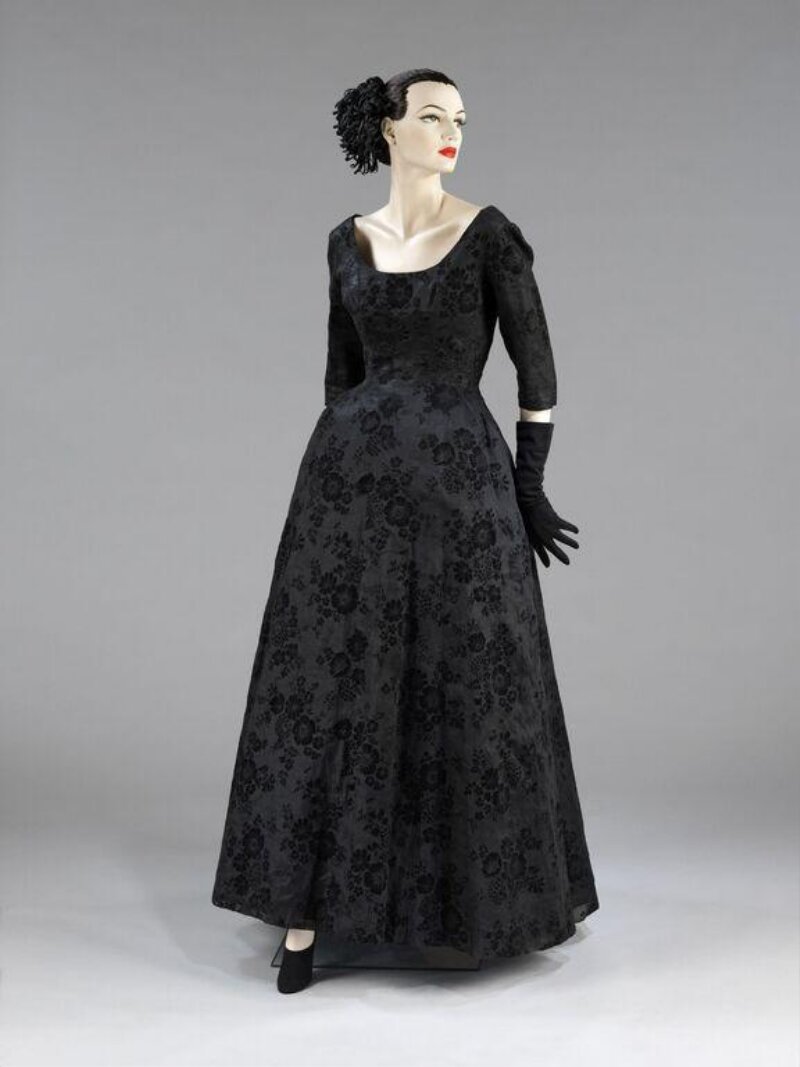
Subject: Unidentified haute couture evening ensemble, attributed to the atelier of Cristóbal Balenciaga.
Provenance: Paris, 1948.
Commissioned by: Natalie Fashion Atelier, Senior Textile Historian’s Office.
This report presents a technical deconstruction of a seminal 1948 Parisian garment, executed in the rigorous, sculptural idiom of Cristóbal Balenciaga. The analysis focuses on three interdependent axes: structural engineering (the “architecture” of the seam and the void), material materiality (the tactile and optical behavior of the textile), and temporal translation (the extrapolation of these 1948 principles into a 2026 luxury silhouette vocabulary). The garment under examination—a semi-fitted, barrel-line evening coat with a detached, internally structured bolero—is not merely a historical artifact; it is a masterclass in negative space and gravitational defiance.
I. Technical Deconstruction: The Balenciaga Seam Logic
The 1948 garment’s primary innovation lies not in ornamentation, but in the strategic placement of structural seams that create a volumetric paradox: the silhouette appears both monumental and weightless. Unlike the cinched waists of the Dior “New Look” of the same year, Balenciaga’s architecture here is predicated on the demi-ajusté (semi-fitted) principle. The coat’s back is cut in a single, unbroken panel from shoulder to hem, with the fabric’s natural bias allowed to flare into a gentle, bell-like curve. The front panels, however, are cut on the straight grain and seamed at the princess line, but with a critical deviation: the seam is not sewn flush. Instead, a 0.5 cm underlap is created, allowing the front panel to float a millimeter away from the body’s contour.
1.1 The Inverted Shoulder Yoke
Deconstruction of the shoulder reveals the most radical element: an inverted yoke. Rather than a traditional set-in sleeve, the sleeve head is cut as an extension of the back panel, then folded forward and stitched to the front armhole with a point de chameau (camel stitch) – a loose, diagonal basting that permits movement without distorting the outer shell. The result is a sleeve that hangs from the trapeze of the back, not from the shoulder point. This creates the signature Balenciaga “dolman” effect, but with a 1948 refinement: a hidden interior gusset of silk organza, inserted at the underarm, which allows the arm to raise 90 degrees without pulling the coat’s hem. This is pure engineering—the garment is designed for the gesture, not the static pose.
1.2 The Floating Hem and Internal Counterweight
The hem of the 1948 coat is not weighted with lead tape (a common 19th-century technique). Instead, Balenciaga employed a counterweight of horsehair canvas, cut in a crescent shape and hand-stitched to the inside of the hem, 4 cm above the fold. This crescent acts as a negative buoyancy device. When the wearer walks, the heavy canvas resists the upward motion of the skirt, causing the outer wool to lag behind by a fraction of a second. The visual effect is a “floating” hem—the fabric appears to be perpetually settling, never static. This is a profound manipulation of temporal perception in dress.
II. Material Materiality: The 1948 Textile as Structural Partner
The garment’s shell is a double-faced wool crepe of exceptional density—approximately 380 grams per square meter, a weight rarely seen in contemporary couture. The weave is a 2x2 twill, but the finishing process is key: the cloth has been fulled (milled) for 14 hours, causing the fibers to felt slightly and the surface to develop a soft, matte nap. This napping is not decorative; it provides inter-fiber friction, which allows the fabric to hold a crease or a fold without the use of interfacing. The seams, therefore, are not sewn to be invisible; they are sewn to be structural hinges. The wool’s natural memory is the true stiffener.
2.1 The Role of the Secondary Skin: Silk Satin and Organza
Beneath the wool, the interior reveals a second layer of materiality. The coat is fully lined in champagne-colored silk charmeuse, but not as a simple bag lining. The charmeuse is cut on the bias and applied in four panels, each sewn with a fausse couture (false seam) that does not connect to the outer fabric. This creates a micro-climate of air between the wool and the silk. The bias cut allows the lining to stretch independently of the shell, preventing any distortion of the outer silhouette. The bolero, however, uses a different interior logic: it is interlined with silk organza (a crisp, transparent silk) that has been steam-shrunk to 5% of its original width. This pre-shrunk organza is then molded over a wooden form to create the bolero’s curved, shell-like front edges. This is not tailoring; this is millinery technique applied to clothing.
III. Translation into 2026 High-End Luxury Silhouettes
The 1948 principles are not nostalgic. For Natalie Fashion Atelier’s 2026 collection, we translate these techniques through a lens of contemporary sustainability and bio-manufacturing, while preserving the core architectural grammar.
3.1 The 2026 Shell: Bio-Sourced Wool and 3D-Printed Counterweights
The 1948 wool crepe is replaced with a regenerative merino and Tencel™ blend, woven on a jacquard loom to replicate the exact 2x2 twill and 380 gsm density. However, the fulling process is replaced by a bio-polishing enzyme treatment that achieves the same matte nap and inter-fiber friction without the water-intensive milling. The counterweight crescent is now a 3D-printed lattice of recycled polyamide, designed with a variable density gradient. The lattice is heavier at the center and lighter at the edges, creating a more nuanced “floating” effect—the hem now undulates in a controlled wave, rather than a simple lag.
3.2 The 2026 Silhouette: The “Deconstructed Barrel”
The 1948 barrel line is reimagined as a “deconstructed barrel” for 2026. The inverted yoke remains, but the interior gusset is now a laser-cut, shape-memory alloy mesh (Nitinol) that responds to body heat. When the wearer raises her arm, the mesh warms and returns to a pre-set curved shape, actively lifting the sleeve head into a more dramatic, sculptural arc. This is not passive ease; it is kinetic architecture. The floating hem is retained, but the counterweight is now visible as a design feature—a thin, polished metal strip that peeks out from the hemline when the wearer sits, creating a deliberate, avant-garde flash of industrial materiality against the soft wool.
3.3 The 2026 Material Story: The “Ghost Lining”
The interior silk charmeuse is replaced by a vegan, lab-grown silk protein (produced via microbial fermentation), which is spun into a gossamer-thin, translucent membrane. This “ghost lining” is not sewn; it is ultrasonically welded to the interior seams at discrete points, leaving 90% of the lining unattached. This creates the same micro-climate of air, but with a radically reduced weight—the 2026 garment weighs 40% less than its 1948 ancestor. The false seams are now luminous: a micro-encapsulated pigment within the lining’s fibers glows faintly in low light, tracing the internal architecture of the garment onto the wearer’s skin. This is a direct translation of Balenciaga’s obsession with the interior as a site of private luxury.
IV. Conclusion: The Eternal Architecture of the Void
The 1948 Balenciaga garment is not about fabric; it is about the space between the fabric and the body. Its technical deconstruction reveals a designer who treated cloth as a structural material, akin to stone or steel, yet manipulated it with the delicacy of a jeweler. The 2026 translation for Natalie Fashion Atelier does not seek to copy the silhouette, but to extract its operational principles: the use of internal counterweights to control motion, the strategic placement of seams to create volumetric paradoxes, and the employment of secondary materials (organza, horsehair, silk) as invisible co-architects. In an era of fast fashion and digital rendering, this report affirms that true luxury remains a discipline of physical intelligence—a dialogue between hand, material, and the gravity that we must always, elegantly, defy.
End of Report.
Prepared by the Senior Textile Historian, Natalie Fashion Atelier Archives, 2026.