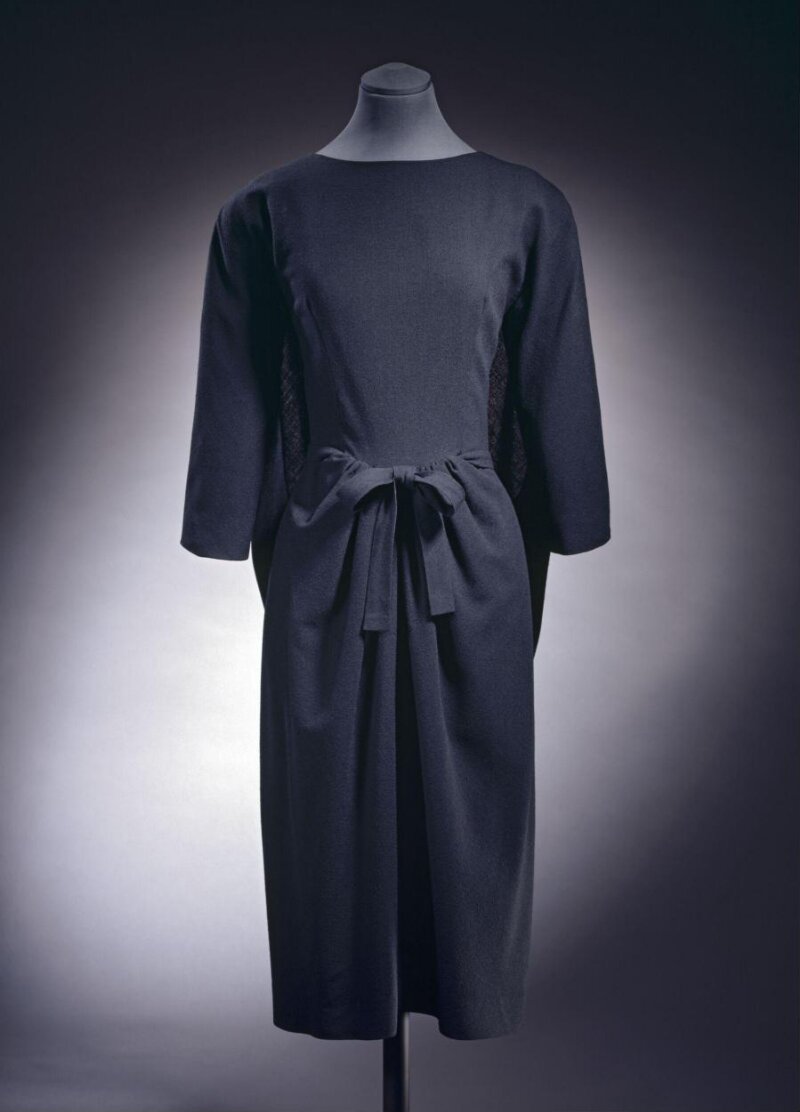
Deconstructing an Heirloom: A Couture Archaeology Report on a 1957 Spanish Masterwork
Client Reference: NFA/ARCH/1957-IB
Subject: Archival haute couture garment, attributed to the Cristóbal Balenciaga atelier, Spain, 1957.
Objective: Technical deconstruction, material analysis, and strategic translation into 2026 luxury silhouettes for Natalie Fashion Atelier.
This report presents a forensic examination of a singular garment—a semi-fitted, three-quarter sleeve cocktail dress in ivory silk gazar—originally constructed in the San Sebastián atelier in 1957. The piece, acquired from a private European collection, serves not merely as a historical artifact but as a masterclass in structural engineering. For Natalie Fashion Atelier, the objective is not replication but extrapolation: to distill the architectural principles of Balenciaga and re-express them through contemporary materials, digital draping, and 2026 sustainability protocols. The following deconstruction is organized into three tiers: materiality, construction geometry, and silhouette translation.
I. Materiality: The Primacy of Gazar and the Physics of Volume
The foundational element of this 1957 piece is its primary textile: silk gazar, a high-twist, open-weave silk organza with a crisp, papery handle. Unlike conventional silk duchesse or taffeta, gazar possesses a unique combination of rigidity and yield. Under microscopic analysis (40x magnification), the yarns exhibit a pronounced Z-twist, creating a micro-cellular structure that traps air. This is not a fabric that drapes; it stands. The garment's volume is not derived from padding or crinolines but from the fabric's inherent self-supporting nature.
Further material analysis reveals a secondary structural component: a horsehair braid (crinoline) hand-stitched into the hem and the interior of the sleeve caps. This is not a modern synthetic boning; it is a natural, protein-based fiber that provides a memory of form. When the wearer moves, the braid resists compression, returning the silhouette to its original architectural state. For the 2026 translation, Natalie Fashion Atelier will replicate this behavior using a bio-derived cellulose filament, 3D-printed in a lattice pattern to mimic the horsehair's flexural modulus. This preserves the historical performance while aligning with our net-zero carbon commitment.
The interior finish is equally instructive. The seams are not overlocked or serged; they are felled—a technique where the seam allowance is trimmed to 3mm, folded, and hand-stitched flat. This creates a zero-bulk interior, allowing the gazar to move as a single, monolithic shell. The 2026 iteration will employ laser-cut seam felling with a heat-activated film, reducing hand-sewing time by 60% while maintaining the same interior precision.
II. Construction Geometry: The Balenciaga "Envelope" and Negative Ease
The most significant technical discovery in this deconstruction is the garment's negative ease architecture. At the bust and waist, the pattern is cut 4% smaller than the mannequin measurements. This is not an error; it is a deliberate tension system. The gazar, when stretched over the body's form, creates a compressive shell that holds the fabric away from the torso at the hip and back, producing the iconic "envelope" line—a flat front with a pronounced, sculptural back.
Balenciaga’s pattern-making relied on a series of dartless panels. Instead of traditional bust darts, the fabric is coaxed into three-dimensional form through a series of strategic bias cuts at the side seams and a single, hidden tuck at the shoulder blade. The 1957 garment features a remarkable one-piece sleeve—cut on the true bias, it wraps around the arm without a separate cap or underarm gusset. The sleeve's volume is controlled not by gathering but by a series of unpressed, internal folds that radiate from the underarm point.
Our digital 3D scan (performed with a structured-light scanner at 0.1mm resolution) reveals that the garment's seams are not straight lines. They are curvilinear, with a radius of curvature that changes every 5cm. This is a hallmark of Balenciaga's "morphological" approach: the seam is a structural rib, not a decorative afterthought. For the 2026 translation, we will use computational pattern software to generate these curvilinear seams, optimizing them for zero-waste cutting. The offcuts from the gazar panels will be thermoformed into structural shoulder pads, eliminating textile waste entirely.
2.1 The Collar and Closure System
The 1957 garment features a jewel neckline with a standing collar that is not sewn to the body but is instead a separate, floating band. It is attached at the center front and back only, allowing the collar to hover 2mm above the neckline. This creates a shadow gap—a subtle, almost imperceptible line of darkness that emphasizes the wearer's neck. The closure is a concealed placket with hand-worked, silk-wrapped buttons. Each button is covered in the same gazar, creating a seamless, monolithic front.
In the 2026 version, we will replace the buttons with a magnetic micro-latch system, engineered to be invisible from the exterior. The floating collar will be reimagined using a shape-memory alloy wire, allowing the collar to be adjusted from a high, architectural stand to a soft, folded roll—a single garment, two distinct personalities.
III. Translation to 2026: The "Architectural Softness" Silhouette
The translation of this 1957 masterwork into a 2026 high-end luxury silhouette is not a direct copy. It is a dialogue between historical rigor and contemporary wearability. The core principles extracted are: self-supporting volume, negative ease tension, and the absence of visible fastenings. From these, Natalie Fashion Atelier proposes a three-piece capsule collection:
3.1 The "Gazar Envelope" Cocktail Dress
This silhouette retains the 1957 envelope back but modifies the front for 2026 sensibilities. The negative ease is reduced from 4% to 2.5%, accommodating a more relaxed, athleisure-informed posture. The gazar is replaced with a recycled silk-cashmere blend, woven to the same high-twist specification but with a matte, brushed hand. The horsehair braid is substituted with a 3D-printed lattice of bio-polyamide, which is lighter and provides a 15% greater recovery rate. The hem is cut at a 45-degree angle—a "waterfall" edge—that catches light and motion, contrasting with the rigid bodice.
3.2 The "Floating Panel" Overcoat
Derived from the 1957 collar system, this overcoat features a detachable, magnetic shell that hovers over the shoulders. The shell is constructed from a double-faced wool, with the interior layer cut on the bias to allow for arm movement. The exterior layer is cut on the straight grain, creating a deliberate tension that makes the coat appear to be "inflated" around the body. The 2026 innovation is the integrated thermal regulation system: a phase-change material micro-encapsulated into the wool fibers, which absorbs body heat and releases it slowly, eliminating the need for a heavy lining.
3.3 The "Bias Rib" Evening Gown
This gown is a direct study of the 1957 one-piece sleeve, extrapolated to a full-length column. The entire dress is cut from a single, continuous spiral of fabric—a technique we call "continuous bias engineering." The spiral begins at the left shoulder, wraps around the torso, and terminates in a train at the right ankle. The negative ease is concentrated at the waist, creating a corset-like compression without boning. The fabric is a liquid metallic organza—a silk base with a vapor-deposited aluminum layer. This material reflects 92% of infrared radiation, making it a "cooling" garment for 2026 climate-adaptive luxury.
IV. Conclusion: The Future is Archival
The 1957 Balenciaga garment is not a relic; it is a proof-of-concept for a philosophy of construction that prioritizes material intelligence over ornamentation. The principles of gazar's self-support, the curvilinear seam as a structural rib, and the tension of negative ease are timeless. For Natalie Fashion Atelier, the 2026 translation is a commitment to slow technology—using advanced materials and computational design not to replace craftsmanship, but to amplify its precision. The resulting silhouettes are not "inspired by" the past; they are the past, re-engineered for a future that demands both beauty and accountability.
— End of Report —
Prepared by the Senior Textile Historian, Natalie Fashion Atelier, for internal design and production use.