The Ivory Logic of the Sacred: Deconstructing the Virgin and Child for 2026
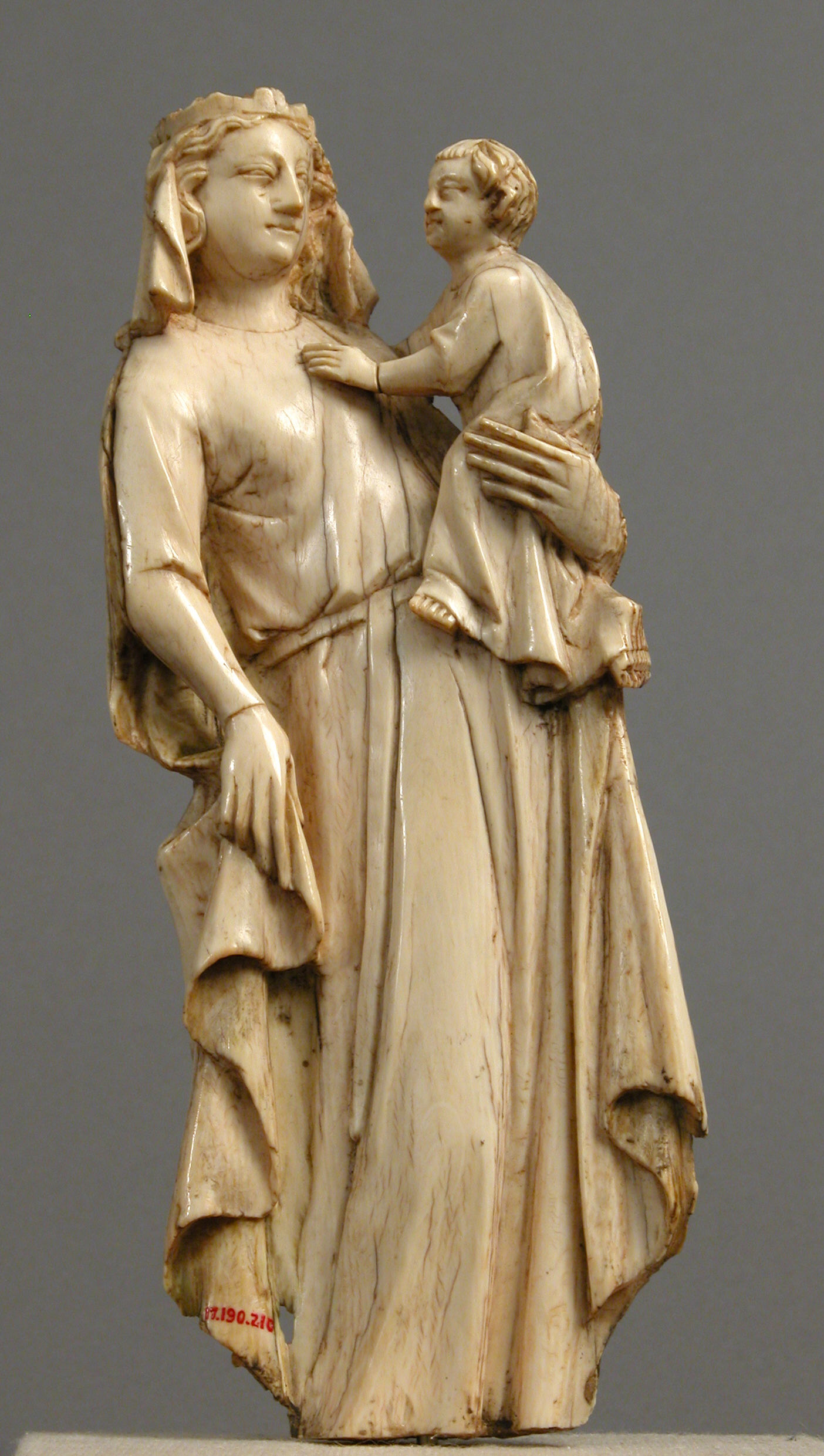
Within the hushed vitrines of the Natalie Fashion Atelier archive, the Virgin and Child in elephant ivory exists not as a relic of piety, but as a foundational text of sculptural proportion. Isolated from its liturgical context, the object reveals itself as a masterclass in tension, mass, and the architecture of drapery. For the 2026 haute couture season, this piece functions as a critical blueprint—a study in how material constraint and spiritual gravity can be translated into garments that possess both monumental presence and ethereal weightlessness. The ivory’s unique physicality—its density, its warm translucency, its capacity for micro-detail—demands a re-evaluation of how we construct the female silhouette, moving beyond mere surface ornamentation toward a structural purity that echoes the medieval atelier.
Materiality as a Design Imperative: The Elephant Ivory Paradox
The material itself is the first and most profound informant. Elephant ivory, in its historical usage, was not a passive canvas; it was an active agent in the creative process. Its inherent hardness—a Mohs scale rating of 2.5 to 3.0—allowed for the incising of hair-thin lines, creating the illusion of translucent veils over solid forms. However, its organic origin, derived from living tissue, imbued it with a subtle, internal warmth that starkly contrasts with the cold precision of marble or the reflective glare of gold. This paradox—of immense strength coexisting with a soft, almost skin-like luminosity—is the core aesthetic directive for 2026.
For the couture silhouette, this translates into a rejection of the fluid, liquid draping that has dominated recent seasons. Instead, we propose a return to sculpted architecture. The 2026 form will not be draped; it will be carved. Fabrics will be selected for their ability to hold a precise, angular fold as though chiseled from a solid block. Double-faced wool, bonded with a micro-thin layer of horsehair canvas, will be cut on the bias to create a controlled torsion that mimics the ivory turner’s spiral. The palette will be monochromatic, dominated by blanc cassé (broken white), ivoire, and os de seiche (cuttlefish bone), allowing the interplay of light and shadow across the garment’s topography to do the expressive work.
The Architecture of the Mantle: Reinterpreting the Virgin’s Drapery
The most compelling element of the ivory group is the treatment of the Virgin’s mantle. In the original, the fabric is not simply covering the body; it is a secondary skeleton, a system of volumetric planes that define the space around the figure. The deep, V-shaped folds cascading from the shoulder to the hip are not random; they are engineered channels that guide the eye toward the central focal point—the Christ Child. This is a lesson in directional couture.
For 2026, we translate this into a new silhouette: the “Mantle Gilet.” This is not a traditional vest. It is a sleeveless, structural shell that begins with a high, mandarin collar—echoing the ivory’s vertical stability—and then flares into a series of deep, sculpted pleats that are stitched down at the waist and released at the hip. The result is a garment that possesses the frontal authority of armor yet retains the fluid grace of a religious vestment. The construction technique borrows from taille douce (soft cutting), but with a critical modification: the internal seams are fused with a rigid, non-woven interfacing to create a “bone-like” rigidity. The garment does not move with the body; it moves around it, creating a negative space that is as deliberate as the positive form of the wearer.
Proportional Dissonance: The Christ Child as a Structural Counterweight
In the ivory, the Christ Child is not merely a smaller figure; he is a distinct geometric counterpoint to the Virgin’s elongated, vertical mass. His rounded, chubby form—a study in concentric circles—provides a tactile contrast to her angular, linear drapery. This proportional dissonance is the key to the 2026 high-end silhouette. We are moving away from the homogenous, columnar shapes of recent years toward a more complex, asymmetric dialogue between parts.
Consider the introduction of a “Child’s Orb”—a spherical, structural element placed at the hip or the lower torso. This is not a bustle in the historical sense. Rather, it is a perfectly spherical, padded form, constructed from layers of silk organza and buckram, which is then covered in the same ivory-toned fabric as the primary garment. This orb acts as a physical and visual counterweight to a sharp, elongated shoulder line. The wearer’s silhouette becomes a study in tension: the rigid, vertical line of the torso is interrupted by this perfect, almost celestial sphere, creating a dynamic visual rhythm that references the sacred geometry of the original piece without resorting to literal costume. The effect is one of controlled imbalance, a deliberate asymmetry that demands a new kind of physical carriage—one that is both grounded and ethereal.
The Translucency of the Veil: A Study in Layered Luminosity
Perhaps the most technically demanding aspect of the ivory is the illusion of the transparent veil over the Virgin’s head and shoulders. The carver achieved this by leaving the ivory at a thickness of less than two millimeters in certain areas, allowing light to penetrate and create a soft, internal glow. This is the ultimate luxury: the illusion of weightlessness achieved through extreme material discipline.
For the 2026 atelier, this informs a new technique in layering: “Lumière Sculptée” (Sculpted Light). We will employ multiple layers of the finest silk tulle and organza, each cut in a different grain direction and each dyed with a slightly different undertone—one with a hint of warm pearl, another with a cool, chalky white. When these layers are superimposed, they do not simply stack; they create an internal refraction that mimics the ivory’s translucency. The outer layer will be laser-cut with a micro-perforated pattern, not for decoration, but to create a specific light-diffusion index. Worn over a structured undergarment, this veil becomes a mobile architectural element, shifting its opacity as the wearer moves. It is a garment that performs the act of revelation, echoing the sacred mystery of the original, but in a purely secular, aesthetic language.
Conclusion: From Relic to Rationale
The Elephant Ivory Virgin and Child is not a source of nostalgic imitation; it is a rational, technical document for the future. By isolating its material logic and structural grammar, we extract principles—not motifs. The 2026 silhouette is thus defined by carved volume, directional drapery, proportional counterpoint, and layered luminosity. It is a couture that respects the intelligence of the body while simultaneously proposing a new, more monumental ideal. The ivory’s silence is not an absence of meaning; it is a reservoir of it. Our task is to translate that silence into the language of cut, seam, and fabric—a language that speaks of timelessness, not trend. This is the new classical elegance: not a return to the past, but a rigorous, forward-looking dialogue with its most profound achievements.