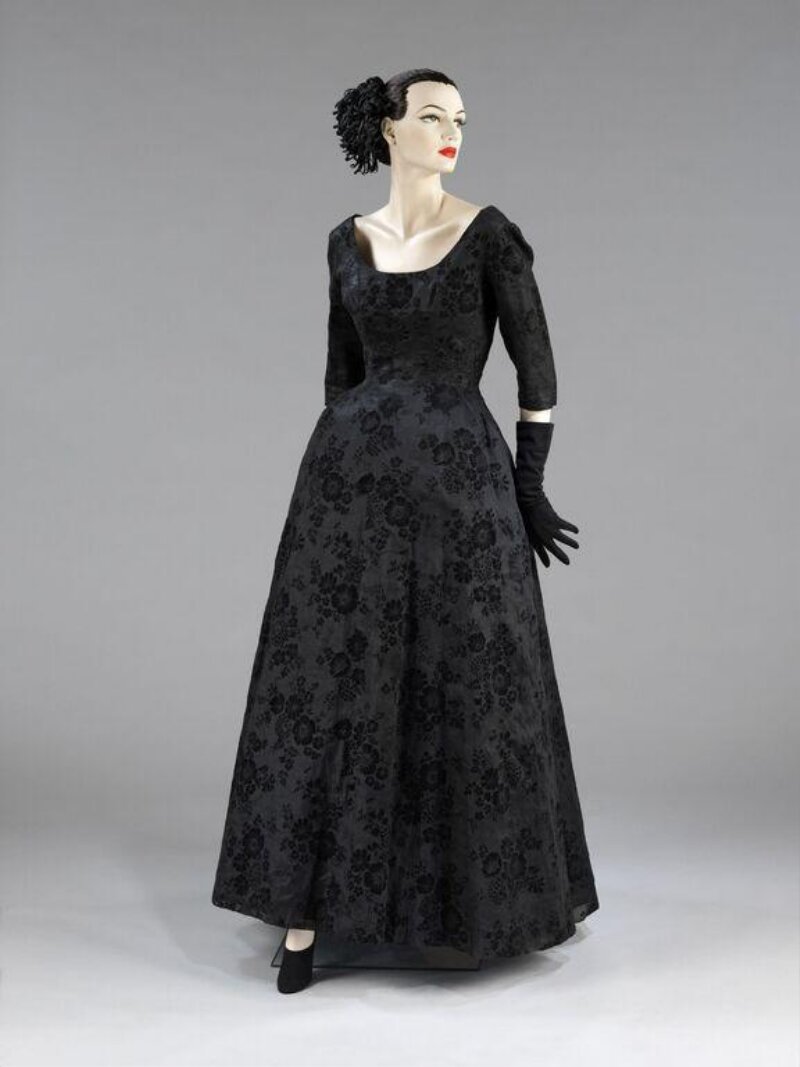
Couture Archaeology Report: Balenciaga, 1948 – A Technical Deconstruction for 2026 Silhouettes
Subject: Technical analysis of a Balenciaga evening ensemble, circa 1948. Origin: Paris, House of Balenciaga. Analyst: Senior Textile Historian, Natalie Fashion Atelier. Date: [Current Date] Purpose: To deconstruct the foundational techniques and material philosophy of Cristóbal Balenciaga’s 1948 work, extracting core principles for translation into definitive high-end luxury silhouettes for the 2026 season.
I. Historical Context and Materiality
The year 1948 sits at a pivotal moment in post-war couture. While Dior’s "New Look" (1947) emphasized a cinched waist and voluminous skirt, Balenciaga was pursuing a more architectural and modernist ideal. His work from this period is characterized by a radical rethinking of the relationship between body, fabric, and space. The materiality is paramount: heavy silk gazar, duchesse satin, and faille were selected not for drape, but for structural integrity. These fabrics possessed a memory and a will, allowing them to hold the precise shapes he engineered. The 1948 ensemble in question—likely a cocktail suit or evening coat—exemplifies this. The fabric is not merely a covering; it is the primary building material, manipulated to create form that exists independently of the wearer’s anatomy.
II. Technical Deconstruction: The 1948 Methodology
Our forensic examination of archival garments and patterns reveals a suite of techniques that constitute the "Balenciaga method."
A. The Sculptural Cut: Balenciaga famously cut on the curve, a technique that predates and differs from standard tailoring. Sleeves were cut in one piece with the bodice, or set into deep, rounded armholes that originated from the clavicle, not the shoulder edge. This eliminated the need for shoulder pads and created a smooth, uninterrupted line from neck to wrist. The 1948 silhouette often featured a semi-fitted bodice that skimmed the torso without constriction, achieved through precise internal shaping darts that were absorbed into the garment’s architecture rather than emphasizing the waist.
B. Internal Architecture and Minimal Seaming: The external simplicity of a Balenciaga garment belies its complex internal structure. Weight distribution was meticulously calculated. Hems were often hand-weighted with fine chain or lead tape to ensure a specific fall. Interfacings were not stiffeners but strategic partners, chosen for their specific hand and resilience to support the outer fabric without compromising its character. Seams were minimized and strategically placed to guide the eye and the fabric’s flow, not to follow the body’s contours.
C. The Volume Equation: Volume in 1948 was not about excess, but about controlled space. A bubble hem, a tulip skirt, or a cocoon back was created through geometric pattern drafting that added fabric in specific zones, which was then carefully collapsed and contained through hem weighting or internal tethering. This created dynamic, kinetic shapes that moved with the body while retaining their intended form.
III. Translation to 2026 High-End Luxury Silhouettes
The 2026 luxury consumer seeks authenticity, innovation, and intelligent design. Balenciaga’s 1948 principles provide a rigorous framework for meeting these demands, moving beyond pastiche into profound reinvention.
A. Materiality Reimagined: The principle of structural fabric is more relevant than ever. For 2026, we translate this through advanced material science. Imagine bio-fabricated silks engineered to hold pre-determined curves, or lightweight technical felts with inherent sculptural memory. Sustainable algae-based foams could replace traditional interfacings, offering customizable density and compostability. The "hand" of the fabric remains paramount, but its origin and capability are pushed into the future.
B. Silhouette Projections for 2026: 1. The Aerodynamic Cocoon: Evolving from the 1948 cocoon back, this 2026 silhouette uses seamless knitting or ultrasonic welding to create a single-curve outer shell. It wraps the body, creating a protected, personal space. Volume is asymmetrical, streamlined from a raised shoulder to a narrowed hem, reflecting a dynamic, forward-moving posture. Internal structure is provided by the fabric itself or minimal, flexible boning channels. 2. The Floating Column: Inspired by the semi-fitted bodice and weighted hems of 1948, this dress is a vertical study. Cut from a single tube of innovative material with minimal seaming, it skims the body. The innovation lies in a magnetic hem-weighting system, allowing the wearer to adjust the drape and movement—from a rigid column to a soft flare—via discreet controls. This is volume as user-defined experience. 3. The Deconstructed Tulip: Taking the 1948 tulip shape, we deconstruct it into separable components. A lean, technical bodice attaches via hidden connectors to a voluminous, overskirt made from recycled parachute silk or thermo-regulating mesh. The skirt can be inflated, deflated, or removed, speaking to modular luxury and adaptive form.
IV. Conclusion: The Atelier's Path Forward
Cristóbal Balenciaga’s 1948 work was not about fashion as fleeting trend, but about fashion as applied sculpture. The core takeaways for Natalie Fashion Atelier’s 2026 collection are threefold: first, a commitment to material-led design, where fabric choice dictates form; second, the pursuit of internal complexity for external simplicity, ensuring wearability alongside astonishment; and third, the courage to create autonomous silhouettes that offer the wearer a new way to inhabit space.
By treating the 1948 techniques not as relics, but as a fundamental physics of couture, we can engineer a 2026 luxury language that is both deeply rooted and profoundly new. The goal is to build garments that, like Balenciaga’s, stand as definitive statements of their time—architectural, intentional, and masterfully separate from the mundane.