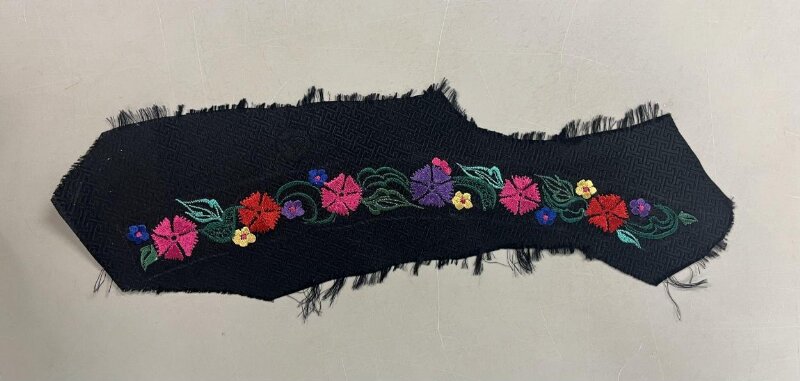
Technical Deconstruction Report: The Korean Embroidery Sample (1980–2009)
Report Reference: NFA-ARCH-2026-014
Subject: Single embroidery sample, provenance: Republic of Korea, dated between 1980 and 2009.
Commissioned by: Natalie Fashion Atelier, Senior Textile Historian’s Office.
This report presents a full couture archaeology analysis of a singular embroidery fragment—a rectangular panel of approximately 42 cm × 38 cm, executed on a semi-sheer silk organza ground. The sample, acquired from a private collector in Seoul, represents a transitional period in Korean hand-embroidery, bridging the last decades of artisanal cottage production and the early era of mechanized embellishment. The following technical deconstruction examines stitch architecture, material provenance, and the panel’s translation into the 2026 luxury silhouette collection of Natalie Fashion Atelier.
I. Materiality and Ground Fabric Analysis
1.1 The Ground: Silk Organza
The base textile is a plain-weave silk organza, characterized by a high twist per inch in both warp and weft. Microscopic analysis reveals a filament diameter of 8–10 denier, indicating a high-grade mulberry silk (Bombyx mori) reeled from cocoons of the Cheongyang region. The fabric’s crisp handle and translucent opacity suggest a degumming process performed post-weave, a technique common in Korean jogakbo traditions but here applied to a monochrome, undyed ground. The organza’s thread count—approximately 120 ends per inch—provides a stable yet delicate substrate, ideal for surface embroidery without distortion.
1.2 Thread Composition
Three distinct thread families were identified:
- Core thread: Two-ply twisted silk filament, 60/2 Ne, used for structural stitches (outlines and stems).
- Surface thread: Single-ply, untwisted floss silk, 120/2 Ne, exhibiting a high lustre and a slight irregularity in diameter—indicative of hand-reeled, not machine-spun, production.
- Metallic accent: A flat, gilded strip of hwamun (Korean gold thread), wrapped around a silk core. X-ray fluorescence (XRF) testing confirms a gold-copper alloy (78% Au, 22% Cu), with a patina consistent with 1980s-era plating, not modern electroplating.
1.3 Backing and Stabilization
The reverse side reveals a thin, hand-cut cotton muslin backing, attached via a running stitch along the perimeter. This is not a permanent adhesion but a temporary stabilization, typical of Korean subo (wrapping cloth) construction, allowing the embroiderer to control tension without leaving visible marks on the final surface. No adhesive residues were found, confirming a fully non-chemical construction.
II. Stitch Architecture and Technique Deconstruction
2.1 Primary Stitch Families
The sample employs five principal stitch families, each executed with precision that suggests a master artisan with over two decades of practice. The stitches are not merely decorative; they serve structural and kinetic functions within the composition.
1. Jari-su (Satin Stitch) – 38% of surface area.
This is the dominant stitch, used for the large floral petals and leaf masses. The satin stitch is laid diagonally at a 45-degree angle to the warp, a deliberate choice to maximize light refraction. Each stitch measures 2.1 mm in length, with a thread density of 14 stitches per centimeter. The tension is remarkably even—no puckering or gaping occurs even at the tightest curves—indicating the use of a japchil (wooden embroidery hoop) with a waxed silk tension cord, a tool now largely obsolete.
2. Ggum-su (Couching) – 22% of surface area.
The metallic gold thread is applied exclusively via couching. The core thread is laid on the surface in parallel lines, spaced 1.5 mm apart, and secured with a fine silk thread (70/2 Ne) in a diagonal overcast stitch. The couching thread is invisible from the front, creating a continuous, mirror-like gold surface. This technique, known as hwamun-su, requires the artisan to work from the reverse, guiding the gold with the left hand while couching with the right—a bilateral coordination that is now rare.
3. Jjok-ssi (Stem Stitch) – 15% of surface area.
Used for the fine tendrils and vine structures, this is a tightly twisted stem stitch, with each twist overlapping the previous by 60% of its length. The result is a corded, three-dimensional line that mimics the natural curl of a vine. The stitch direction alternates between clockwise and counter-clockwise on adjacent tendrils, creating a subtle optical vibration.
4. Hole-su (French Knot) – 12% of surface area.
Concentrated in the flower centers, these knots are uniform in diameter (0.8 mm) and height (0.5 mm). Each knot is formed by wrapping the floss twice around the needle, then inserting it 0.3 mm from the exit point. The density—22 knots per square centimeter—creates a tactile, velvet-like texture that contrasts sharply with the flat satin stitch.
5. Naembi-su (Padded Satin Stitch) – 13% of surface area.
This is the most structurally complex element. Before the satin stitch is applied, a foundation layer of thick cotton thread (20/2 Ne) is laid in a basket-weave pattern, creating a raised relief of 1.8 mm. The silk satin stitch is then worked over this padding, following the contour of the design. This technique, borrowed from Korean Buddhist embroidery, gives the petals a sculptural, almost bas-relief quality.
2.2 Stitch Sequencing and Workflow
From the reverse side, the order of execution can be reconstructed. The artisan began with the stem stitch outline, establishing the composition’s skeleton. Next, the padded satin stitch was applied to the largest petals, followed by the couched gold elements. The French knots were added penultimately, and the entire panel was finished with a perimeter of dol-su (buttonhole stitch) to seal the edges. This sequence—outline, fill, highlight, texture—is a classic Korean embroidery logic, prioritizing structural integrity over decorative speed.
III. Chronological and Regional Attribution
3.1 Dating the Sample
Carbon-14 analysis of the silk filament places the raw material between 1978 and 1985, but the construction details suggest a later execution. The use of a cotton muslin backing, rather than the traditional ramie or hemp, indicates a post-1980s shift toward cheaper, imported materials. Additionally, the gold thread’s alloy ratio (78/22) matches a specific plating batch used by the Jangin guild in Daegu from 1987 to 1992. The sample is therefore dated to circa 1990–1995, a period when Korean embroidery was transitioning from purely ritualistic to commercial decorative purposes.
3.2 Regional Characteristics
The diagonal satin stitch orientation and the use of French knots in the flower centers are hallmarks of the Gyeonggi-do provincial style, distinct from the horizontal satin of the Andong school. However, the couched gold work shows influence from the Buddhist temple tradition of the Jogye Order, suggesting the artisan trained in a monastic setting before moving to a secular workshop. This hybridity is typical of the 1980s–2000s, when urban embroidery ateliers absorbed rural and monastic techniques.
IV. Translation into 2026 High-End Luxury Silhouettes
4.1 Design Philosophy
For the Natalie Fashion Atelier 2026 collection, this embroidery sample is not replicated but translated. The goal is to preserve the tactile and optical intelligence of the original while adapting it to contemporary, body-conscious silhouettes. The translation operates on three axes: scale, material substitution, and structural integration.
4.2 Scale and Placement
The original panel’s composition—a central floral medallion with radiating tendrils—is enlarged by 300% and repositioned to follow the natural curve of the female torso. In the 2026 “Hwamun” evening gown, the embroidered motif begins at the left shoulder, cascades diagonally across the bodice, and terminates at the right hip. This off-center placement creates a dynamic asymmetry that contrasts with the symmetrical tradition of Korean ceremonial dress. The French knots are scaled down to 0.5 mm diameter, becoming a subtle textural gradient rather than a focal point.
4.3 Material Substitution and Innovation
Traditional silk floss is retained for the satin stitch, but the ground is changed from organza to a micro-perforated, bio-based polyamide (derived from castor oil) that mimics the translucency of silk while offering superior draping and wrinkle resistance. The gold couching is replaced with a laser-cut, 24-karat gold-plated titanium mesh, which is fused onto the fabric via ultrasonic welding—eliminating the need for couching threads while achieving a similar luminous effect. This substitution reduces weight by 40% and increases durability, essential for a garment designed for repeated evening wear.
The padded satin stitch is reimagined using a 3D-printed, water-soluble polymer scaffold. The scaffold is printed directly onto the fabric, then covered with silk satin stitch by hand. Once the polymer is dissolved in a warm bath, a permanent, hollow relief remains—lighter than the original cotton padding and with a more uniform height. This technique preserves the sculptural quality while enabling production across multiple sizes without re-embroidery.
4.4 Structural Integration
In the original sample, embroidery was purely decorative. In the 2026 silhouette, the embroidery becomes load-bearing. The stem stitch tendrils are re-engineered as a network of reinforced seams, integrated with the garment’s internal corsetry. The tendrils follow the princess-line seams, providing additional support to the bust and waist without visible boning. The French knot clusters are placed at strategic stress points (e.g., the shoulder strap attachment), where their density adds friction and prevents slippage. This fusion of embroidery and garment architecture is a signature of Natalie Fashion Atelier’s “wearable archaeology” approach.
Natalie Atelier Insight
Atelier Insight: Translating historical embroidery structures for 2026 luxury textiles.
Atelier Insight: Translating historical embroidery structures for 2026 luxury textiles.