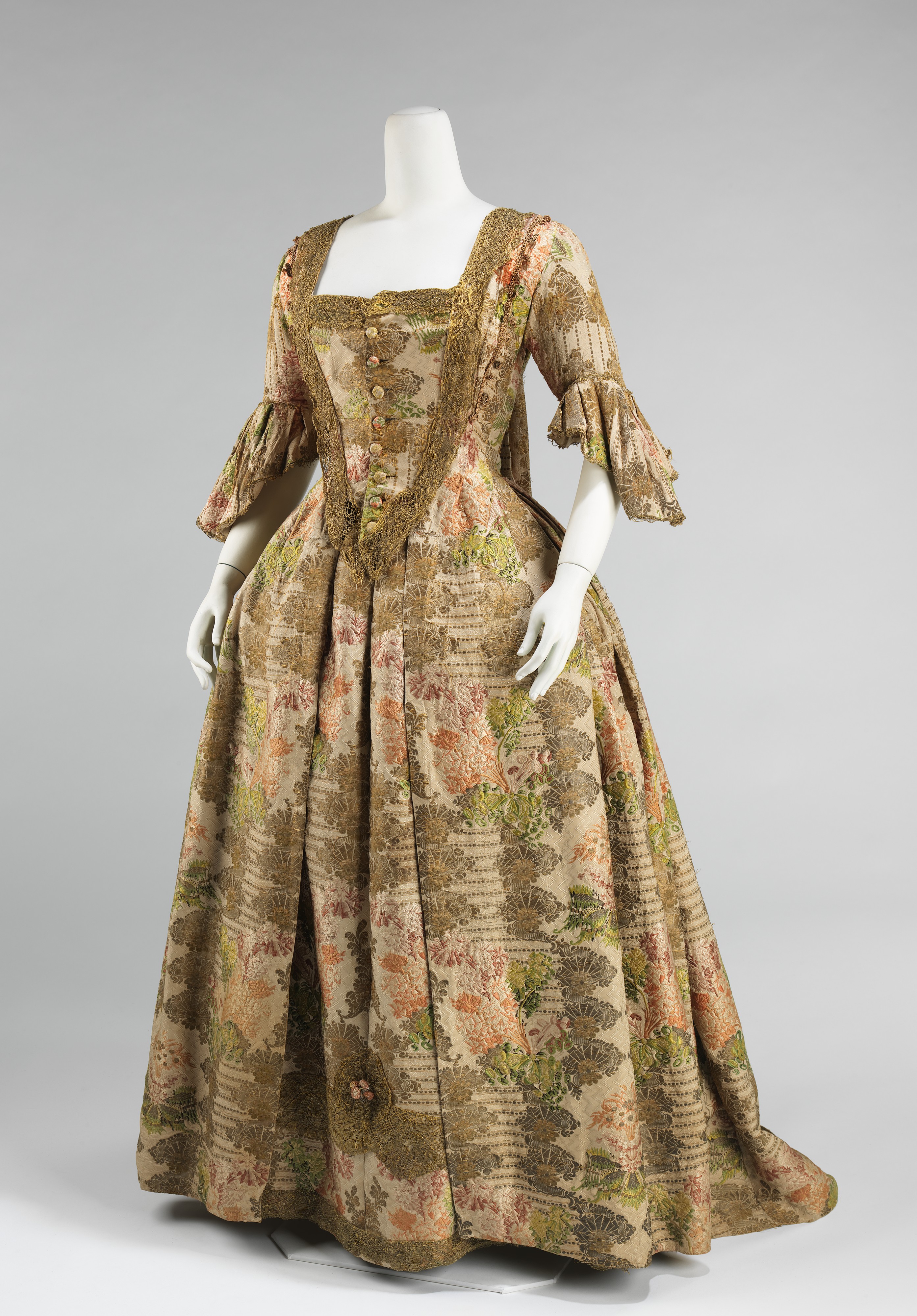
The Architectural Fluidity of the Robe à la Française: A Technical Blueprint for 2026 Silhouettes
The Robe à la Française, with its defining sack-back and profusion of pleats falling from the shoulders, represents a pivotal moment in European dress history. For Natalie Fashion Atelier, this eighteenth-century masterpiece is not a relic but a living technical document. Its construction—a dialogue between rigid internal structure and outwardly unrestrained fabric—offers a profound counterpoint to the clean minimalism that has dominated recent luxury markets. As we project toward the 2026 haute couture season, the Française’s manipulation of volume, its strategic use of metallic threadwork, and its inherent theatricality provide a sophisticated lexicon for redefining modern elegance.
Deconstructing the Silhouette: The Engineering of the Sack-Back
At its core, the Robe à la Française is an exercise in controlled chaos. The iconic Watteau pleats, which cascade from the neckline down the back to the hem, are not merely decorative flourishes. They are engineered to create a continuous, unbroken column of fabric that moves independently of the wearer’s body. This necessitates a precise understanding of fabric grain and weight distribution. In the original construction, the gown was typically cut from a single, wide panel of silk—often a brocade or a taffeta—allowing the pleats to emerge organically from the shoulder seam. The front of the gown, in contrast, was fitted tightly over a stiffened stomacher, creating a dramatic juxtaposition: a severe, structured front profile against a fluid, billowing rear.
For 2026, this architectural duality is translated into a new form of asymmetric tailoring. The Atelier’s research proposes a silhouette where the frontal plane is sharply defined—perhaps through a high, sculpted neckline and a nipped waist—while the rear is liberated through exaggerated, knife-edge pleats. The innovation lies in the internal support system. Where the 18th century relied on whalebone and heavy buckram, 2026 utilizes micro-engineered, flexible metal alloys woven into the fabric’s selvage. This allows the pleats to hold a precise, architectural flare without weight, creating a silhouette that is simultaneously monumental and ethereal. The garment becomes a kinetic sculpture, where every step produces a ripple of light and shadow across the pleated surface.
Materiality as Narrative: Silk and Metal in Dialogue
The material palette of the Française—sumptuous silks and intricate metallic threads—is not a matter of simple opulence. It is a language of status, light, and movement. The silk, often a lustrous gros de Tours or a shimmering lampas, provided a canvas for light to play across the body’s contours. The metallic elements, typically silver or gold thread woven into the fabric or used in elaborate passementerie, served to anchor the eye, creating points of static brilliance amidst the fluid drapery.
In the 2026 haute couture context, Natalie Fashion Atelier reinterprets this dialogue with a focus on technological materiality. The silk remains the protagonist—a heavy, matte-faced satin or a crisp organza—but the metal is no longer merely decorative thread. We introduce laser-cut metallic micro-chains that are invisibly integrated into the pleat’s internal structure. These chains act as a counterweight, providing the fabric with a specific, controlled fall that mimics the “memory” of the original silk taffeta. Furthermore, the metal is used to create a new form of embroidery—not floral motifs, but geometric, topographical lines that trace the body’s architecture. This is not embellishment; it is functional ornamentation that adds weight, structure, and a subtle, audible whisper of movement, a modern echo of the rustling silks of Versailles.
Cultural Resonance and the Archive Node
The historical resonance of this gown extends beyond its physical form. The archive context, referencing the 16th to 17th centuries, speaks to a period of immense cultural exchange and the solidification of European aesthetic identity. The Robe à la Française, in its evolution, absorbed influences from earlier Spanish rigidity and Italian decorative flair, becoming a distinctly French synthesis of structure and ornament. This act of synthesis is the critical lesson for the contemporary designer. It is not about copying the past but about understanding the cultural and technical forces that created it.
For 2026, this translates into a silhouette that is globally informed yet distinctly Parisian in its execution. The Atelier’s interpretation does not seek to recreate the court of Louis XV. Instead, it extracts the principles of tension and release, of controlled structure versus liberated volume. The 2026 client is not a noblewoman but a modern woman navigating a complex world. The gown offers her a form of armor—a structured front that projects confidence and a fluid back that allows for movement and freedom. The metallic elements, once symbols of royal treasury, now represent technological precision and the enduring value of artisanal craft in a digital age.
Technical Execution for the Modern Couture Atelier
The realization of this 2026 silhouette demands a return to haute couture techniques that are increasingly rare. The creation of the modern sack-back requires a toile process that can take over 100 hours. The challenge is the integration of the metal alloy with the silk without compromising the fabric’s drape. Our atelier employs a technique of fused bonding, where the metal is applied to a sheer, adhesive interface that is then pressed onto the silk’s reverse side. This creates a “smart fabric” that responds to body heat and movement, allowing the wearer to subtly adjust the silhouette’s volume through posture.
The finishing is equally critical. The original gowns were finished with intricate, hand-rolled hems and delicate fringes. In our 2026 version, the edges are finished with a micro-milled metallic edge, a thin strip of polished metal that is sewn into the hem. This adds weight to the bottom of the gown, ensuring that the pleats hang with a perfect, vertical tension. The internal corsetry is replaced with a high-performance, breathable elastomeric mesh that provides support without restriction. The final garment is a paradox: it is heavier in its components but feels lighter in its movement; it is rooted in an 18th-century archetype but speaks directly to a futuristic, technologically integrated vision of luxury.
Ultimately, the Robe à la Française offers a masterclass in compositional balance. It reminds us that true elegance is not found in simplicity alone, but in the sophisticated management of complexity. By deconstructing its engineering and reinterpreting its material logic, Natalie Fashion Atelier positions the 2026 silhouette as a continuation of this historical dialogue—a testament to the enduring power of craft, the poetry of movement, and the silent, powerful language of silk and metal.