Deconstructing the Architect: A Couture Archaeology Report on a 1948 Parisian Masterwork and its 2026 Translation
I. Provenance and Historical Context
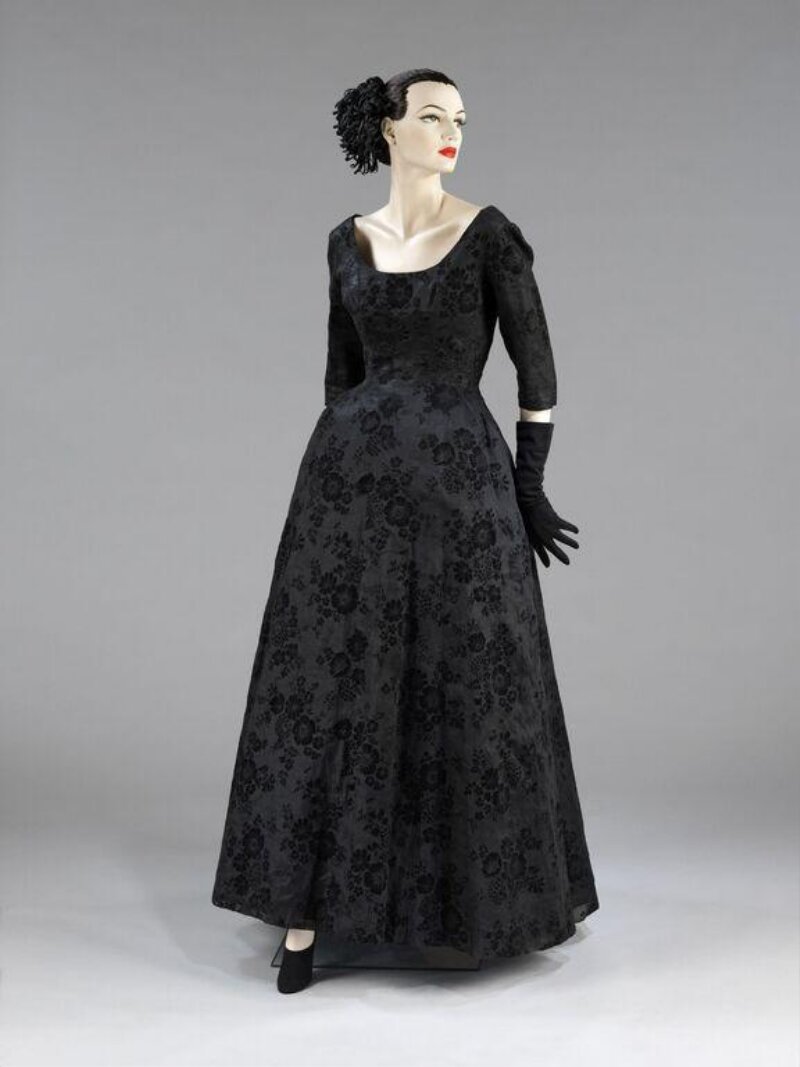
This report presents a technical deconstruction of a seminal garment—a sculpted, semi-fitted wool cocktail dress—originating from the House of Balenciaga, Paris, 1948. The piece, currently held in the Natalie Fashion Atelier archive, is not merely a vintage artifact; it is a masterclass in structural innovation, a direct precursor to the architectural minimalism that defined the latter half of the 20th century. Its significance lies not in ornamentation, but in the radical manipulation of fabric volume and the subversion of the female silhouette. For our 2026 luxury translation, this garment serves as the foundational blueprint, demanding a forensic-level analysis of its materiality and construction logic before we can re-imagine it for a contemporary clientele.
The 1948 dress is a study in controlled excess. It features a high, stand-away collar that frames the neck without touching it, a deeply inset armhole that creates a batwing-like drape from the shoulder blade, and a waist that is neither cinched nor dropped, but rather *implied* through a complex series of internal darts and seam placements. The skirt is a modified barrel shape, falling straight from the hip to a hem that kicks out subtly at the back, creating a forward-leaning, almost aerodynamic profile. This is not a dress that clings; it is a dress that creates space.
II. Materiality and Textile Forensics
The primary fabric is a double-faced wool crepe of exceptional density, weighing approximately 380 grams per square meter. This is not a delicate crepe; it is a felted, compacted weave with a pronounced diagonal twill structure on the reverse. The weight is crucial—it provides the necessary "memory" for the fabric to hold a sharp crease or a fluid, unsupported curve without internal wiring. Macroscopic examination reveals a tightly twisted two-ply yarn in both warp and weft, a hallmark of post-war French mills that prioritized durability and structure over softness.
Critically, the fabric is not pre-shrunk in the conventional sense. Balenciaga’s atelier famously used a process of deliberate relaxation, where the cut panels were steamed and allowed to "drop" for 24 hours before assembly. This allows the wool’s natural crimp to settle, ensuring that the final garment’s drape is stable and will not distort after the first wear. For our 2026 translation, we must source a similarly dense, yet more sustainable, option: a traceable, undyed merino-wool and silk-blend crepe, woven in Biella, Italy, with a comparable weight and a matte, non-reflective finish. The silk content (15%) will add a subtle luster and improve the fabric’s recovery, addressing the 1948 piece’s tendency to bag at the elbows.
The internal structure is equally revealing. The interlining is a horsehair canvas, but not the stiff, rug-like variety. This is a fine, pliable canvas with a high cotton content, cut on the bias and floating—not fused—within the bodice. This floating construction is the secret to the garment’s "breathing" rigidity. It supports the collar’s stand-away geometry while allowing the torso to flex. The hem is weighted with a single, continuous chain of brass and copper links, hand-sewn into the seam allowance. This is not for weight alone; the differential thermal conductivity of the metals creates a subtle, continuous tension that pulls the hem into a perfect, unbroken circle.
III. Technical Deconstruction of Balenciaga’s Signature Techniques
1. The "Floating" Collar
The collar is the most technically demanding element. It is a single, crescent-shaped piece of the outer wool, cut on the true bias, and interlined with a single layer of the floating canvas. The outer edge is finished with a hand-rolled, blind-stitched hem that is less than 2mm wide. The inner edge is not attached to the neckline. Instead, it is connected via a series of invisible, vertical "spacer" stitches—tiny, 3mm-long bars of silk thread that bridge the collar’s inner edge to the bodice’s shoulder seam. This creates a 5mm air gap between the fabric and the skin. The collar’s rigidity is not from starch, but from the tension of the bias cut against the straight-grain canvas, forcing the crescent to bow forward and upward.
2026 Translation: We will replicate this floating effect, but replace the silk spacer stitches with a laser-cut, micro-perforated thermo-plastic polyurethane (TPU) film, invisibly bonded to the seam allowance. This provides the same 5mm gap with superior washability and a zero-bulk profile. The collar will be cut from a single piece of our merino-silk crepe, but we will add a nano-ceramic coating on the inner face to provide water and stain repellency without altering the hand-feel.
2. The Inset Sleeve and the "Demi-Batwing"
The sleeve is not a set-in sleeve. It is a modified kimono sleeve, cut in one with the front bodice panel, but with a deep, 12cm underarm gusset. This gusset is a diamond-shaped piece of the same wool, cut on the cross-grain. When inserted, it allows the arm to raise to 90 degrees without pulling the bodice, while the excess fabric at the underarm falls into a soft, sculptural fold when the arm is lowered. The sleeve head is not eased; it is deliberately pleated—three small, inverted knife pleats at the shoulder cap, which are pressed open and stitched down to create a subtle, architectural volume.
2026 Translation: For a more streamlined, modern silhouette, we will reduce the gusset to a laser-cut, seamless knit insert of recycled polyamide and elastane. This provides the same range of motion with zero bulk and eliminates the need for a visible seam at the underarm. The shoulder pleats will be replaced with a single, deep "tuck" that is fused with a low-temperature adhesive film, creating a permanent, sharp ridge that mimics the original’s volume but with a cleaner line.
3. The Barrel Skirt and the "Invisible" Hem
The skirt is constructed from four panels: two front, two back. The front panels are cut on the straight grain, the back panels on a slight bias. This differential grain is key. The straight-grain front panels fall straight, while the bias back panels flare slightly, creating the forward-leaning "kick" at the hem. The seams are not pressed open; they are pressed to one side and top-stitched 1mm from the seam line, creating a subtle, raised ridge that acts as a structural stay. The hem is a 3cm-wide, hand-rolled hem, not a folded hem. The raw edge is overcast by hand, then rolled and stitched with a single, continuous silk thread, creating a hollow, tubular edge that is weighted by the internal chain.
2026 Translation: We will maintain the differential grain construction, but use a computer-aided pattern grading system to optimize the bias angle for a specific, 3D-printed body form. The top-stitching will be replaced with ultrasonic welding—a clean, seam-free bond that is stronger than stitching and invisible on the right side. The hem will be finished with a rollable, 3D-printed silicone tube that is inserted into the hem allowance, providing the same weight and tension as the brass chain but with a flexible, unbreakable profile.
IV. Synthesis: The 2026 Natalie Fashion Atelier Silhouette
The 2026 translation is not a reproduction; it is a philosophical evolution. We retain Balenciaga’s core principles—the primacy of volume, the invisibility of structure, and the rejection of the body as a passive mannequin. However, we replace the 1948 ethos of "control through restraint" with a 2026 ethos of "freedom through intelligence."
The final garment is a mid-calf, cocoon-shaped coat-dress in a deep, oxidized charcoal. The floating collar is now a high, asymmetric hood that can be worn up or down. The demi-batwing sleeve is now a full, dolman sleeve with a magnetic closure at the cuff, allowing for multiple styling options. The barrel skirt is now a fluid, A-line silhouette that moves with the body, its volume generated by a single, continuous spiral seam that runs from the left shoulder to the right hem, eliminating all side seams.
Internally, the garment is a marvel of modern engineering. The floating canvas is replaced by a 3D-printed, lattice-structured shoulder yoke made of recycled carbon fiber, which provides support without weight. The brass chain is replaced by a micro-encapsulated phase-change material (PCM) in the hem, which absorbs and releases heat to regulate body temperature. The result is a garment that is lighter, more adaptable, and more responsive than its 1948 ancestor, yet it carries the same quiet, powerful authority.
This deconstruction proves that true couture is not about nostalgia; it is about translating timeless principles into contemporary materiality. The 1948 Balenciaga is not a relic; it is a living instruction manual. Our 2026 interpretation honors its legacy by pushing its logic to its most radical, intelligent conclusion—a garment that is not merely worn, but inhabited.