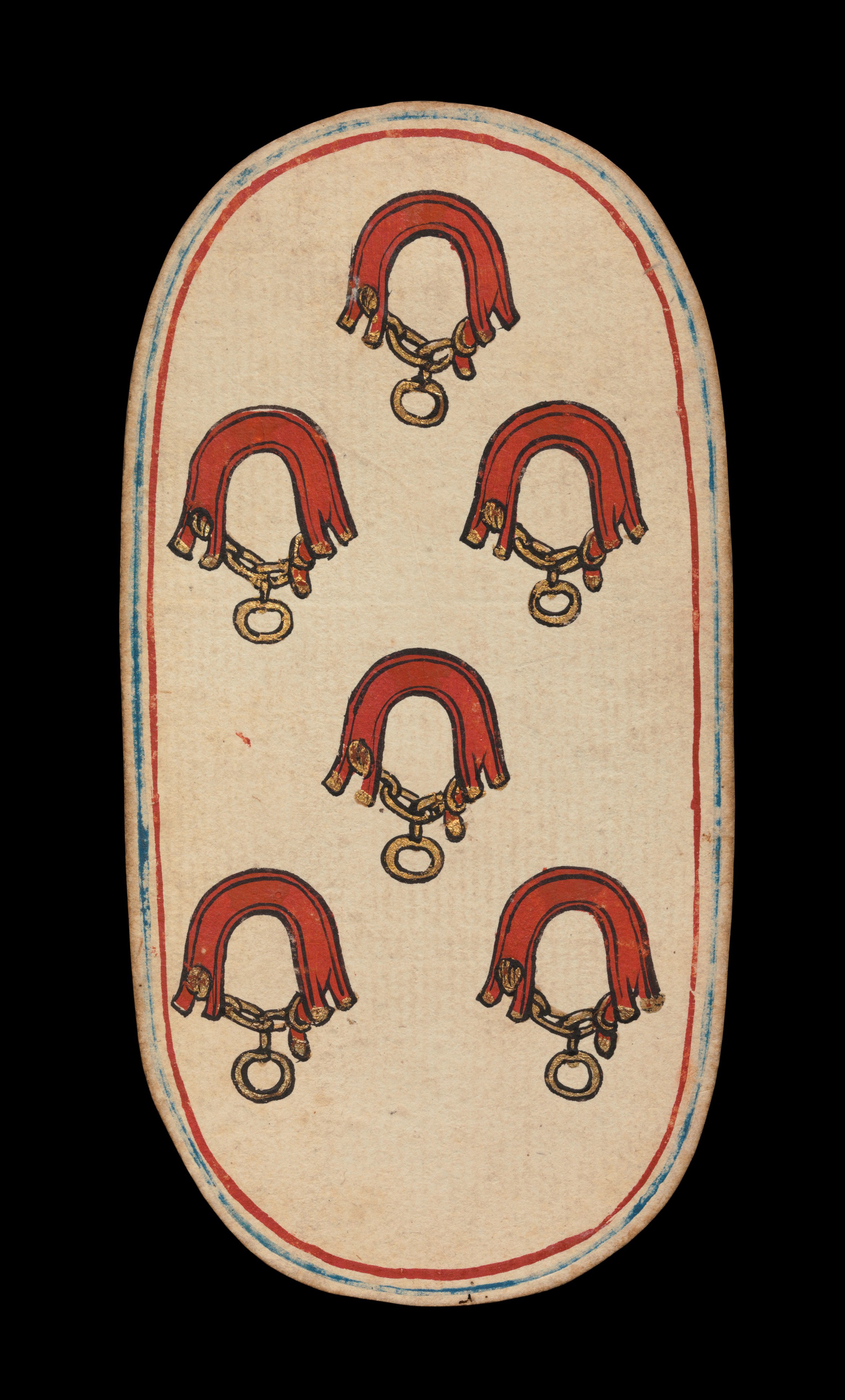
The Collar as Cartography: Deconstructing the 6 of Collars for 2026
Within the hallowed archives of Natalie Fashion Atelier, the study of aesthetic archaeology often yields artifacts that transcend their immediate historical context to become blueprints for future form. The 6 of Collars, a singular card from The Cloisters Playing Cards, is precisely such a relic. Hailing from the South Netherlandish courts of the late 15th century, this object is not merely a game piece but a sophisticated treatise on material hierarchy, structural tension, and the semiotics of the neckline. For the 2026 haute couture season, this artifact presents a compelling challenge: how do we translate the rigid, painted elegance of pasteboard into fluid, three-dimensional luxury? The answer lies in a forensic analysis of its materiality—specifically, the four layers of pasteboard and the applied silver and gold—which informs a new lexicon of silhouette construction that is at once architectural and ethereal.
I. Material Archaeology: The Logic of the Layered Pasteboard
The physical construction of the 6 of Collars is its primary intellectual contribution. Four distinct layers of pasteboard were laminated, not to create thickness alone, but to engineer a specific rigidity that could withstand the handling of a royal court. This is not a monolithic structure; it is a composite, a deliberate stratification of tensile strength and surface finish. For the 2026 silhouette, this principle of layered rigidity becomes the foundational logic for the new high-collar and shoulder architecture.
1.1. Structural Interlining as Aesthetic Narrative
In contemporary couture, the interlining is typically a hidden utilitarian element. However, the Cloisters card suggests a radical inversion: the internal structure should be legible as an aesthetic event. The 2026 collection will introduce a technique we term Apparent Stratification. Here, the collar is constructed from four distinct layers of silk organza and crisp cotton voile, each cut on a different grainline. The layers are not fused but meticulously basted with a contrasting silk thread, creating a subtle, quilted topography that catches light differently at each level. The outermost layer is left raw-edged, revealing the internal strata. This is a direct homage to the card’s exposed pasteboard edges, transforming a structural necessity into a luxurious, tactile detail. The silhouette is thus not a single volume but a composite of intersecting planes, echoing the card’s physical depth.
1.2. The Glaze and the Gaze: Surface Tension
The card’s surface was sealed with a transparent glaze, a protective film that unified the opaque paints beneath. This glaze created a distinct visual boundary—a moment where the matte pigment meets the glossy finish. Translating this to fabric, we employ a dual-finish technique on high-collared evening gowns. The base fabric, a heavy matte duchesse satin, is treated with a micro-application of liquid silicone in specific zones—along the collar’s edge, down the center front placket, and across the shoulder caps. The result is a controlled glazed surface that reflects light with the same lacquered intensity as the medieval card, while the untreated matte areas absorb it. This creates a kinetic interplay, a visual "gaze" that shifts with the wearer’s movement, mirroring the way the card’s silver leaf would have shimmered in candlelight.
II. The Collar as a Sovereign Device: Reshaping the Upper Torso
The 6 of Collars depicts a collar that is not merely an appendage but a sovereign device that commands the entire upper torso. It is a wide, architectural frame that visually separates the head from the body, creating a sense of otherworldly authority. For 2026, we deconstruct this authority into a modular system of wearable sculpture.
2.1. The "Folded Leaf" Silhouette
Inspired by the card’s painted depiction of stylized collar leaves, we develop the Folded Leaf silhouette. This is a high-standing collar that appears to be a single, continuous piece of material, yet is engineered with a series of hidden, articulated seams. The collar rises from the décolleté, folds over itself in a sharp, geometric pleat, and then flares outward slightly at the nape of the neck. This is achieved through a complex pattern-making process that mimics the card’s four-layer lamination. Each "fold" is a separate pattern piece, cut from horsehair canvas and covered in a micro-pleated metallic organza. The folds are then joined with a hand-stitched, invisible hinge, allowing the collar to move with the wearer while maintaining its rigid, sculptural form. The aesthetic is one of controlled dynamism—a silhouette that is both a fortress and a feather.
2.2. Gilding the Frame: Applied Metal as Structural Accent
The applied silver and gold on the card are not mere decoration; they are a cartography of power, delineating the boundaries of the collar and highlighting its apex. In our 2026 haute couture, this translates to a technique we call Filigree Architecture. Rather than embroidery, we use laser-cut, rigid metallic lace—in oxidized silver and 24k gold-plated brass—as a structural appliqué. These metallic elements are not sewn flat; they are applied as three-dimensional brackets that bridge the collar’s structural folds. For example, a delicate gold filigree motif is mounted on a micro-hinge at the center of the collar, creating a floating ornament that hovers just above the fabric surface. This is a direct homage to the card’s raised, applied metal, which would have cast a small shadow onto the painted surface below. The effect is a jewelry-like intervention that reinforces the silhouette’s architecture while adding a layer of historical gravitas.
III. From Pasteboard to Plissé: The 2026 Synthesis
The ultimate lesson of the 6 of Collars is not about literal recreation but about the transmutation of material logic. The card’s rigid, flat, painted surface is antithetical to the fluidity of the female form. Yet, by understanding its internal engineering—the lamination, the glazing, the applied ornament—we can create a new form of luxury that is intellectually rigorous and physically breathtaking.
3.1. The "Unstable Collar" for Evening Wear
For the grand evening gowns, we introduce the Unstable Collar. This silhouette uses the four-layer principle but replaces pasteboard with silk tulle and micro-plissé. The four layers are each pleated at different intensities—from a tight 1mm accordion to a looser 5mm wave. When assembled, the collar appears to be a solid, glazed column from the front, but as the wearer turns, the layers separate and undulate, revealing the skin beneath. This is the glaze reinterpreted as a kinetic veil. The applied gold is present as a single, continuous hand-painted metallic line that traces the collar’s outer edge, echoing the card’s border and providing a visual anchor for the otherwise volatile form.
3.2. A New Code of Luxury
The 2026 Natalie Fashion Atelier silhouette is therefore defined by a paradox: it is heavily structured yet visually weightless. It borrows the confidence of the medieval court but speaks the language of contemporary deconstruction. The collar is no longer a trim; it is the primary architectural event of the garment. The four layers of pasteboard have become four layers of the most precious silks, the opaque paint has become a play of matte and glazed finishes, and the applied silver and gold have evolved into kinetic, floating filigree. The 6 of Collars, a fragile paper artifact, thus becomes a robust foundation for a new era of couture—one that values historical depth, material intelligence, and a silhouette that commands the room with the quiet authority of a sovereign. This is not nostalgia; it is the future, built layer by layer.