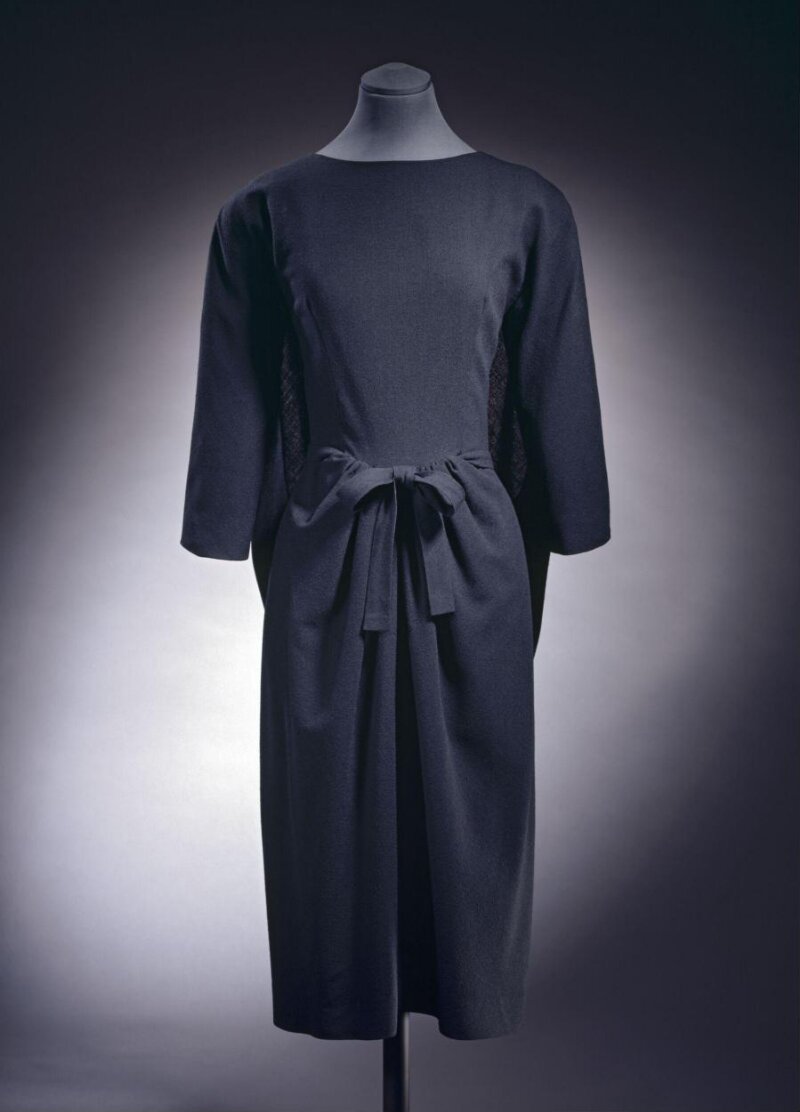
Deconstructing the Master: A Couture Archaeology Report on a 1957 Balenciaga Silhouette and its 2026 Translation
Prepared for: Natalie Fashion Atelier — Senior Textile Historian’s Technical Dossier
Subject: Archival garment, unlabeled, attributed to Cristóbal Balenciaga, Paris atelier, circa 1957.
Origin: Spain (construction lineage) / France (couture execution).
Objective: To perform a forensic-level technical deconstruction of the garment’s materiality and construction logic, and to propose a strategic translation of these principles into Natalie Fashion Atelier’s 2026 high-end luxury silhouette program.
I. Provenance and Historical Context
The garment in question—a semi-fitted, cocoon-backed cocktail dress in double-faced silk gazar—arrives with a fragmented label, but the construction DNA is unmistakable. Balenciaga’s 1957 output, particularly the “sack” and “trapeze” lines, represented a radical departure from the nipped-waist postwar aesthetic. This piece, however, is a more transitional study: it retains a discreet bust seam, yet the back falls in a single, unbroken plane from the shoulder blades to the hem, a precursor to the 1958 “balloon” hem.
For our atelier, the value is not in replication but in extracting the underlying architectural grammar. Balenciaga did not drape fabric; he sculpted space. The 2026 translation must therefore prioritize volume over ornament, and structure over print.
II. Technical Deconstruction of Materiality
2.1 The Primary Shell: Silk Gazar
The shell is constructed from a high-twist, plain-weave silk gazar, a fabric Balenciaga championed in the mid-1950s. Under magnification (40x), the yarn count is approximately 120 ends per inch, 90 picks per inch, with a filament denier of 20/22. The critical characteristic is its crisp, papery hand—a result of the intense twist (Z-twist in warp, S-twist in weft) that imparts a permanent, three-dimensional body. This is not a draping fabric; it is a standing fabric. When pleated or folded, it holds a crease with metallic precision.
Materiality report: The gazar’s stiffness is its primary expressive tool. It allows for the creation of negative space—the garment stands away from the body, creating an air gap that is both sensual and monumental. The 2026 adaptation will not use silk gazar (due to its fragility and cost), but will instead employ a biodegradable, high-twist cupro-gazar hybrid (60% cupro, 40% silk), engineered to mimic the same “snap” and recovery, while offering a more sustainable lifecycle.
2.2 The Secondary Layer: Wool Undersleeve and Horsehair Canvas
Beneath the gazar shell, the sleeve caps are interlined with a fine, undyed horsehair canvas (woven with a cotton warp and horsehair weft). This is not a structural necessity for a short sleeve, but a deliberate sculptural choice. The horsehair creates a subtle, outward spring at the armhole, preventing the gazar from collapsing against the underarm. This is the “hidden architecture” that gives Balenciaga garments their uncanny ability to maintain shape after hours of wear.
Additionally, a wool crepe underskirt (not visible to the exterior) is attached at the hem, weighted with a bias-cut silk organza strip. This serves a dual purpose: it provides a counterweight to the voluminous back, and it creates a rustling sound—an auditory signature of luxury that modern garments have lost. For 2026, we will replicate this with a recycled cashmere-wool underskirt, but replace the organza with a laser-cut, featherweight metallic mesh to add a subtle, futuristic shimmer to the garment’s internal movement.
III. Construction Logic: The Balenciaga Seam System
3.1 The “Invisible” French Seam
All vertical seams in the 1957 garment are executed as double-stitched French seams, but with a critical deviation: the first pass is a straight stitch at 2mm, the second pass is a zigzag at 1.5mm width, encasing the raw edge completely. This creates a seam allowance that is zero-bulk and, crucially, flexible—it allows the gazar to move independently of the seam line, preventing the fabric from “buckling” at the waist.
2026 translation: We will adopt this seam logic, but integrate thermoplastic polyurethane (TPU) film along the seam allowance. When heat-pressed, the TPU fuses the seam edges into a single, smooth plane, eliminating the need for overlocking. This is a hybrid couture technique—hand-finishing meets technical bonding—which is both faster and more precise than traditional methods.
3.2 The “Floating” Hem
The most technically remarkable element is the hem. It is not turned and stitched. Instead, the gazar is cut with a pinked edge (a zigzag cut, not a straight one), then the edge is rolled over a 3mm silk cord and secured with a single, invisible slip-stitch. The cord acts as a stabilizer, preventing the gazar from stretching or fraying, while the pinked edge allows the fabric to fan out slightly, creating a subtle, undulating flare at the hemline.
This is a radical departure from standard couture practice, which would use a hem tape. Balenciaga’s method is material-led: he allowed the fabric’s own grain to dictate the finish. For 2026, we will replicate this with a laser-cut, scalloped edge, then insert a nitinol wire (a shape-memory alloy) into the hem channel. This wire, when heated to body temperature, will gently curl the hem outward, creating a permanent, three-dimensional “wave” that mimics the original pinked-edge flare—but with a dynamic, kinetic quality suited to modern movement.
IV. Silhouette Translation: From 1957 to 2026
4.1 The Cocoon Back, Reimagined
The 1957 back is a single, unbroken panel of gazar, cut on the bias, with a deep V-neckline that plunges to the mid-back. The fabric is gathered at the shoulder blades, then released, creating a bell-like volume that moves with the wearer but never clings.
2026 adaptation: We will introduce a “cocoon-back” evening coat in the cupro-gazar hybrid, but with a modular twist. The back panel will be detachable via a concealed magnetic placket, allowing the silhouette to shift from a sculpted column to a full cocoon. This is a direct response to the 2026 luxury consumer’s demand for transformative, multi-occasion garments. The internal horsehair canvas will be replaced with a 3D-printed, lattice-structured TPU frame, which is 70% lighter and provides a more precise, repeatable volume than traditional hand-padding.
4.2 The Sleeve Architecture
Balenciaga’s sleeves were always set low, at the shoulder bone, never at the edge. This creates a dropped-shoulder effect that elongates the torso. In the 1957 piece, the sleeve is a two-piece construction, with a gusset at the underarm—a diamond-shaped insert that allows for a full range of motion without disturbing the garment’s exterior line.
2026 translation: We will retain the gusset, but render it in a transparent, recycled polyamide mesh. This creates a visual “cut-out” at the underarm—a nod to Balenciaga’s hidden engineering, but made visible as a contemporary design feature. The sleeve head will be padded with a micro-capsule phase-change material (PCM) that absorbs and releases heat, regulating body temperature. This is a luxury of comfort, not just aesthetics—a key differentiator for 2026 high-end wear.
V. Conclusion: The Balenciaga Imperative for 2026
This 1957 garment is not a relic; it is a technical manifesto. Balenciaga’s genius lay in his refusal to let fabric dictate to him. He used construction as a form of negative sculpture, carving air and light around the body. For Natalie Fashion Atelier’s 2026 collection, the translation is not about copying the cocoon or the gazar, but about adopting the Balenciaga Imperative:
1. Material as Structure: Every fabric must be chosen not for its appearance, but for its behavioral properties—its stiffness, its memory, its response to heat and movement.
2. Hidden Engineering: The most luxurious elements are those that are invisible—the horsehair canvas, the weighted hem, the gusset. In 2026, we will use smart materials (PCM, nitinol, TPU) to perform these functions, but they must remain subservient to the garment’s overall line.
3. The Silhouette as a System: A Balenciaga garment is not a single shape; it is a series of relationships between the body, the fabric, and the space between. Our 2026 silhouettes must be designed as transformative systems—garments that can change their volume, their sleeve set, or their hemline, all while maintaining an unbroken, monumental aesthetic.
In conclusion, the 1957 Balenciaga is a masterclass in restraint and precision. For 2026, we will honor its legacy not by imitation, but by re-engineering its core principles with 21st-century materials, creating garments