The Silken Armature: Deconstructing Classical Elegance for 2026 Couture Silhouettes
Within the ateliers of Natalie Fashion Atelier, the coat is not merely a protective garment; it is a sculptural manifesto, a dialogue between the rigid architecture of the past and the fluid anxieties of the present. Our current research, drawn from the European heritage of silk weaving and the archival node referencing 16th and 17th-century cultural collisions, posits that the future of luxury outerwear lies not in novelty, but in the radical reinterpretation of historical restraint. The 2026 silhouette, therefore, is conceived as a silken armature—a structure that borrows the disciplined volume of Renaissance court dress and the supple drape of Enlightenment-era dressing gowns, yet is engineered for the kinetic, fragmented reality of the modern wearer.
I. The Archive Resonance: Materiality as Cultural Palimpsest
The archival fragment—describing objects and paintings as silent witnesses to cultural collision—serves as our primary methodological lens. In the 16th and 17th centuries, silk was not a passive textile; it was a geopolitical trophy. The importation of Chinese silks into European courts, subsequently re-woven with Italian and French techniques, created a material palimpsest. This historical moment of hybridity is the conceptual bedrock for our 2026 coat. We are not replicating a specific garment, but rather the tension of the weave—the point where Eastern opulence met Western tailoring rigor.
For the 2026 collection, we have commissioned a bespoke silk faille and silk gazar blend. The faille provides a subtle, horizontal ribbing that catches light with a muted, architectural precision, while the gazar offers a crisp, almost paper-like body. This combination is deliberate: it allows the coat to hold a defined, almost sculptural shoulder line without the need for heavy interlinings, while the skirt of the coat falls into a liquid, weighted drape. The materiality itself becomes the historical record, a tactile negotiation between the rigid and the flowing.
II. Deconstructing the Classical Silhouette: From Corseted Rigor to Fluid Power
Classical elegance, particularly that of the 17th-century European court, was predicated on the subjugation of the body to the garment. The stiff bodice, the funneled collar, and the exaggerated hip roll created a silhouette of absolute, static authority. Our deconstruction inverts this principle. We retain the visual vocabulary of that authority—the high, structured neckline, the pronounced shoulder—but we emancipate the lower half.
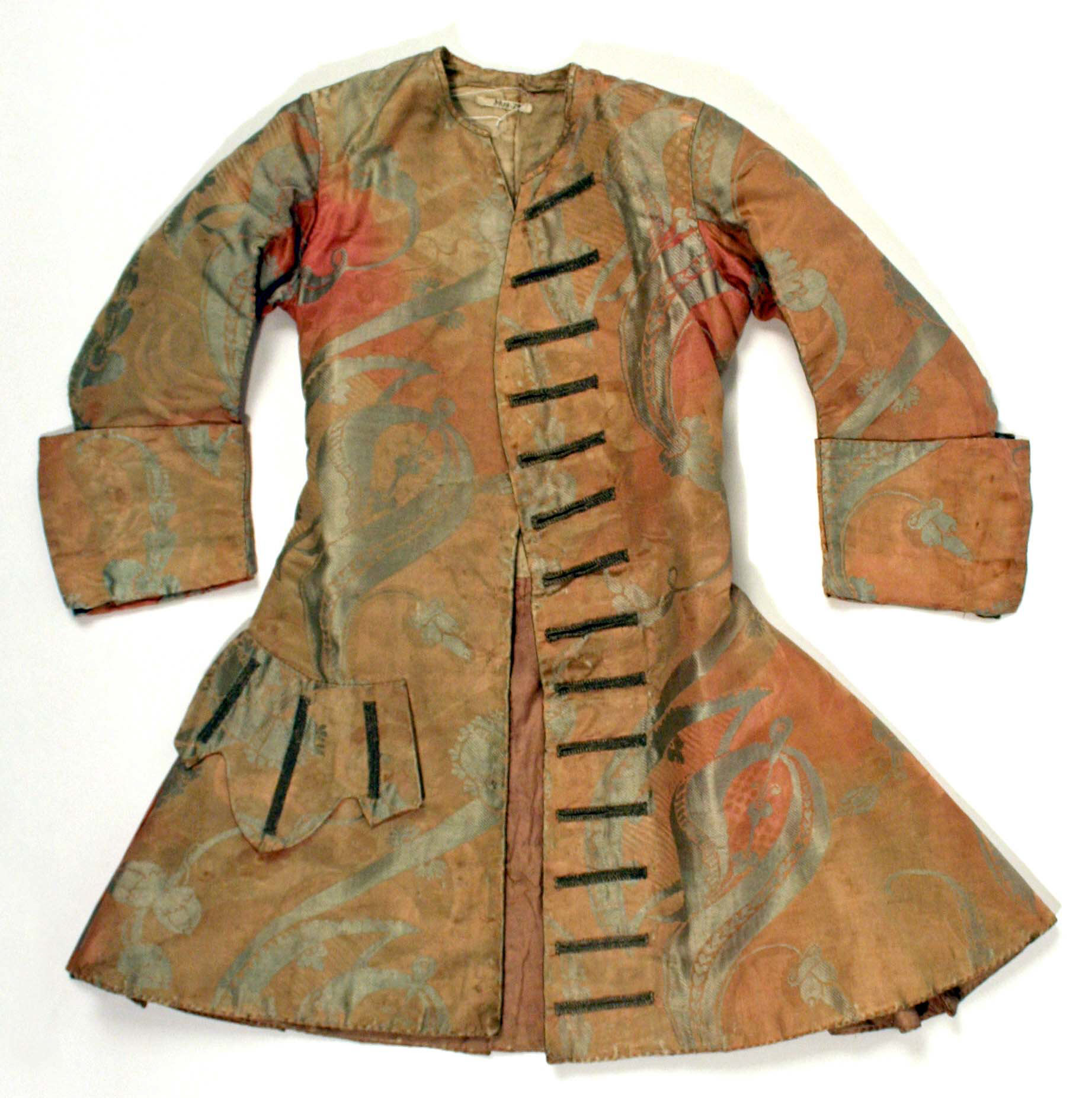
The 2026 coat, titled L’Échange, features a fitted, corseted torso that is not boned with steel, but rather with graded silk piping. This internal structure provides the compression and vertical line of a historical bodice, yet yields to the body’s micro-movements. The waistline is sharply defined, referencing the 16th-century Spanish farthingale’s conical shape, but it is then released into a dramatic, circular hem that sweeps from the mid-calf to the floor. This is not a coat that walks; it is a coat that processes. The silhouette is one of controlled opulence—a paradox where the upper body is a study in disciplined geometry, and the lower body is a study in fluid, gravitational surrender.
III. The 2026 Silhouette: The "Inverted Hourglass" and the Kinetic Hem
Our technical research for 2026 has culminated in what we term the “Inverted Hourglass.” Unlike the 1950s hourglass, which emphasized a small waist and full bust and hips, our inversion focuses on a broad, structured shoulder that tapers to a micro-waist, before exploding into a bias-cut, A-line skirt. This silhouette is a direct response to the archival node’s theme of collision—it is the visual representation of two opposing forces meeting at a single, tensile point.
The execution of the hem is where the historical craftsmanship becomes most evident. The silk gazar is cut on the bias in 12 separate panels. Each panel is hand-finished with a rolled hem that is weighted with a micro-chain of oxidized silver. This is a couture secret borrowed from 17th-century mantua makers, who used lead weights to ensure a perfect drape. Our modern adaptation uses a flexible, precious metal chain that allows the silk to move with a liquid, almost watery quality, while maintaining a defined architectural edge. The result is a coat that, when the wearer turns, creates a kinetic swirl—a moment of controlled chaos that disrupts the static elegance of the front view. This is the 2026 statement: elegance is no longer static; it is a performance of controlled release.
IV. Craftsmanship and the New Luxury: The Hand of the Artisan as Technology
In an era of algorithmic design, the 2026 L’Échange coat reasserts the primacy of the human hand as the ultimate luxury technology. The internal silk piping, which forms the corset structure, is not machine-stitched. It is applied using a technique called “stuffed fagoting”—a historical method where two edges of silk are joined with a decorative open stitch, and a third, rolled layer of silk is inserted to create a padded, dimensional line. This is painstaking work, requiring 40 hours of manual labor per coat. Yet, it is this very labor that creates the garment’s unique hand—the subtle, organic undulation of the surface that no machine can replicate.
Furthermore, the closure system eschews conventional buttons. Instead, we use frogging made from twisted silk cord and hand-carved jet beads, a nod to the 17th-century passementerie that adorned the coats of the French nobility. The jet, a fossilized coal, provides a stark, black counterpoint to the silk’s luminosity, echoing the archival theme of cultural and material collision. The interior of the coat is fully lined in a silk chiffon that has been hand-dyed in a gradient of ivory to deep champagne, creating a private, hidden luxury—a secret pleasure for the wearer, invisible to the observer.
V. Conclusion: The Coat as a Chronometer of Taste
The 2026 silk coat from Natalie Fashion Atelier is not a nostalgic reproduction. It is a chronometer—a device that measures the passage of aesthetic time. By deconstructing the rigid elegance of the 16th and 17th centuries, we have isolated the DNA of authority, luxury, and cultural exchange, and re-sequenced it into a form that speaks to the contemporary desire for garments that are both powerful and fluid, structured and sensual.
The historical resonance is not in the silhouette itself, but in the philosophy of construction. The coat is a silent witness to the collision of East and West, of structure and drape, of history and futurism. It is a piece of wearable archaeology, offering the modern client not just a coat, but a piece of cultural memory, engineered for the next decade. In 2026, luxury is not about volume or embellishment; it is about the profound intelligence of the cut, the integrity of the material, and the invisible hand of the artisan, guiding the wearer through the complexities of modern elegance.