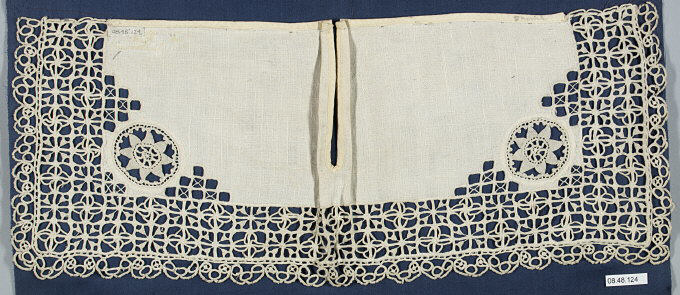
The Collar as Architectural Threshold: A Study in Cutwork and the 2026 Silhouette
The collar occupies a singular position in the lexicon of haute couture. It is neither wholly garment nor wholly accessory, but a liminal architecture—the threshold where the body’s verticality meets the garment’s drape, where the face’s narrative meets the fabric’s silence. In the context of Natalie Fashion Atelier’s ongoing aesthetic archaeology, the collar is not merely a functional finish; it is a site of concentrated meaning, a microcosm of historical memory encoded in thread and void. This research artifact isolates the collar as an object of study, focusing specifically on the materiality of cutwork—the deliberate excision of fabric to create pattern, light, and shadow—and traces its evolution from classical European ateliers to its imperative role in defining the 2026 luxury silhouette.
Defining Cutwork: Beyond Emptiness
Cutwork, in its most rigorous technical definition, is the process of removing sections of a ground fabric—typically linen, cotton, or silk—and stabilizing the remaining edges with embroidery, buttonhole stitching, or fine cordonnet. Unlike appliqué or embroidery, which add to the surface, cutwork operates through subtraction. It is a negative-space discipline, one that privileges the void as much as the thread. Historically, this technique reached its apogee in Renaissance Italy and later in the whitework traditions of Brittany and Madeira, where it was used to create ecclesiastical linens and aristocratic cuffs. The collar, as a discrete garment piece, became the perfect canvas: small enough to demand precision, visible enough to broadcast status.
In the archive of global heritage, cutwork is not monolithic. The Reticella of sixteenth-century Venice, with its geometric grid and needle-lace fillings, speaks to a mathematical, almost Cartesian order. The Richelieu of nineteenth-century France introduces floral and foliate motifs, softer and more romantic, yet equally disciplined in its bar-tack bridges. The Hedebo of Denmark offers a more organic, almost sculptural approach, where the cut areas are left raw-edged and the embroidery becomes a topographic map of the fabric’s own tensile strength. Each tradition treats the collar as a frame, but the framing logic differs: Venetian frames the face with geometry, French with botany, Danish with texture.
The Classical Elegance of the Collar: A Structural Re-Reading
Classical elegance, in the context of the collar, is often misread as mere ornament. A deeper analysis reveals that the historical collar was a structural device that manipulated the wearer’s posture and the garment’s fall. The Elizabethan ruff, for instance, was not a frivolous frill; it was a rigid, pleated disc of cutwork and starch that forced the head into a specific, regal alignment. The lace collar of the Louis XIV era, with its deep points and scalloped edges, served to visually elongate the neck and broaden the shoulders, creating a silhouette of aristocratic gravitas. The Victorian high collar, often of cutwork over a contrasting underlayer, acted as a corset for the throat, imposing a vertical discipline that echoed the era’s moral and social strictures.
In isolating the collar from its full garment, we perform an act of aesthetic archaeology: we strip away the sleeve, the bodice, the skirt, to see the collar as a pure, autonomous form. What emerges is a lesson in tension and release. The cutwork collar holds the fabric taut where it is intact and releases it where it is excised. This creates a rhythm of opacity and transparency, of solid and void, that is profoundly architectural. The collar becomes a miniature façade, with its own cornices, pilasters, and fenestration. The classical elegance lies not in the motifs themselves, but in the proportion between the cut and the uncut, the precision of the edge, and the silence of the ground fabric.
Materiality and the 2026 Silhouette: From Archive to Avant-Garde
As we project this heritage into the 2026 luxury market, the collar’s cutwork materiality offers a counter-narrative to the prevailing trends of oversized minimalism and digital-print maximalism. The 2026 silhouette, as forecast by leading couture houses and textile innovation labs, is moving toward a structured softness—garments that are voluminous yet defined, fluid yet with a clear internal skeleton. The cutwork collar is uniquely positioned to serve as that skeleton, but reimagined through contemporary material science and a globalized aesthetic.
First, consider the scale shift. Historical cutwork collars were intimate, often measuring no more than a few centimeters in depth. The 2026 interpretation demands an amplification. We propose cutwork collars that extend into the shoulder line, becoming a cape-like yoke that frames the upper torso. The excised areas are no longer small eyelets but large, sweeping arcs that reveal the bare shoulder or a contrasting underlayer of metallic mesh or liquid silk. This is not a nostalgic revival but a re-scaled monument to the technique. The void becomes a canvas for the body’s own topography.
Second, the material palette must evolve. Traditional cutwork relies on crisp, high-twist cottons and linens. For 2026, we integrate biodegradable synthetic silks, recycled metallic organzas, and laser-cut precision on wool crepe. The laser, in this context, is not a shortcut but a tool for achieving tolerances that hand-stitching cannot match—allowing for micro-cut patterns that appear, from a distance, as a solid fabric, but up close reveal a lace-like lattice. This creates a dual-read silhouette: at a glance, the collar is a clean, architectural crescent; upon closer inspection, it dissolves into a thousand tiny voids, each one a testament to the hand’s intent and the machine’s precision.
Deconstructing the Classical: The Collar as a Modular System
The classical collar was a fixed, integral part of the garment. The 2026 couture collar, informed by cutwork’s logic of subtraction, becomes a modular system. We propose detachable collars—not as an afterthought, but as a primary design strategy. A single gown can be transformed by swapping its cutwork collar: one in white Richelieu for a daytime, almost virginal elegance; another in black laser-cut leather for an evening of severe modernity; a third in translucent resin and silk for a futuristic, aquatic shimmer. This modularity aligns with the contemporary luxury consumer’s desire for investment pieces that offer multiple expressions, but it also honors the collar’s historical role as a separate, often detachable accessory—a piece of jewelry for the neckline.
Furthermore, the deconstruction of classical elegance involves a deliberate asymmetry. The historical collar was rigorously symmetrical, a reflection of cosmic and social order. The 2026 cutwork collar embraces the irregular. One side may feature dense, intact fabric; the other, a cascade of cutwork that trails down the shoulder blade. This asymmetry is not chaotic but choreographed, drawing the eye along a diagonal that creates a more dynamic, sculptural silhouette. It challenges the wearer to move with intention, as the collar’s voids and solids shift with each gesture.
Technical Execution and the Atelier’s Imperative
For Natalie Fashion Atelier, the 2026 cutwork collar demands a return to slow craftsmanship within a high-tech ecosystem. The technique begins with a digital pattern that maps the cutwork’s density and direction. This pattern is then transferred to a water-soluble stabilizer, upon which the ground fabric is stretched. The embroidery—whether silk thread, metallic filament, or a hybrid of both—is stitched in a continuous, spiraling sequence that anticipates the final cut. Once the embroidery is complete, the fabric is placed in a warm bath, dissolving the stabilizer and leaving only the cutwork structure. The final excision is performed by hand, with a scalpel, to ensure that no thread is nicked and that each void’s edge is perfectly clean.
This process is not merely technical; it is ritualistic. It forces the atelier to slow down, to consider each collar as a unique artifact. In an era of rapid production and disposable fashion, this ritual is the ultimate luxury. The 2026 silhouette, therefore, is not just a shape but a statement of values: patience, precision, and a reverence for the historical continuum. The cutwork collar becomes a wearable manifesto, a proof that the past’s most refined techniques can be the future’s most radical propositions.
Conclusion: The Collar as a Threshold to Tomorrow
The classical elegance of the cutwork collar is not a relic to be preserved under glass. It is a living grammar, a set of rules about void and form, tension and release, that remains profoundly relevant. By isolating the collar as an object of aesthetic archaeology, we have deconstructed its historical meanings—status, posture, order—and reconstructed them for a new century. The 2026 silhouette, with its structured softness, modular systems, and asymmetric dynamism, finds in cutwork a perfect ally. The collar is no longer the end of the garment; it is the beginning of a new conversation between the body, the fabric, and the space between. In the hands of the atelier, the void becomes a voice, and the cutwork collar speaks—not of the past, but of a future that is meticulously, beautifully, and technically inevitable.