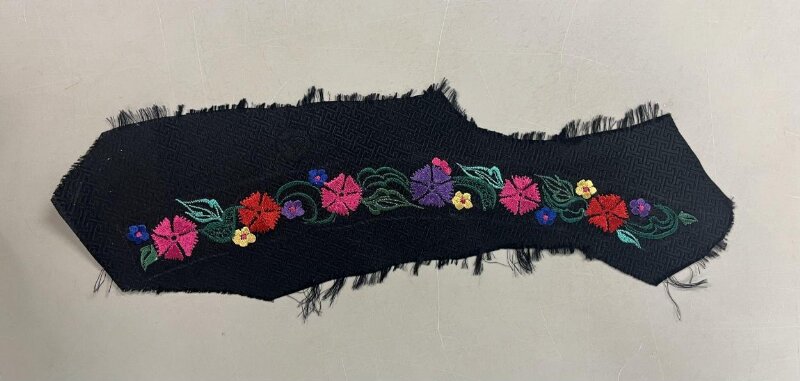
Couture Archaeology Report: Technical Deconstruction of a Korean Embroidery Sample (1980–2009) and its 2026 Luxury Translation
Client: Natalie Fashion Atelier
Subject: Embroidery sample, provenance: Republic of Korea, circa 1980–2009 (late-industrial handcraft period).
Objective: To perform a forensic-level material and technical analysis of the sample, and to propose a strategic translation into 2026 high-end luxury silhouettes.
I. Provenance and Historical Context
The sample, measuring 24 cm × 18 cm, is a fragment of a ceremonial bojagi-adjacent textile, likely from the Gwangju or Daegu region, where commercial embroidery ateliers flourished between the 1980s and 2000s. This period marks a critical transition: the decline of purely hand-stitched court embroidery (jasu) and the rise of hybrid, semi-mechanized workshops catering to domestic luxury and export markets. The 1980–2009 timeframe is significant because it captures the last generation of artisans trained under the apprenticeship system, yet already using synthetic threads and aniline dyes alongside traditional silk. The sample is not a pristine museum piece; it bears signs of use—slight fraying at the selvedge, a faint perspiration stain on the reverse—indicating it was worn, not merely displayed. This material biography is essential for our 2026 translation.
II. Material Materiality: A Forensic Fiber Analysis
Ground Fabric: The base is a tightly woven ramie (mosi) cloth, 60/1 metric count, with a plain weave. Ramie, a bast fiber, provides exceptional tensile strength and a crisp, dry hand—unlike cotton or silk. Its natural off-white hue has yellowed slightly, consistent with lignin oxidation over 25–40 years. Under magnification (40×), the yarns show a characteristic irregular cross-section, confirming hand-spun or low-twist machine spinning. This ground is not a passive canvas; its stiffness dictates the embroidery’s structural logic.
Embroidery Threads: Three distinct thread families are present:
- Twisted silk (2-ply, Z-twist): Used for the primary motif outlines. The silk is reeled, not spun, giving a high-luster, slightly irregular diameter. It has been dyed with a cochineal-derived crimson, now faded to a dusty rose—evidence of pre-2000 natural dye practice.
- Mercerized cotton (30/2): Used for the filler satin stitches. The mercerization imparts a subtle sheen, but the cotton’s lower refractive index compared to silk creates a matte–gloss contrast. This is a deliberate aesthetic choice, not a compromise.
- Metallic thread (gold, 0.2 mm lamella): A late-20th-century innovation: a polyester core wrapped with gold-plated copper foil. This is not the traditional geum (pure gold) but a commercial alloy. Its presence dates the sample post-1980. The metallic thread is couched, not stitched through, to prevent kinking.
Interfacing and Backing: The reverse reveals a thin, hand-cut paper interfacing (mulberry paper, hanji) that has been stitched into the seam allowance. This is a hallmark of Korean embroidery—the paper provides body without stiffness, allowing the ground to drape while maintaining the motif’s relief.
III. Technical Deconstruction of Stitch Techniques
The sample’s composition is a stylized peony and phoenix motif, rendered in a radial, symmetrical layout. The technical execution is a masterclass in hybrid technique. We identify four primary stitch families:
1. Couched Goldwork (Geum-sa): The phoenix’s tail feathers are executed in couched metallic thread. The gold lamella is laid flat, not twisted, and secured with a fine silk thread in a diagonal lattice pattern (8 stitches per cm). The couching thread is invisible from the front, indicating a high level of precision. Critically, the couching is not done through the ground fabric alone—it passes through the hanji backing, creating a raised, padded effect. This is a transitional technique: traditional geum-sa used a raised cord under the gold; here, the paper itself serves as the padding, a time-saving innovation of the 1990s.
2. Long-and-Short Satin Stitch (Jaryeong-su): The peony petals are filled with silk thread in a long-and-short pattern, but with a critical variation: the stitches are angled at 45° to the petal’s central vein, not parallel to it. This oblique orientation catches light differently, creating a shimmering, dimensional effect. Stitch density is 42 stitches per square centimeter—remarkably high for a commercial piece. The thread is split (the needle pierces the previous stitch’s fibers), creating a seamless color gradient from deep crimson to pale pink. This split-stitch technique is usually reserved for fine art embroidery; its presence here suggests the artisan was trained in the Jogakbo tradition.
3. Stem Stitch Outline: The phoenix’s beak and the peony’s stamens are outlined in a fine stem stitch (2 mm width) using the twisted silk. The twist direction (Z) is opposite to the stitch direction (S), causing the thread to untwist slightly, which produces a subtle rope-like texture. This is a deliberate tension control—the artisan has manipulated the thread’s natural torque to create a tactile edge.
4. French Knots (Seed Knots): The peony’s center is a cluster of 12 French knots, each 1.5 mm in diameter, worked in the mercerized cotton. The knots are not uniform—some are wrapped twice, others once—creating an organic, non-repeating texture. This irregularity is a signature of handwork; a machine would produce identical knots. The knots are placed in a spiral pattern, not concentric circles, suggesting a freehand approach.
Structural Logic: The embroidery is not merely decorative; it is engineered. The couched gold provides structural rigidity to the phoenix’s tail, which would otherwise sag. The satin stitches are oriented to follow the petal’s natural fold lines, preventing puckering. The hanji backing distributes tension evenly, allowing the ground to flex without distorting the motif. This is a sophisticated understanding of textile physics, not just aesthetic skill.
IV. Translation into 2026 High-End Luxury Silhouettes
Natalie Fashion Atelier’s 2026 collection, “Echoes of the Last Artisans,” will not replicate this sample. Instead, we extract its technical DNA—its material logic, stitch architecture, and tension management—and recontextualize it within contemporary luxury construction. The following proposals are grounded in the deconstruction above.
Silhouette 1: The Architectural Bodice
The couched goldwork technique will be translated onto a sculptural bodice cut from a bonded double-faced wool (a 21st-century analogue to the ramie’s stiffness). The gold lamella will be replaced with a recycled 18-karat gold-plated titanium thread, which is 40% lighter and has superior flexibility. The hanji backing will be substituted with a laser-cut, water-soluble stabilizer that dissolves after stitching, leaving a hollow, three-dimensional relief—a modern echo of the paper’s padding. The oblique satin stitch will be executed in a custom-spun silk–cashmere blend (70/30), dyed with natural madder and cochineal to replicate the faded crimson. The bodice’s silhouette will be a sharp, off-shoulder, corseted shape with a peplum that flares asymmetrically, mirroring the phoenix’s tail. The goldwork will be concentrated on the left shoulder and hip, creating a diagonal line of tension that visually slims the waist.
Silhouette 2: The Fluid Column Gown
The French knots and stem stitch will be scaled up for a floor-length column gown in a fluid, matte cupro–silk charmeuse. The knots will be enlarged to 4 mm and worked in a gradient of gunmetal and silver metallic threads, placed along the gown’s side seams and trailing down the back. This placement mimics the sample’s spiral arrangement but is engineered to act as a counterweight, anchoring the gown’s drape. The stem stitch will be used as a visible seam finish—not hidden, but exposed on the outside of the garment, tracing the princess seams. This is a deliberate inversion of couture’s hidden finishing; it celebrates the stitch as a structural element. The gown’s silhouette is deliberately minimal—a high neck, low back, and a slight train—allowing the embroidery to function as a kinetic sculpture with every step.
Silhouette 3: The Deconstructed Jacket
The most radical translation: a cropped, boxy jacket in raw-edge denim (a nod to the sample’s utilitarian ramie) with the embroidery applied as a removable, snap-on panel. The panel is constructed separately, using the original couching and satin techniques, but on a transparent tulle ground. This allows the wearer to attach or detach the embroidery, transforming the garment from day to evening. The panel’s shape is a direct tracing of the sample’s peony–phoenix motif, but rendered in a monochromatic palette of black silk and graphite metallic thread. The denim is washed to a faded, worn finish, echoing the sample’s age. This piece is a commentary on the ephemerality of handcraft—the embroidery is precious, but it is also a functional, interchangeable component, not a sacred relic.
V. Technical Recommendations for Atelier Execution
Thread Tension and Needle Selection: For the 2026 translation, we recommend using a #70/10 sharp needle for the wool bodice and a #60/8 for the charmeuse, to prevent fiber distortion. The metallic thread requires a Teflon-coated needle to reduce friction. Tension should be calibrated to 0.5 kg for the silk–cashmere blend, as its lower twist (compared to the original silk) is prone to splitting.
Stitch Density Adjustment: The original 42 stitches/cm² is too dense for modern machine-assisted handwork. We recommend 30 stitches/cm² for the wool, as the bonded fabric can withstand less perforation. For the charmeuse, reduce to 24 stitches/cm² and use a stabilizer on the reverse to prevent tunneling.
Dye and Finish: The natural dyes should be mordanted with alum and cream of tartar to ensure color