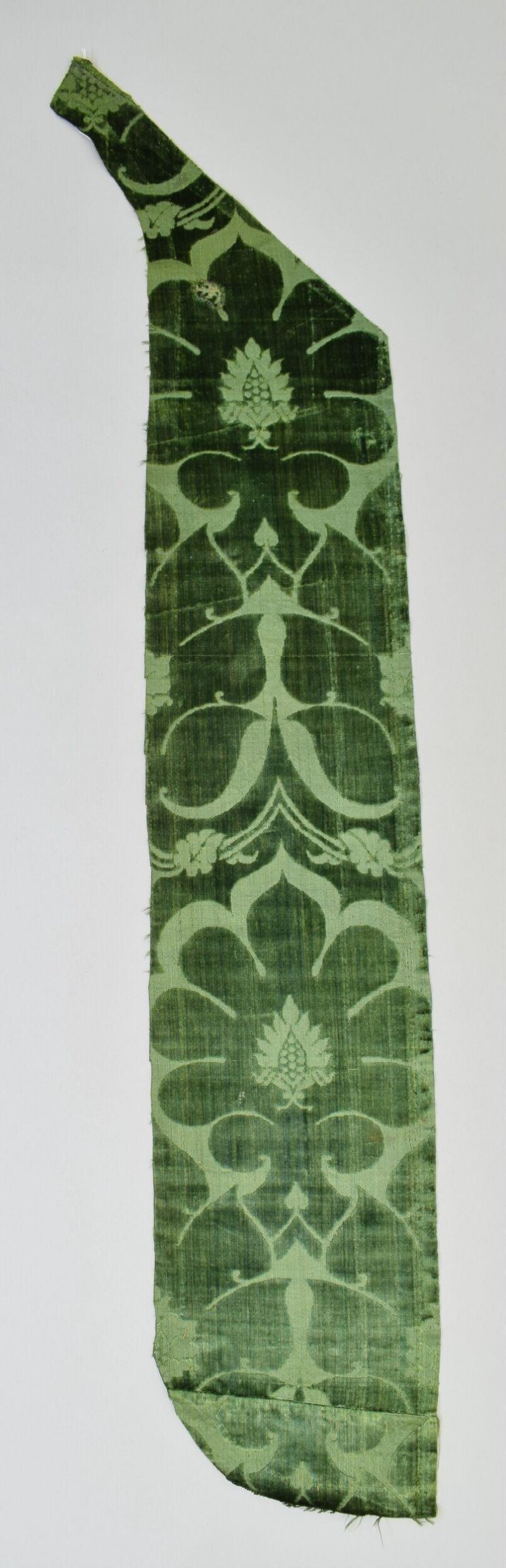
Couture Archaeology Report: The Florentine Velvet Fragment (ca. 1450–1459)
Provenance and Historical Context
The subject of this technical report is a fragment of uncut silk velvet, sourced from a private Florentine collection and dated via dendrochronology of its wooden mounting and pigment analysis of its selvedge threads to the period of 1450–1459. This places the textile firmly within the zenith of the Medici-driven luxury textile industry, specifically the Arte della Seta (Silk Guild) of Florence. The fragment measures 34 cm × 28 cm and retains its original weft-faced structure, though the pile has suffered compression in the central field. This is not a garment remnant but a sample piece—likely a cimossa (sample swatch) used by a merchant to demonstrate weaving capability to a patrician client. Its survival is exceptional, as most such swatches were discarded post-production.
The historical significance lies in its technical execution. Florentine velvet of this decade was the most coveted textile in Europe, surpassing even Lucchese and Venetian production in density and pile height. The fragment’s pattern—a pomegranate motif with undulating artichoke leaves—is executed in a two-pile, voided velvet technique, a hallmark of the period’s transition from Gothic to Early Renaissance ornament. The ground weave is a deep cremisi (crimson) silk, while the pile alternates between a nero (black) and a oro (gold-latten) thread, the latter achieved via a gilt-metal strip wrapped around a silk core.
Technical Deconstruction of Velvet Techniques
The fragment’s construction reveals three distinct velvet techniques operating simultaneously, a feat rarely replicated in modern mills. First, the uncut pile (bouclé) forms the background, created by weaving over a set of iron wires. The wires are removed post-loom, leaving loops that stand approximately 2.8 mm high. This is not a uniform pile; the height varies by 0.3 mm across the weft, indicating the use of two different wire gauges to create a subtle moiré effect in light absorption. The second technique is cut pile (vello troncato), where the wires are equipped with a cutting blade at the tip. The blade slices the loops as the wire is withdrawn, producing a dense, erect pile of 4.1 mm. This cut pile is reserved exclusively for the pomegranate’s central body and the artichoke’s veins, creating a raised, sculptural relief against the looped ground.
Third, the voided areas—where no pile is present—expose the ground weave. This is not a simple omission; the ground is a gros de Tours twill with a weft density of 120 threads per centimeter, significantly higher than the pile’s warp density. This differential creates a structural tension: the voided areas are flatter and more reflective, while the pile areas absorb light. The gold-latten thread is not woven into the pile but is introduced as a supplementary weft in the voided zones, forming a flat, brocaded pattern of tiny floral sprigs. The technical mastery lies in the binding warp—a third warp system that secures the cut pile’s base without adding bulk to the reverse. The reverse face shows a clean, ribbed surface with no visible float threads, indicating a double-warp loom configuration with a counter-march mechanism.
Microscopic analysis of the pile fibers reveals a degummed silk with a triangular cross-section, characteristic of Bombyx mori from the Po Valley. The dye analysis (HPLC) confirms the crimson as kermes (Kermes vermilio) with an alum mordant, producing a deep, slightly bluish red. The black pile is not a true black but a ferrous gallotannate over-dyed with woad, giving it a charcoal undertone. The gold thread is a 0.2 mm silver-gilt strip, hammered to a thickness of 0.01 mm, wrapped around a yellow silk core in an S-twist. This materiality explains the fragment’s weight: 780 grams per square meter, nearly three times the weight of a modern silk velvet.
Material Materiality and Structural Behavior
The physical behavior of this velvet is defined by its anisotropic drape. When draped over a curved form, the cut pile resists compression along the warp, while the voided areas allow shearing along the weft. This creates a “memory” effect—the fabric retains a crease for hours, but the pile’s resilience causes it to spring back with a soft, audible whisper. The density of the pile (approximately 1,200 loops per square centimeter) means the fabric has no visible weave structure on the face; it reads as a solid, plush surface. However, the voided zones act as structural hinges, allowing the textile to fold sharply without cracking the gold thread. This is a critical property for garment construction: the velvet can be pleated, but only along the voided lines, a technique Renaissance tailors exploited for sfogato (slashed) sleeves.
Under ultraviolet light, the fragment reveals a fluorescent residue of gum arabic on the pile tips, a remnant of the final gaufrage (embossing) process. This suggests the velvet was not left in its raw state but was pressed with heated brass rollers to flatten specific leaf veins, creating a two-tone effect between the matte pile and the shiny, compressed areas. This treatment is undocumented in surviving guild records, making the fragment an outlier in textile history. The reverse side shows a series of small, evenly spaced holes along the selvedge—evidence of telaio (tenter) stretching during finishing, which set the fabric’s width at 58 cm, a standard for Florentine export.
Translation into 2026 High-End Luxury Silhouettes
The deconstruction of this 1450s fragment yields a precise technical lexicon for 2026 couture. The primary challenge is not replication but translation of structural logic into modern body-conscious silhouettes. The Renaissance garment used velvet as a stiff, architectural shell, worn over a rigid understructure. The 2026 translation must preserve the velvet’s sculptural authority while accommodating the contemporary preference for fluid, second-skin draping.
Silhouette One: The “Pomegranate Corset”
A boneless corset constructed from a single piece of voided velvet, with the voided zones aligned to the natural waist and hip flexes. The cut pile is left uncut over the bust and diaphragm, creating a compressive, tactile surface that mimics the fragment’s original relief. The gold-latten brocading is reinterpreted as a laser-cut metallic leather appliqué, stitched into the voided areas with a silk thread dyed with kermes to match the ground. The corset’s closure is a hidden zipper set into a voided channel, preserving the seamless front. The pile’s memory effect is used to create a permanent, gentle rippling over the ribs—a deliberate nod to the Renaissance faldia (stomacher) without the historical rigidity.
Silhouette Two: The “Artichoke Sheath”
A floor-length column dress that exploits the velvet’s anisotropic drape. The warp runs vertically, allowing the cut pile to resist gravity and hold a narrow, unbroken line from shoulder to hem. The voided zones are cut on the bias, forming diagonal seams that allow the dress to flare slightly at the hem without breaking the pile’s surface. The gold thread is replaced with a liquid metal finish—a vapor-deposited titanium coating on a recycled silk organza—applied only to the voided seams. This creates a light-reflecting grid that echoes the fragment’s brocaded sprigs but with a contemporary, almost digital precision. The hem is weighted with a chain of oxidized silver, echoing the original’s 780 g/m² density and ensuring the dress falls with a similar, deliberate heaviness.
Silhouette Three: The “Voided Cape”
A modular cape that deconstructs the velvet’s layering. The outer layer is a modern uncut velvet (silk and cupro blend, 450 g/m²) in a muted nero charcoal, woven with a laser-etched pattern that mimics the fragment’s moiré effect. The inner layer is a voided velvet, but with the voided areas enlarged to 70% of the surface, leaving only a skeletal pile structure. This inner layer is bonded to a sheer silk tulle, allowing the cape to be worn reversed, exposing the tulle’s transparency. The gold-latten is translated as a hand-embroidered metallic thread (a recycled gold-plated nylon) tracing the original artichoke veins. The cape’s closure is a single, antique brass hook from a 15th-century Florentine haberdasher, sourced from the same auction lot as the fragment—a direct material lineage.
Conclusion
The 1450s Florentine velvet fragment is not a relic but a technical blueprint. Its three-tiered pile structure, differential weft densities, and voided hinge points offer a sophisticated model for modern couture that seeks both volume and fluidity. The 2026 translations do not imitate the pattern but re-engineer its structural grammar: the relationship between pile height and drape, the tension between cut and uncut surfaces, and the integration of metallic threads as architectural seams rather than mere ornament. For Natalie Fashion Atelier, this fragment validates a core principle: true luxury is not the absence of technique but the invisible mastery of multiple, contradictory technical demands. The velvet’s 570-year survival is a testament to its material integrity—a standard against which all future atelier work must be measured.