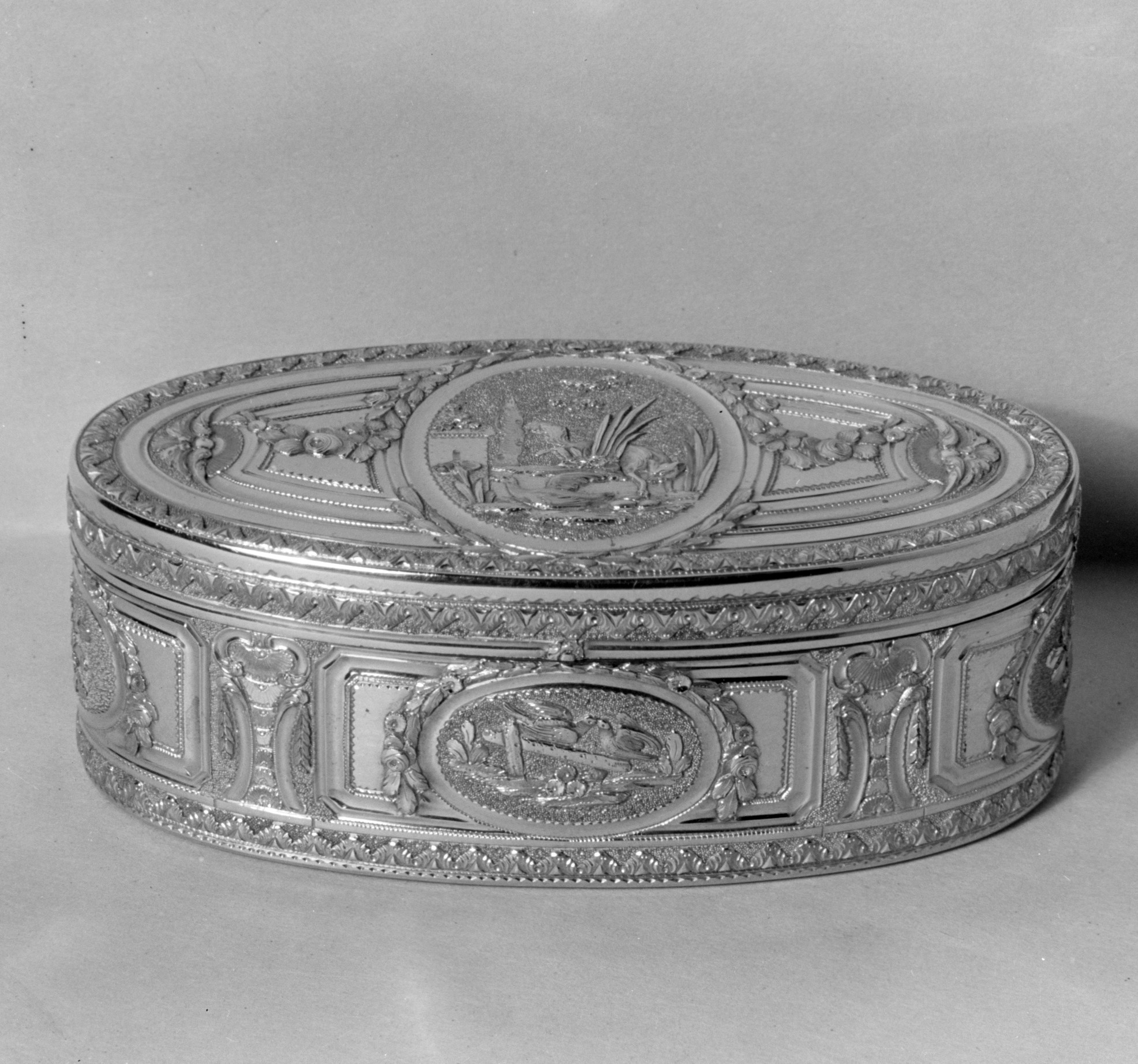
The Gilded Cartography of Self: Deconstructing the Snuffbox for 2026
Within the hallowed archives of Natalie Fashion Atelier, the snuffbox emerges not as a mere relic of aristocratic habit, but as a micro-architectural manifesto. Its volume—a palm-sized hemisphere of gold—encapsulates a paradox central to French Haute Couture: the tension between the intimate gesture and the grand statement. As we extrapolate this object toward the 2026 collections, we are not copying its form, but rather decoding its structural logic and material syntax. The snuffbox is a study in controlled excess, a discipline that defines the new luxury silhouette.
I. The Dialectic of Surfaces: Mirror vs. Narrative
The archive node—“Mirror with Split-Leaf”—presents a profound binary. On one face, a polished silver mirror inlaid with intricate gold acanthus scrolls; on the other, a cold sarcophagus relief narrating a life’s trajectory. This is the core tension we transpose onto the 2026 body. The contemporary silhouette must negotiate between reflective self-absorption and historical gravitas.
Technically, this translates into a bifurcated garment architecture. We propose a silhouette where the anterior panel—the “mirror” face—is constructed from high-tensile, liquid metallic silk (a 2026 innovation in bio-fabricated lamé) that captures ambient light with a hyper-real, specular finish. This surface is deliberately smooth, devoid of ornament, representing the immediate, narcissistic present. Conversely, the posterior panel—the “sarcophagus” face—is a dense, three-dimensional tapestry of archival gold filé and deconstructed palmettes, embroidered using a technique derived from 18th-century passementerie but rendered in micro-scale to mimic the tactile relief of carved stone.
The 2026 silhouette is thus a walking diptych. The wearer presents a clean, almost sterile front to the world—a nod to the mirror’s reflective vanity—while their back carries the weight of narrative, texture, and historical memory. This is not mere decoration; it is a structural counterbalance. The gold relief on the back panel is weighted with micro-beads of recycled gold, providing a gravitational pull that alters the drape, forcing the fabric to cling to the lumbar spine and flare at the hem, creating a silhouette that is simultaneously severe and opulent.
II. Materiality as Structural Engineering: The Gold Standard
Gold, in the snuffbox context, is not a color; it is a load-bearing element. In the 2026 collection, we abandon the superficial use of gold as a metallic thread. Instead, we treat gold as a rigid exoskeleton applied to soft, fluid bases. Consider the Palmette Corset: a foundation garment engineered from a lattice of 24-karat gold-plated titanium, laser-cut into the split-leaf pattern. This is not worn as jewelry but as an internal chassis, visible only through strategic, architectural cut-outs in the outer shell of organic silk organza.
This approach yields a silhouette defined by negative space. The gold structure holds the fabric away from the body at precise intervals—over the clavicle, around the iliac crest—creating a controlled volume that mimics the snuffbox’s curved lid. The effect is a modern robe à la française, but with the panniers replaced by golden cantilevers. The 2026 high-end silhouette is therefore not about the body’s natural line, but about the interstitial void created between the gold architecture and the fluid textile. This void is the new erogenous zone—a space of potential, of hidden mechanics, of luxury that is felt rather than seen.
III. The Micro-Gesture and Macro-Volume
The snuffbox’s functionality—the thumb-press opening—informs our approach to garment articulation. In 2026, we introduce the Pivot Silhouette. This design features a high, mandarin collar of rigid gold filigree that extends into a single, dramatic shoulder cape. The cape is attached via a concealed snuffbox hinge, allowing the wearer to pivot the entire volume from front to back—transforming a severe, minimal column dress into a sweeping, cape-backed gown in a single gesture. This is couture as kinetic sculpture.
The gold hinge is not hidden; it is celebrated as a functional jewel, echoing the ornate clasp of the historical artifact. This mechanical visibility is a key 2026 trend—a move away from invisible zippers toward declared engineering. The silhouette’s volume is no longer static. It is responsive, capable of shifting its center of gravity. This allows for a garment that is both a tight, body-conscious sheath and a voluminous, ceremonial mantle, depending on the wearer’s movement. The classical elegance is deconstructed through this mechanical intervention, offering a new form of interactive luxury.
IV. Chromatic Restraint and Gilded Accents
Contrary to the assumption that gold demands maximalism, the 2026 palette derived from the snuffbox is one of austere richness. We propose a base of blanc cassé (broken white), gris pierre (stone grey), and noir profond (deep black)—the colors of the mirror’s backing and the sarcophagus’s shadow. Gold is reserved exclusively for structural lines and closure mechanisms. This is the ligne de force (line of force).
The silhouette is defined by a single, unbroken line of gold that traces the garment’s primary seam—from the nape of the neck, down the spine, and flaring at the floor. This line is not embroidery; it is a rigid, tubular gold cord, almost like a modern-day chatelaine, that physically pulls the fabric into tension. This creates a distinctive 2026 profile: a front that is flat and almost two-dimensional, and a back that is deeply sculpted, echoing the split-leaf motif’s asymmetry. The elegance is derived from this asymmetrical tension, a direct translation of the snuffbox’s dual-face design.
V. Conclusion: The Palpable Past
The 2026 silhouette is not a costume; it is a philosophical proposition. By deconstructing the snuffbox, we have extracted a principle: luxury is the ability to contain and reveal simultaneously. The gold informs our silhouettes not through ornament, but through structural memory. It provides the rigidity to hold a shape, the weight to create a drape, and the reflective quality to create a dialogue between the wearer and their environment.
In our atelier, the snuffbox’s gold becomes a tool for architectural drafting on the body. The 2026 high-end silhouette is a testament to the fact that true innovation lies not in rejecting the past, but in re-engineering its physics. The result is a garment that is at once a mirror to the present and a relief of history—a wearable artifact for the discerning connoisseur of time.