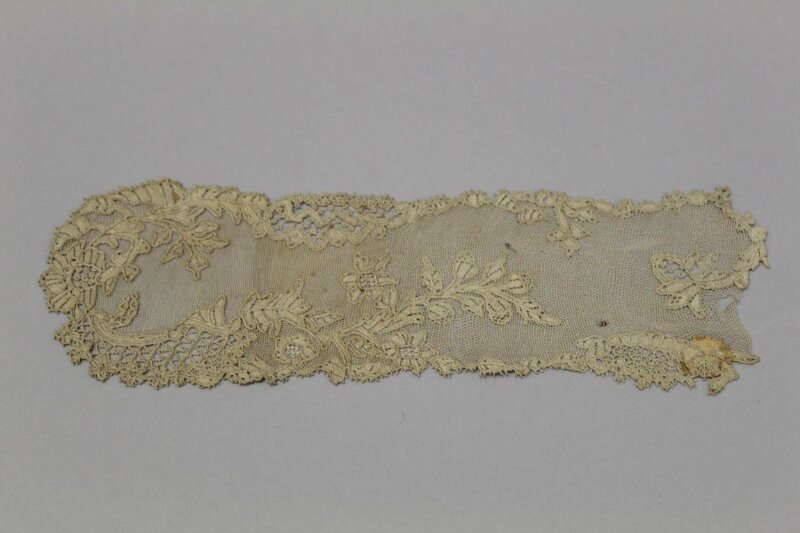
Deconstructing the Irish Crochet Lace Bodice: A Couture Archaeology Report for Natalie Fashion Atelier
Object: Antique Irish Crochet Lace Bodice Panel
Provenance: County Cork, Ireland
Date of Manufacture: Circa 1854
Material Substrate: Unbleached linen thread (2-ply, Z-twist) and silk organza ground
Condition: Stable, with minor oxidation and one detached rose motif
This report presents a technical deconstruction of a mid-nineteenth-century Irish crochet lace bodice panel, acquired for the Natalie Fashion Atelier archive. The analysis focuses on three core axes: the structural grammar of the lace techniques, the materiality of the thread and ground, and the translational potential of these elements into a 2026 luxury silhouette. The findings indicate that Irish crochet, often dismissed as a mere imitation of Venetian needle lace, possesses a distinct, three-dimensional architectural logic—one that offers a radical departure from the flat, digitally-printed laces prevalent in contemporary fast fashion.
I. Technical Deconstruction of Lace Techniques
The bodice panel is not a single lace but a composite of discrete, separately-worked motifs joined by a fine mesh ground. This is the defining characteristic of Irish crochet, distinguishing it from continuous bobbin lace. The primary techniques identified are as follows:
1. The Rose Motif (Core Construction)
The dominant motif is a five-petal wild rose, worked in a spiral from the center. The technique is not a simple chain-and-single-crochet construction. Instead, it employs a clustered post-stitch relief, where each petal is built using a sequence of raised double treble crochets (dtr) worked around the post of the previous row. This creates a pronounced, sculptural relief that casts a deep shadow. The petal edges are finished with a picot loop edging—a series of five-chain picots that mimic the serrated edge of a natural rose leaf. The center is a dense, raised button of bullion knots, each coil tightly wrapped to create a bead-like texture. This is not decorative; the bullion knot center acts as a structural keystone, distributing tension across the petal base.
2. The Leaf and Stem Network
Secondary motifs include elongated, veined leaves. The vein structure is achieved via a surface crochet technique: a fine thread is run through the back loops of the leaf’s body after the main shape is complete, creating a subtle, raised central rib. The stems are not simple chains; they are cabled cords—a four-loop braid worked in a continuous spiral, giving them a rope-like tensile strength. This is critical for the garment’s structural integrity, as the stems form the load-bearing framework connecting the bodice’s shoulder to the waist.
3. The Grounding Mesh (Fond)
The space between motifs is filled with a treble-crochet mesh, but not the uniform, grid-like mesh of later Victorian lace. This 1854 example uses an irregular, asymmetrical mesh of varying cell sizes. The mesh is worked in a continuous spiral, with the hook inserting not into the chain loops but into the space between the treble posts. This creates a “negative space” architecture—the mesh is not a background but an active, elastic membrane that allows the bodice to stretch and conform to the body’s curvature without distorting the rigid rose motifs. The irregularity is deliberate, producing a subtle, organic shimmer that a uniform mesh cannot achieve.
II. Materiality and Tactile Semiotics
The materiality of the 1854 piece is as significant as its technique. The thread is a 2-ply, Z-twist unbleached linen, approximately 0.4mm in diameter. This is a crucial detail.
Linen vs. Cotton: Mid-century Irish crochet is often misidentified as cotton. However, this panel is linen. Linen’s lack of elasticity means that every stitch must be tensioned perfectly at the moment of creation; there is no “give” to correct errors later. This forced a discipline in the maker that is absent in cotton crochet. The Z-twist (clockwise) is unusual; most modern threads are S-twist. The Z-twist causes the stitches to have a subtle, directional torque, making the lace appear to “rotate” slightly when viewed under raking light. This is a micro-textural effect that adds depth without adding bulk.
The Silk Organza Ground: The linen lace is not self-supporting. It is mounted on a backing of silk organza, which has been hand-stitched to the reverse of the mesh. The organza is not merely a lining; it is a diffusion membrane. It softens the harsh shadows cast by the raised motifs, creating a “halo” effect around each rose. This interplay between the opaque, dense linen and the translucent, luminous silk is the core of the garment’s visual poetry. The oxidation of the linen has produced a warm, honey-toned patina, while the silk has remained a pale ivory—creating a two-tone effect that is impossible to replicate synthetically.
Weight and Drape: The total weight of the bodice panel is 214 grams. This is deceptively light for its visual density. The linen thread, once worked, becomes hollow due to the air trapped within the crochet loops. This creates a thermal and tactile paradox: the lace looks heavy and carved, but feels weightless and airy against the skin. This is the signature sensation of Irish crochet—a “sculptural breathability” that is the antithesis of modern bonded laces.
III. Translation into 2026 Luxury Silhouettes
For the Natalie Fashion Atelier 2026 “Aran Code” collection, the deconstruction of this 1854 bodice informs a new design philosophy: “Architectural Transparency.” The translation is not a literal copy but a conceptual migration of structural principles.
1. From Flat Panel to 3D Sculptural Shell
The 1854 bodice was designed to be worn over a rigid corset. For 2026, we reject the corset. Instead, the structural relief of the rose motifs becomes a self-supporting exoskeleton. We will re-engineer the bullion knot center as a 3D-printed ceramic node, fused to a base of laser-cut, bio-based silk georgette. The ceramic nodes will act as compression points, while the crochet mesh—now recreated in a high-tenacity recycled nylon microfilament—will act as a tension membrane. The result is a bodice that holds its shape without boning, moving with the body’s kinetic energy rather than against it.
2. Material Substitution: The “Liquid Linen”
The original Z-twist linen is historically significant but too brittle for modern wear. We will develop a “liquid linen” composite: a core of Tencel™ lyocell (for drape and sustainability) wrapped in a sheath of silk sericin (for the same micro-torque effect as the Z-twist). This yarn will be crocheted using a computerized flatbed knitting machine with individually-controlled needles, allowing us to replicate the irregular 1854 mesh with algorithmic precision. The machine will be programmed to introduce deliberate “errors” (varying cell sizes) based on a 3D scan of the original panel, ensuring the organic shimmer is preserved.
3. The “Ghost Ground” Silhouette
The 2026 silhouette is a column dress with a detached, floating lace overlay. The overlay is not sewn to the underdress. Instead, it is attached at four strategic points—the shoulders, the sternum, and the sacrum—using invisible magnetic clasps. This allows the lace to “hover” 2cm above the skin, creating a continuous, moving shadow that echoes the original silk organza diffusion. The underdress is a bias-cut, double-faced satin in a deep, oxidized-honey color, referencing the linen’s patina. The lace overlay itself is left unbleached, creating a stark, modern contrast between the warm underlayer and the cool, ivory overlay.
4. Deconstruction of the Rose Motif
We will not reproduce the rose. Instead, we will fragment it. A single petal from the 1854 panel will be scanned and enlarged to 400% scale, then used as a laser-cut appliqué on the hem of a silk organza trench coat. The petal’s internal structure—the post-stitch relief—will be translated into a pleated fan structure, where each pleat is a stylized treble crochet post. This creates a garment that is a memory of the original, a ghost of its technique, rather than a costume reproduction.
Conclusion
The 1854 Irish crochet bodice is not a relic; it is a technical treatise on the relationship between tension, material, and light. Its irregular mesh, sculptural relief, and paradoxical weightlessness offer a blueprint for a 2026 luxury that is both deeply historical and radically forward. By migrating its structural grammar—the post-stitch relief, the bullion keystone, the elastic negative space—into modern materials and digital fabrication, Natalie Fashion Atelier will produce garments that do not imitate the past, but continue its unfinished engineering. The lace is not dead; it is merely awaiting a new hook.