From Archive to Atelier: The Quilted Coat as a Blueprint for 2026
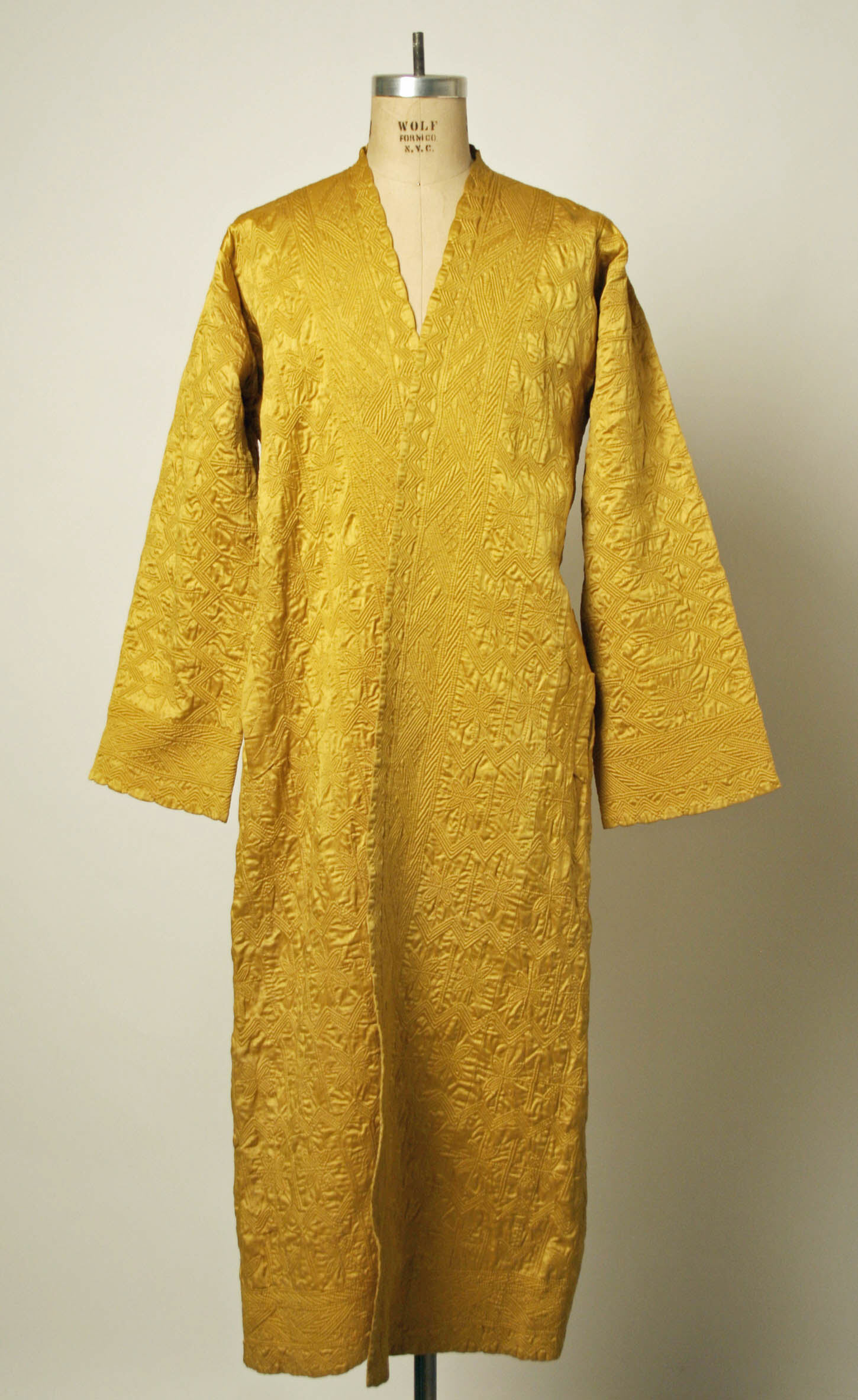
The contemporary luxury landscape is increasingly defined not by novelty, but by the intelligent re-contextualization of historical craft. At Natalie Fashion Atelier, our current research initiative—an exercise in aesthetic archaeology—isolates a singular artifact: the quilted coat with long sleeves. Stripped of its original cultural identifiers, this garment emerges as a pure study in structural tension, material dialogue, and volumetric restraint. By deconstructing its classical elegance, we establish a technical framework that directly informs the 2026 haute couture silhouette, where the past is not referenced but operationalized.
Material Dialectics: The Silk-Cotton Dichotomy
The foundational intelligence of the quilted coat lies in its material pairing. The archive piece employs a satin weave in pure silk for the exterior, contrasted against a plain weave in cotton for the interior structure. This is not a mere decorative choice; it is a functional dialectic. The silk satin offers a fluid, luminous surface with a high refractive index, catching light to create an illusion of weightlessness. Conversely, the cotton plain weave provides a matte, high-friction substrate that anchors the garment to the body, preventing the slipperiness inherent to silk.
Thermal and Tactile Engineering
For 2026, we are translating this dichotomy into a new thermal logic. The quilted matrix—the stitching pattern that binds these two layers—acts as a thermal regulator, creating air pockets that insulate without bulk. The 2026 silhouette will exploit this by reducing the interlining thickness while increasing the density of the quilting stitch. This yields a coat that is paradoxically lighter and warmer, allowing for a closer-fitting, more architectural shoulder line without the historical "puff" of traditional quilted garments. The tactile contrast—cool, smooth silk against warm, absorbent cotton—becomes a signature sensory experience, a private luxury known only to the wearer.
Structural Archaeology: Deconstructing the Silhouette
Isolated from its heritage context, the quilted coat reveals a distinct structural grammar. The long sleeve, in its classical form, is not merely an appendage but a continuation of the torso's volume. Historical patterns often employed a drop-shoulder or a kimono-style sleeve, where the fabric flows uninterrupted from the center back to the wrist. This creates a visual line that is both majestic and severe. Our deconstruction focuses on this seamlessness.
From Volume to Architecture
The 2026 high-end silhouette will reject the oversized, amorphous shapes that have dominated recent seasons. Instead, we are proposing a sculpted volume—a silhouette that is generous in specific, engineered zones and rigorously taut in others. The quilted coat informs this by providing a natural armature. The quilting lines themselves become structural seams, allowing us to shape the garment without darts. We can create a pronounced, almost conical volume at the hip, then cinch it abruptly at the wrist via a concealed cotton placket. The result is a silhouette that is simultaneously soft and architectural, moving away from the body yet precisely defined by it.
The 2026 Silhouette: A Manifesto of Restrained Grandeur
Drawing from the archive, we forecast three distinct high-end applications for the quilted coat’s principles in 2026.
1. The Inverted Quilt (Exterior Structure)
The most radical departure involves reversing the material hierarchy. By placing the cotton plain weave on the exterior and the silk satin on the interior, we achieve a matte, understated outer shell that reads as modern and utilitarian. The quilting stitch is executed in a tonal, high-tension thread, creating a subtle, dimensional grid. This allows for a sharper, more tailored silhouette—a longer, leaner line that skims the body from shoulder to mid-calf. The interior silk satin provides a moment of unexpected opulence when the coat is removed or worn open, a secret flash of luminosity against a monochrome ensemble. This silhouette speaks to a quiet luxury that prioritizes material integrity over overt decoration.
2. The Asymmetric Quilt (Dynamic Drape)
Historical quilting patterns are often symmetrical and grid-based. Our 2026 interpretation deliberately breaks this symmetry to achieve a new dynamism. By employing a radial quilting pattern that emanates from a single point at the right shoulder, we create an asymmetric distribution of volume. The left side of the coat remains relatively flat and close to the body, while the right side cascades into a fuller, more dramatic drape. This is achieved by varying the stitch density—tight at the shoulder, increasingly loose towards the hem. The long sleeves are treated differently: the left sleeve is cut narrow and straight, the right is cut with a subtle bell flare. This silhouette is designed for the modern woman in motion, offering a sense of controlled drama that changes with every gesture.
3. The Micro-Quilt (Precision Layer)
For a more versatile, trans-seasonal piece, we propose a micro-quilted shell. Here, the quilting stitch is reduced to a 5mm grid, creating a texture that resembles a fine, ribbed metal mesh. The materiality is pure silk satin on both sides, with a gossamer-thin layer of cotton voile in between for structure. This technique allows for an incredibly fluid, almost liquid drape, yet the quilted matrix provides enough body to hold a sharp, defined shoulder. The 2026 silhouette for this piece is a cropped, boxy jacket that hits at the high hip, with sleeves that are cut to a precise, bracelet-length. It functions as a high-luxury layering piece, worn over a bias-cut silk slip dress or a tailored wool trouser suit. This is the ultimate expression of technical minimalism, where the complexity is entirely hidden within the fabric’s construction.
Conclusion: The Archive as a Living System
The quilted coat, in its historical isolation, is not a relic but a technical manifesto. Its value for 2026 lies not in direct replication, but in the extraction of its core principles: the dialectic of materials, the structural potential of the stitch, and the architectural logic of the long sleeve. At Natalie Fashion Atelier, we view heritage not as a constraint but as a generative algorithm. By deconstructing the classical elegance of this garment, we have unlocked a vocabulary of volume, texture, and restraint that will define a new era of high-end silhouettes—ones that are intellectually rigorous, materially honest, and profoundly contemporary. The future of couture is not found in the new, but in the profound re-reading of the timeless.