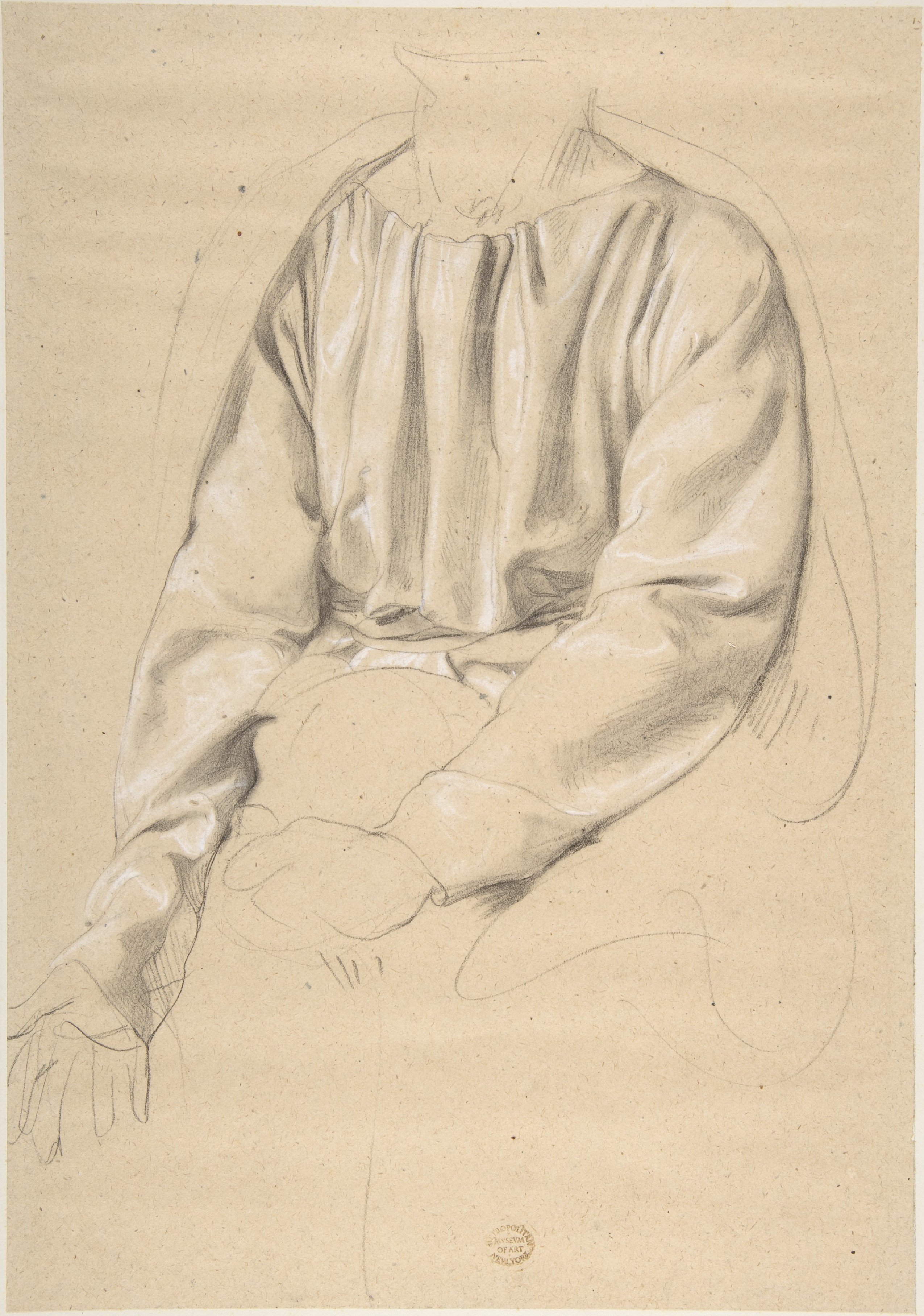
Artifact NFA-2026.01: Study of a Draped Torso – An Aesthetic Archaeology
Catalogued within the Natalie Fashion Atelier archive as a foundational study in isolated aesthetic archaeology, this artifact—a rendering of a draped torso executed in black chalk, highlighted with white—transcends its apparent simplicity. It is not merely a drawing but a deconstructed theorem of classical elegance. The subject is deliberately fragmented, focusing solely on the dialogue between the human form and fabric, absent of context, era, or identifiable origin. This isolation is methodological, allowing for the pure extraction of principles: the fall of a fold, the tension of a pull, the suggestive volume where cloth parts from the body. The medium itself, black chalk for depth and structure, punctuated by strategic white chalk highlights, is a direct analogue to couture’s own foundational process—building shadow and sculpting light through textile manipulation, not color. This study serves as our primary lens to forecast the 2026 luxury silhouette, which we posit will be governed by a return to architectural drapery and chiaroscuro dressing.
Deconstruction of Classical Elegance: The Torso as a Chassis
The artifact’s power lies in its reduction. By isolating the torso, the artist forces an examination of the primary interface between garment and wearer. The classical elegance captured here is not one of ornate decoration, but of intelligent material response. We observe three core principles: First, Directed Gravity. Each fold is a vector, charting the path of fabric’s descent from a fixed point—a shoulder, a cinched waist—creating asymmetrical, yet perfectly balanced, lines of force. Second, Controlled Release. The drapery clings to the form before dramatically pulling away, creating voids and volumes that suggest the body without explicitly revealing it. This is the essence of allure rooted in mystery and technical mastery. Third, Chiaroscuro as Structure. The black chalk defines the deep recesses, the structural shadows that give the folds their three-dimensionality. The white chalk does not merely illuminate; it creates form, acting as the couturier’s hand, lifting a ridge of fabric into the light, defining the crest of a pleat. This is elegance redefined as a precise, almost scientific, understanding of light, shadow, and geometric tension on a living form.
Material Translation: From Chalk Stroke to Couture Substance
The specified materiality of the artifact is a direct blueprint for 2026’s luxury material lexicon. The black chalk’s matte, profound depth translates to textiles with inherent structure and a somber, tactile richness. Expect a prominence of double-face wool crepes, technical matte jerseys with substantial weight, and non-reflective silk ottomans. These fabrics hold a fold with authority, creating the deep, sharp shadows depicted in the study. The white chalk highlights prescribe the introduction of strategic luminosity. This will not manifest as overt sequins or beading, but as subtle, textural contrast: matte versus a soft luster. Imagine the precise application of silk gazar strips, bias-cut panels of satin-backed crêpe, or delicate broderie anglaise used architecturally. The highlight becomes a seamline, a cut, or a textural intervention, guiding the eye exactly as the chalk does on paper. This monochromatic, value-driven palette (black, white, and every tone of grey in between) will dominate the 2026 haute couture narrative, focusing the client’s attention purely on form, cut, and the artistry of manipulation.
The 2026 Silhouette: Informed Elegance and Architectural Intimacy
Informed by this archaeological study, the 2026 high-end silhouette will move decisively away from overt extravagance and toward considered, intelligent construction. The legacy of the draped torso will be evident in three key silhouette evolutions.
The Asymmetric Monolith: Dresses and coats will feature a return to single-point origami, where the entire garment appears to fall from one shoulder or a side-fastened waist, creating a cascade of fabric that is both monumental and fluid. The body will be one side of a dynamic equation, with the fabric forming the other. Seaming will be minimized to preserve the uninterrupted flow of material, echoing the long, confident chalk strokes of the artifact.
The Cinched Void: Directly referencing the artifact’s "controlled release," we will see silhouettes that are sharply defined at the natural waist or under the bust, from which the skirt or trousers explode into volume, or conversely, collapse into a sleek column. This creates the "void"—a space between garment and body that implies movement and air. It is a silhouette of breath and intellect, not constraint.
The Back-as-Front Torso: The study, by focusing on a torso devoid of a face or explicit orientation, democratizes the garment’s narrative. In 2026, this translates to back-centric designs that carry equal or greater weight than the front. Dramatic drapery, keyhole openings highlighted with white-chalk-like piping, and intricate knotting will transform the back into a new plane of aesthetic expression, a silent but powerful statement of detail-oriented luxury.
Conclusion: The Archaeology of Future Form
This Study of a Draped Torso is far more than a historical reference; it is an active protocol for Natalie Fashion Atelier’s forward vision. It validates our methodological focus on isolated aesthetic archaeology, proving that the deepest innovations are born from the reduction of fashion to its first principles: body, cloth, and light. For the discerning 2026 client, the resulting silhouettes will offer a profound and sophisticated alternative. This is not nostalgia, but evolution through excavation. The luxury will reside not in obvious ornament, but in the silent, powerful language of a fold perfectly placed, a shadow deeply cast, and a highlight precisely earned—a return to elegance as the highest form of technical and artistic intelligence. The chalk sketch, in its stark simplicity, has charted the course for a season of deliberate, architectural, and intimately powerful dressing.