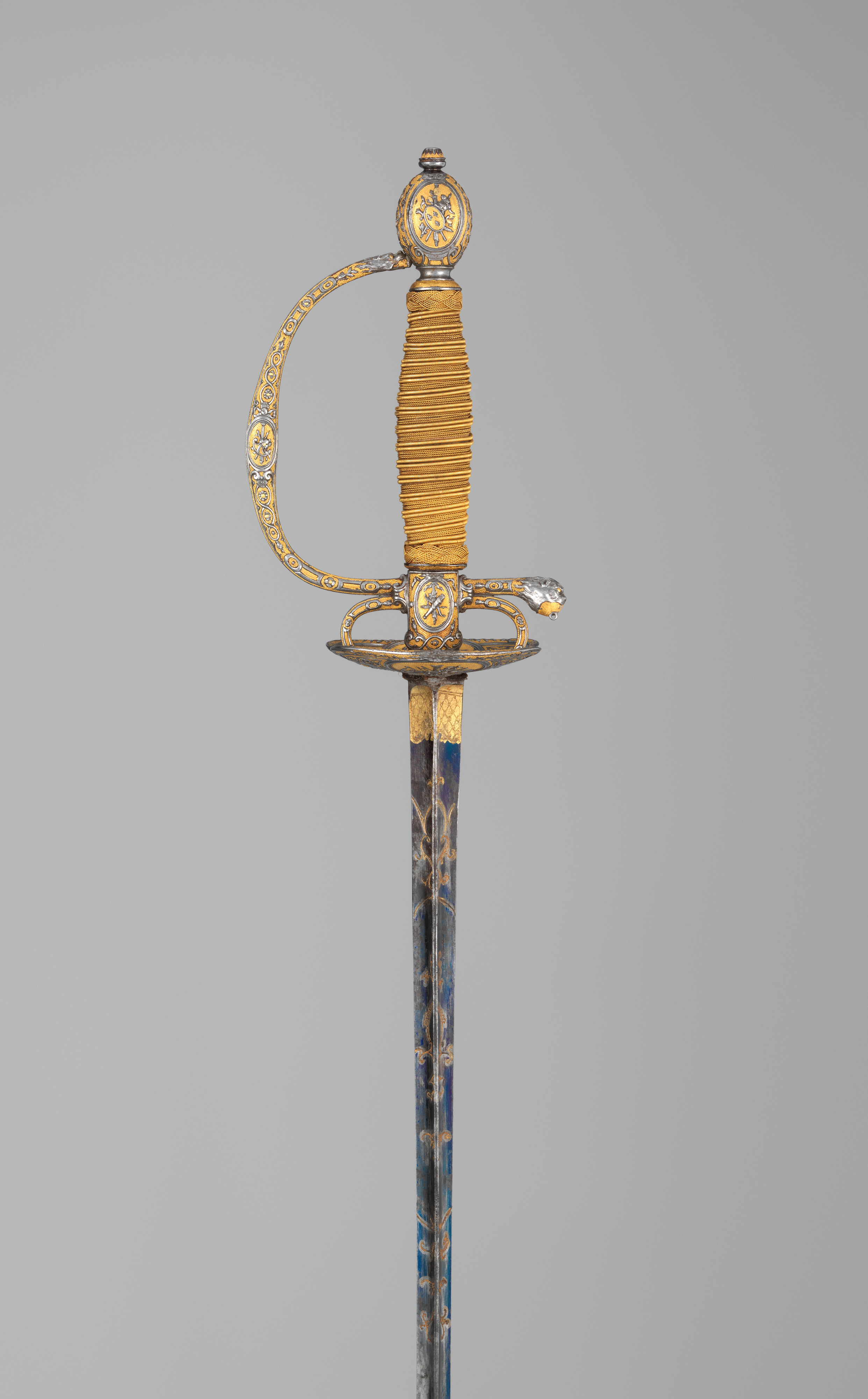
The Smallsword as Structural Metaphor: Deconstructing Classical Elegance for 2026 Couture
Within the hushed archives of Natalie Fashion Atelier, the smallsword—a quintessential artifact of the French ancien régime—emerges not as a relic of martial history, but as a masterclass in disciplined opulence. Isolated from its ceremonial context, this object of steel, gold, wood, and textile offers a profound aesthetic archaeology: a study in linear tension, gilded restraint, and the architecture of the human silhouette. For the 2026 haute couture season, the smallsword is not merely an inspiration; it is a technical blueprint. Its principles of tapered verticality, contrasting material hierarchies, and functional ornamentation directly inform a new lexicon of luxury silhouettes that prioritize sculptural precision over voluminous excess.
Material Dialectics: Steel, Gold, Wood, and Textile as a Couture System
The smallsword’s genius lies not in any single material, but in the dialectical relationship between its components. The blade—forged from high-carbon steel—represents the purest expression of line. Its distal taper, from robust ricasso to needle-sharp point, creates a visual and physical trajectory of unwavering focus. In 2026, this translates directly into the architectural seam. We are moving away from the soft, draped shoulder toward a sharply defined, almost metallic shoulder line, achieved through internal boning and horsehair canvas. The couture jacket’s sleeve now mimics the blade’s profile: broad at the deltoid, then tapering with relentless precision to a narrow, elongated cuff that extends past the wrist bone—a gesture of both power and finesse.
Contrast this with the hilt’s goldwork. The chiseling, the repoussé, the subtle matte-vs-polished finishes—these are not decorative afterthoughts but strategic interruptions. Gold here functions as a light-capture mechanism, drawing the eye to the hand, the waist, or the décolletage. For the atelier, this informs the placement of metallic thread embroidery, not as scattered embellishment, but as a directional vector. A 2026 evening gown will feature a single, continuous line of gold bullion embroidery, tracing from the left hip, across the torso, and terminating at a precisely engineered clasp at the right collarbone. This is not ornament; it is a structural highlight, echoing the way the gold quillon and pommel frame the hand as the sword’s center of gravity.
The wooden grip, often of ebony or walnut, introduces a third material language: warmth and tactility against cold metal. Its wrapped wire or shagreen texture provides grip—a functional necessity that becomes a sensory luxury. In our 2026 silhouettes, this translates to the tactile counterpoint of matte, dense fabrics against fluid ones. Think of a column dress in heavy, dark wool crepe (the wood), its surface unbroken, but with a corset-like insert of polished, lacquered leather (the steel) at the center front. The contrast is not visual alone but haptic—a garment that invites touch and communicates a quiet, assured solidity.
Finally, the textile of the sword knot—a silk ribbon or twisted cord—offers the element of kinetic softness. It is the only part of the object that moves independently, a fluid counterpoint to the rigid blade. This informs the 2026 use of detachable, weighted drapery. A sheath dress may feature a single, long scarf of liquid silk satin, anchored at the shoulder and allowed to fall to the hem, its movement echoing the sword knot’s sway. This is not casual layering; it is a calculated release of tension, a moment of controlled chaos within an otherwise disciplined composition.
Silhouette Architecture: The Tapered Line and the Gilded Waist
The most significant contribution of the smallsword to 2026 silhouettes is the re-establishment of the tapered line as the primary mode of elegance. The 18th-century male silhouette, defined by the justaucorps and the smallsword hanging at the hip, created a continuous, unbroken vertical from shoulder to knee. Our contemporary interpretation rejects the boxy, oversized shapes of recent seasons in favor of a fitted, elongated torso that flares only slightly at the hem, much like the blade’s subtle widening near the hilt.
This manifests in two distinct archetypes. The first is the “Blade” Coat: a floor-length, single-breasted silhouette in double-faced cashmere, with a razor-sharp lapel that extends into a long, narrow point. The waist is cinched not with a belt but with an internal, curved steel stay that creates a concave, sculpted profile. The second is the “Quillon” Gown: a bias-cut evening dress in silk gazar, where the bodice is structured like the hilt—a rigid, boned cage that flares outward at the shoulders and hips, creating a negative space at the waist that is then filled by a panel of gold lamé. This is the gilded waist, a direct homage to the sword’s guard, which visually anchors the entire composition.
Ornament as Engineering: The New Functional Decoration
The smallsword teaches us that true luxury is integrated ornament. The gold chasing on the hilt is not applied; it is the hilt. Similarly, 2026 couture decoration must be structurally integral. We are abandoning the appliqué in favor of engineered embroidery that follows the seams, reinforcing them while simultaneously decorating them. A jacket’s side seam will be traced with a dense, metallic braid that acts as a stabilizing element, preventing stretch and defining the silhouette’s edge. The result is a garment where the embellishment is the architecture, and the architecture is the embellishment—a seamless fusion of form and function that echoes the smallsword’s perfect synthesis of weapon and jewel.
Conclusion: The Discipline of Elegance
The smallsword, isolated in the archive, is a testament to the fact that elegance is not a matter of addition, but of subtraction and control. Its steel, gold, wood, and textile are not disparate elements but a cohesive system of visual and tactile priorities. For Natalie Fashion Atelier’s 2026 collection, this artifact provides the ultimate brief: a silhouette that is taut, unerring, and gilded with intention. The new luxury is not in volume or spectacle, but in the precision of a line, the weight of a fabric, and the placement of a single, perfect metallic thread. It is the quiet authority of the sword, sheathed and waiting, whose power is fully understood in its restraint.