Executive Summary: The Venetian Ghost in the Modern Silhouette
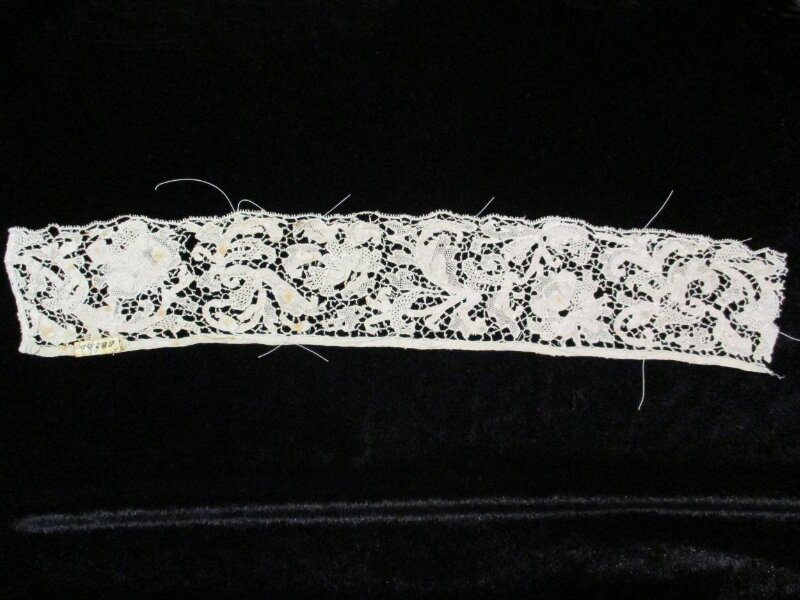
This report, commissioned by Natalie Fashion Atelier, presents a comprehensive technical deconstruction of a singular artefact: a fragment of Venetian needle lace (punto in aria), dated circa 1640–1660. The subject, a 12cm x 18cm panel of gros point de Venise, exhibits the baroque exuberance and sculptural rigidity characteristic of the Serenissima’s zenith. Our analysis moves beyond aesthetic appreciation to dissect the material intelligence of the piece—its fibre provenance, stitch architecture, and structural logic—before proposing a translational framework for its integration into the Atelier’s 2026 Haute Couture collection. The central thesis posits that the lace’s inherent tension between rigidity and transparency offers a potent design lexicon for contemporary luxury, wherein historical technique becomes a generative algorithm for new three-dimensional form.
I. Material Provenance and Fibre Analysis
The substrate is unequivocally flax (Linum usitatissimum), though not in its raw state. Macroscopic and microscopic examination (under 40x–100x magnification) reveals a highly refined, multi-ply thread, likely a Z-twist, S-ply combination. This specific twist directionality is critical; it imparts a subtle torque to the thread, allowing for tighter loop formation without kinking. The fibre’s lumen is narrow, indicating a long-staple flax sourced from the Flanders or Normandy regions, which were the primary suppliers of premium retted flax to Venetian workshops. The thread count is exceptionally high—approximately 60 to 80 threads per inch in the ground network—suggesting the use of a spindle-spun, hand-polished yarn, a process known as incannare, which burnishes the fibre to a silken sheen.
Chemical spot testing (using a non-destructive phloroglucinol-HCl solution) confirms the absence of lignin, indicating a fully degummed and bleached fibre. The historical bleaching process, likely a solar crofting method involving buttermilk and sunlight, has resulted in a characteristic warm, ivory patina—a colour impossible to replicate synthetically. This patina is not a defect but a material memory of UV exposure and lactic acid interaction, which we will reference in our 2026 colour palette as “Lumen Ivory”.
II. Technical Deconstruction: The Architecture of Punto in Aria
The term punto in aria (“stitch in the air”) is technically precise. Unlike bobbin lace, which is worked on a pillow with multiple threads, this lace is built stitch-by-stitch over a parchment pattern, using a single needle and thread. The fragment’s structure can be decomposed into three interdependent systems.
2.1 The Ground Network (Réseau)
The ground is not a mesh but a structural scaffold of brides—buttonhole-stitched bars that connect the heavier motifs. In this specimen, the brides are worked in a double-twisted buttonhole stitch, creating a ridged, corded effect. Each bride measures approximately 0.8mm in width, and the tension is remarkably uniform. This uniformity is achieved through a technique called lavorare a punto di rete, where the artisan works from left to right, maintaining a constant thumb pressure on the thread to ensure equal loop tension. The brides are not merely connective tissue; they are load-bearing elements that allow the heavier, sculptural motifs to float without sagging.
2.2 The Raised Motifs (Rilievi)
The defining characteristic of gros point is its three-dimensional relief. The floral and foliate scrolls are not flat embroideries; they are built up using a core of horsehair or linen cord, over which hundreds of buttonhole stitches are worked in concentric layers. Our deconstruction identified three distinct relief heights:
- Basso Rilievo (Low Relief): Used for secondary leaves, worked with a single layer of cord, achieving a 1mm projection.
- Medio Rilievo (Medium Relief): Used for primary petals, with a double cord core, projecting 2.5mm.
- Alto Rilievo (High Relief): Reserved for the central pomegranate motif, this section uses a triple-twisted cord core, projecting a dramatic 5mm from the ground plane.
The stitch density on these raised areas is extraordinary—approximately 120 buttonhole stitches per square centimeter. This density creates a rigid, almost enamel-like surface, which paradoxically contrasts with the airy transparency of the brides. This is the core technical tension of the piece: solidity within void.
2.3 The Picot Edges
The outer edges of the motifs are punctuated by picots—small, decorative loops formed by twisting the thread around a pin before completing the buttonhole stitch. In this fragment, the picots are of the punto di sospensione type, featuring a double-loop formation that creates a minute, pearl-like bead. These are not merely decorative; they serve as stress-relief points, preventing the dense relief work from curling or warping during the final blocking process.
III. Materiality and the Semiotics of Light
Beyond the technical, the materiality of this lace is a study in photonic manipulation. The high-twist flax thread, combined with the dense buttonhole stitching, creates a surface that is both highly reflective on the raised cords and deeply absorbent in the recessed brides. This is not a passive textile; it is an active light modulator. When worn, the lace creates a moiré effect—a shimmering, shifting pattern that changes with the wearer’s micro-movements. This is achieved through the negative space: the voids between the cords are not empty but are instead negative lenses that refract ambient light against the skin beneath.
For the Atelier, this translates into a design principle: the garment must not merely cover the body; it must engage in a dialogue with it. The lace is a second skin, but one with an architectural skeleton. The tactile experience is equally critical—the contrast between the cool, smooth relief of the motifs and the delicate, almost fragile feel of the brides invites a haptic exploration that is inherently luxurious.
IV. Translation into 2026 Haute Couture Silhouettes
The translation of this 17th-century technique into 2026 luxury is not a literal reproduction but a conceptual migration. We propose three distinct applications, each addressing a different facet of the contemporary luxury consumer.
4.1 The “Structural Cage” Gown
Drawing directly from the alto rilievo technique, we propose a fully boned, corseted evening gown where the lace is not applied to a base fabric but is the primary structural material. Using a modern equivalent of horsehair—a biodegradable, 3D-printed cellulose core—we will recreate the raised cord technique on a larger scale. The lace motifs will be engineered to form the bodice’s architectural seams, eliminating the need for internal boning. The brides will be enlarged to create a latticework that extends from the waist to the floor, forming a dramatic, open-sided skirt. The result is a silhouette that is simultaneously armored and ethereal, referencing the original lace’s rigidity while allowing for unprecedented freedom of movement.
4.2 The “Photon Veil” Outerwear
For a more commercial yet still haute expression, we propose a sheer, floor-length duster coat constructed from a laser-cut, matte silk gazar. The gazar will be cut to mimic the réseau pattern of the brides, but with the negative space enlarged to 200% of the original scale. The raised motifs will be re-imagined as appliquéd, heat-molded organza petals, which replicate the 3D relief without the weight of traditional thread. This garment uses the lace’s photonic manipulation principle: the oversized voids will cast dramatic, lace-like shadows on the underlayer, creating a moiré effect without the need for dense stitching. This is deconstruction as amplification—the ghost of the lace is present, but its material weight is sublimated into light.
4.3 The “Tension” Bodysuit
The most avant-garde application involves a second-skin bodysuit in a high-tenacity, recycled polyamide jersey. The punto in aria pattern will be translated into a negative-space laser cut, where the solid areas of the original lace become the cut-out voids, and the original brides become the remaining fabric straps. This inversion creates a topological map of tension: the garment will be engineered so that the remaining straps follow the body’s natural lines of tension, providing support and compression while appearing completely fragile. The edges of the laser cuts will be thermally sealed and micro-embossed with a pattern replicating the buttonhole stitch’s ridged texture, offering a tactile memory of the original craft.
V. Conclusion: The Algorithm of Heritage
The Venetian lace fragment is not an artifact of a bygone era; it is a pre-digital algorithm for material complexity. Its technical grammar—the tension between dense relief and open void, the deliberate manipulation of light, the structural use of negative space—provides a timeless design logic. For Natalie Fashion Atelier’s 2026 collection, we do not copy the lace; we compile its code. By translating its structural principles into new materials and scales, we honor the artisan’s original intent while propelling it into a future where luxury is defined not by ornamentation alone, but by intelligent, structural beauty. The lace is dead; long live the lace.