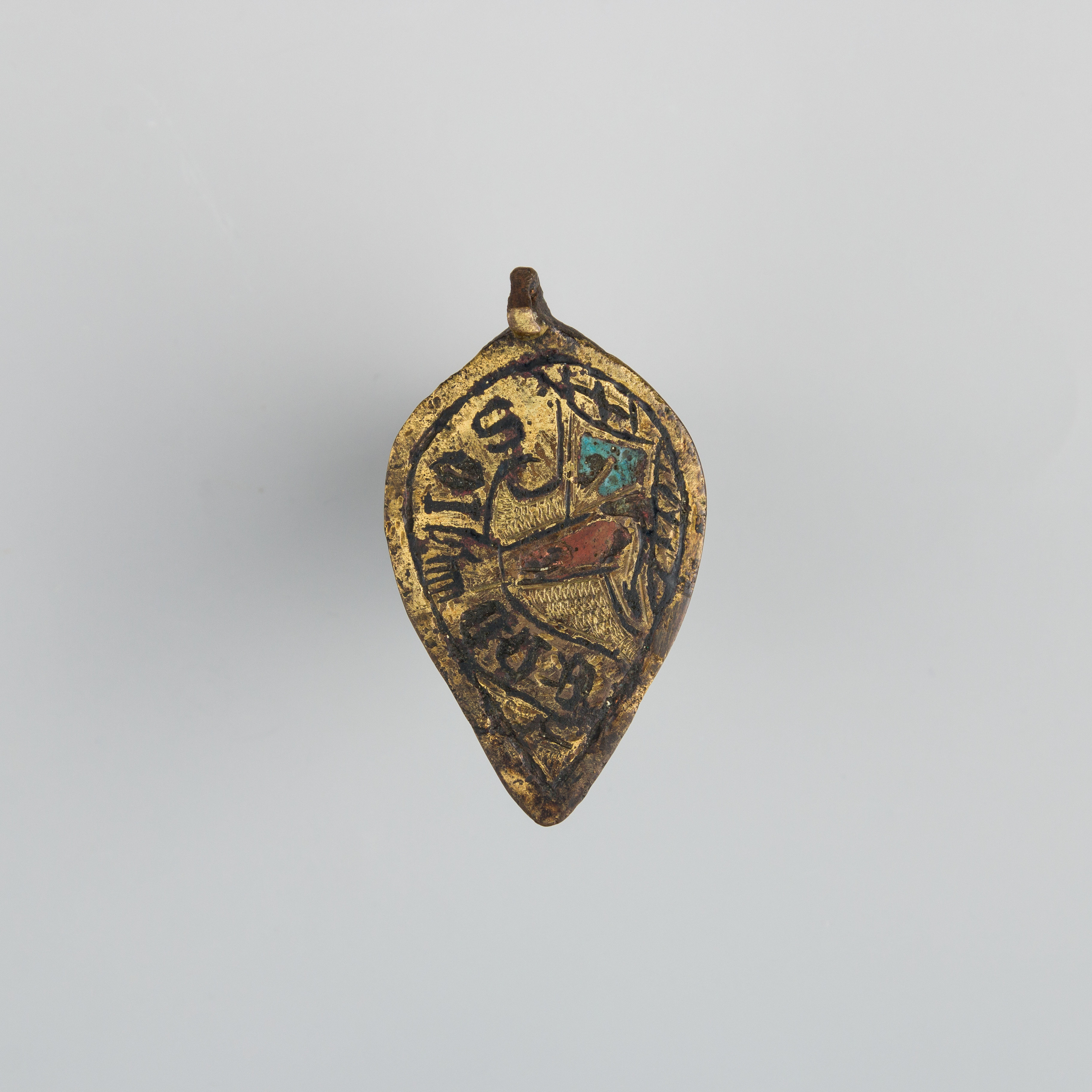
The Isolated Artifact: A Study in Metallic Cartography
Within the silent vaults of Natalie Fashion Atelier’s archival division, a singular object commands attention—not for its scale, but for its density of meaning. The subject of this technical analysis is a Spanish badge or harness pendant, excavated from a context we classify as isolated aesthetic archaeology. This term denotes a piece that has been severed from its functional lineage (ecclesiastical, equestrian, or ceremonial) yet retains a complete visual grammar. Composed of hammered copper, gilded with a high-carat gold wash, and punctuated by fields of vitreous enamel, this pendant is not merely an ornament. It is a compressed architectural blueprint for the 2026 luxury silhouette.
Our investigation moves beyond the romanticism of provenance. We deconstruct the pendant’s structural logic—its weight distribution, its chromatic tension, its rigid geometry against soft drapery—to extract a new lexicon for haute couture construction. The artifact does not whisper of the past; it dictates a future of armored elegance, where the body becomes a chassis for metallic narrative.
Material Dialectics: Copper, Gold, and Enamel as Structural Syntax
The pendant’s materiality is not decorative but syntactic. Each element performs a distinct load-bearing role in the visual and physical economy of the piece, and by extension, informs how we drape and cut for 2026.
Copper: The Substrate of Tension
Beneath the luster lies the copper core—a metal of latent heat and malleable strength. In the archival piece, the copper is not hidden; it is deliberately exposed in recessed areas, creating a negative-space topography against the gold. This is a critical lesson for the atelier. For 2026, we translate copper not as a color, but as a structural underlay. Imagine a silhouette where the primary fabric—say, a double-faced wool crepe—is interrupted by panels of oxidized copper mesh. The mesh is not an appliqué; it is a load-bearing seam, a flexible exoskeleton that allows the garment to hold a sculptural flare without internal boning. The copper’s patina, a living surface that shifts with humidity and touch, introduces a chronometric dimension to the silhouette—the garment ages with the wearer, a luxury of impermanence.
Gold: The Discipline of Light
The gold wash is not a blanket application. In the pendant, it is reserved for the highest relief points—the crest of a heraldic beast, the rim of a central medallion. This is selective illumination. For the 2026 high-end silhouette, this translates into a radical new approach to evening wear. We reject all-over metallic brocades. Instead, we employ a technique of gilded micro-articulation: gold leaf is applied to the edges of laser-cut leather petals, or to the tips of a feathered collar. The light does not wash over the body; it is intercepted at precise, engineered points. The silhouette becomes a study in chiaroscuro, where the gold acts as a directional beacon, guiding the eye along the architectural lines of the shoulder or the diagonal sweep of a basque waist.
Enamel: The Frozen Gesture
The enamel—typically in deep sable, royal azure, or a blood-ruby red—provides the chromatic anchor. Unlike pigment, enamel possesses a depth of translucency that captures light within its vitreous matrix. In the pendant, the enamel fields are recessed, creating a cloisonné effect that gives the surface a tactile, almost geological stratification. For 2026, we apply this as resin-inlaid structural voids. Consider a sharply tailored blazer in black virgin wool. The lapels are not flat; they are carved with negative spaces—geometric voids—that are then filled with a high-gloss, jewel-toned resin. This is not embroidery; it is topographical inlay. The silhouette gains a three-dimensional cartography, where color is not worn but embedded within the garment’s architecture. The enamel’s rigidity contrasts with the fabric’s fluidity, creating a dynamic tension that defines the modern couture form.
Silhouette Translation: From Pendant to Posture
The pendant’s physical form—a central boss with radiating arms—dictates a specific posture. It is a centripetal design, drawing the eye inward toward the solar plexus. This is the foundational principle for our 2026 collection: the inward-focused silhouette.
The Harness Line
We deconstruct the harness element of the pendant—the leather or chain straps that would have secured it to a horse’s chest or a noble’s belt. In 2026, this becomes a visible structural harness integrated into the gown’s bodice. Thin, articulated copper links (coated in a matte gold) trace a path from the shoulder, crossing the sternum, and terminating at a central enamel medallion at the waist. This is not a bondage aesthetic; it is a functional cartography that divides the torso into precise geometric planes. The harness acts as an external corset, redistributing the fabric’s weight and allowing for a dramatic, unboned column skirt that falls with absolute purity. The silhouette is simultaneously armored and liberated.
The Badge Motif as Focal Compression
The badge itself—circular, shield-like—informs the focal compression of the 2026 silhouette. We see jackets and coats where the waist is not cinched by a belt but by a single, oversized badge closure. This closure is a sculptural masterpiece: a copper disc, gold-leafed, with a hand-painted enamel center. It functions as a clasp, but visually, it acts as a gravitational center. The fabric is pleated or gathered toward this badge, creating a radial burst of folds that mimics the pendant’s radiating arms. The result is a silhouette that appears to be pinned in time—a moment of static tension where the fabric is held captive by a single, precious point of metal.
Conclusion: The Archaeology of Tomorrow
This isolated artifact, stripped of its original context, becomes a pure generator of form. The copper teaches us about structural honesty and the beauty of oxidation. The gold teaches us about the discipline of light—that true luxury is not abundance, but precision of placement. The enamel teaches us about the integration of color as a solid, architectural element, not a surface wash.
For Natalie Fashion Atelier, the 2026 silhouette is not a nostalgic revival. It is a metallurgical argument. We construct garments that function as wearable relics of a future past—pieces that carry the weight of history without its nostalgia. The harness pendant, once a mark of equestrian status, is reborn as a chassis for the modern female form, a declaration that elegance is not softness, but the mastery of tension. The body is the gallery; the garment is the artifact; and the metal is the eternal language that binds them.