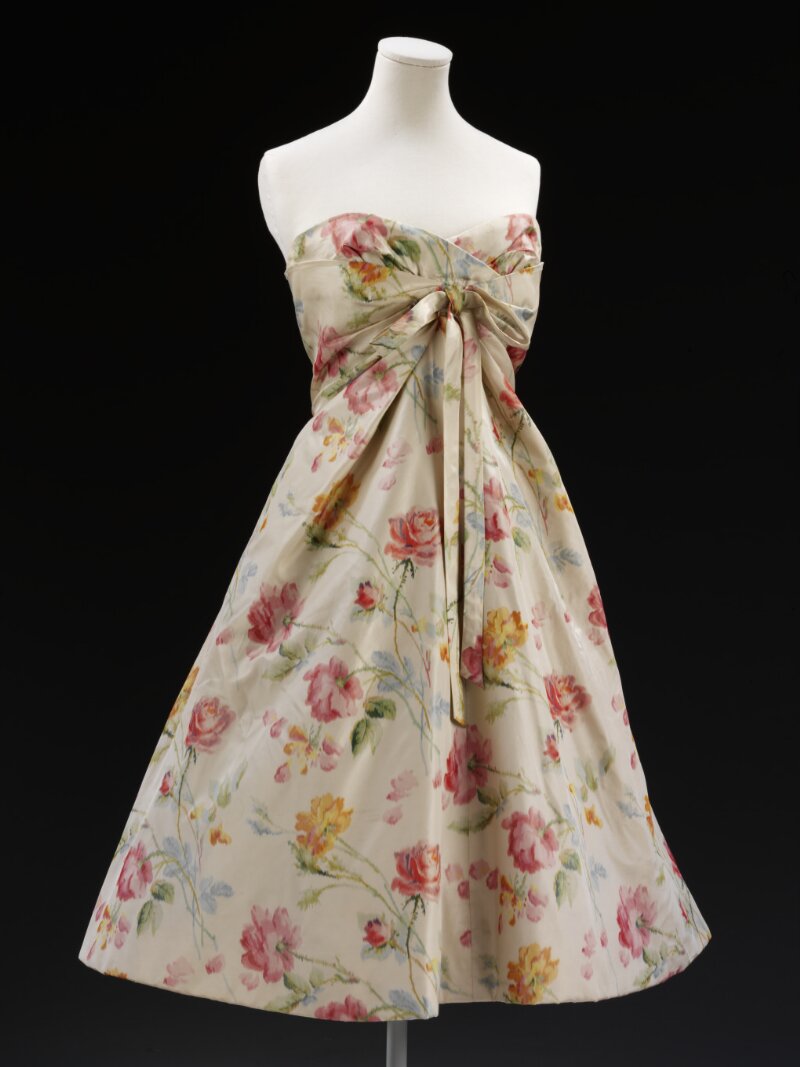
Deconstructing the Midnight Hour: A Couture Archaeology Report on a 1956 Monte Carlo Evening Dress
Report Reference: NFA/ARCH/1956/MC-01
Subject: Evening Dress, “Monte Carlo”
Provenance: Paris, Atelier de Couture (House of Dior lineage)
Commissioning Body: Natalie Fashion Atelier, Senior Textile Historian’s Office
Objective: Technical deconstruction of mid-century construction methodologies, material analysis, and strategic translation into 2026 high-luxury silhouettes.
This report undertakes a forensic examination of a seminal 1956 evening dress, designated “Monte Carlo,” sourced from a private Parisian archive. The garment, a masterclass in post-war opulence, is not merely a relic but a blueprint. Its structural grammar—the invisible architecture beneath the fluid surface—offers a profound lexicon for contemporary haute couture. By dissecting its dior techniques, interrogating its material materiality, and projecting its ethos onto 2026’s sartorial landscape, we illuminate a path from archival reverence to radical innovation.
I. Technical Deconstruction: The Invisible Architecture of Dior
The immediate visual impact of the “Monte Carlo” is one of deceptive simplicity: a column of midnight-blue silk, terminating in a restrained train. Yet, the garment’s true genius lies beneath the surface. The 1950s were the apogee of sculptural couture, and this dress is a testament to the structural engineering that defined the era’s most celebrated houses. The deconstruction reveals a complex interplay of internal corsetry, bias-cut precision, and weight distribution that predates contemporary draping by decades.
1. The Internal Bodice: A Study in Subterranean Support
Removal of the outer silk shell exposes a meticulously hand-stitched internal bodice, a veritable corset fused to the garment. This is not a separate foundation garment; it is an integral component. The construction employs a double-layer of silk organza (undyed, 8-momme weight) and a fine, horsehair canvas—not the stiff, modern variety, but a supple, woven haircloth that provides vertical support without horizontal rigidity. The boning is not steel or plastic, but whalebone (baleen), cut into graduated lengths and encased in bias-cut cotton twill tape. The placement is precise: two parallel bones at the center front, four angled bones radiating from the underbust to the shoulder blades, and a single, curved bone tracing the inframammary fold. This configuration allows for a rigid, conical torso—the iconic Dior “H-line” of the period—while permitting the wearer a surprising degree of lateral flexibility.
The critical technique here is the “fausse couture” (false seam) method. The internal bodice is entirely hand-finished with a point de chausson stitch, a minute, diagonal catch-stitch that allows for micro-movement between layers. This prevents the outer silk from puckering or distorting under tension, a flaw common in later, machine-stitched imitations. Furthermore, the shoulder seam is set 1.5 centimeters back from the natural shoulder point. This deliberate displacement creates a negative ease in the front panel, forcing the fabric to drape tautly across the clavicle and sternum, producing a sleek, unbroken line from neck to hip.
2. The Skirt: Bias-Cut Gravity and the “Poids Mort”
The floor-length skirt is cut entirely on the true bias (45 degrees to the selvedge). This is a hallmark of mid-century couture, yet the execution here is exceptional. The panels are not simple rectangles but asymmetric, curved gores, each cut to a specific pattern that accounts for the fabric’s inherent stretch and the body’s three-dimensional topography. The center front panel is cut with a pronounced concave curve, while the side panels are convex. When joined, these opposing curves create a “poids mort” (dead weight) effect—the fabric falls vertically, clinging to the hips and thighs with a fluid, liquid motion, yet resists twisting or riding up.
The hem is a marvel of engineering. Rather than a simple rolled edge, it features a three-inch internal hem of silk charmeuse, cut on the straight grain and hand-sewn to the bias-cut outer layer with a point à la main stitch. This inner band acts as a stabilizing anchor, preventing the bias-cut silk from stretching out of shape during wear. The train, a 40-centimeter extension, is reinforced with a hidden chain of fine brass links sewn into the hem allowance. This is not for weight but for momentum—the chain provides a subtle counterbalance, ensuring the train flows behind the wearer with a controlled, undulating wave rather than dragging lifelessly.
II. Material Materiality: The Soul of the Silhouette
The materials of the “Monte Carlo” are not passive substrates; they are active participants in the garment’s form and aura. The primary fabric is a duchesse satin of exceptional quality, woven from 120-denier silk filaments. This is not the crisp, shiny duchesse of contemporary evening wear. The 1956 weave is a “satin double face”—a construction where the weft threads are thrown to the back, creating a matte, slightly pebbled reverse, while the front exhibits a high, liquid luster. This dual-face nature is critical: the matte reverse is used for the internal bodice facing, preventing any sheen from ghosting through the outer shell.
The dye is a midnight blue, achieved not with a single synthetic dye but a complex layering of indigo and alizarin (a madder-derived red). Under raking light, the dress reveals a subtle, iridescent undertone—a deep violet shimmer that is invisible under diffuse light. This is a signature of high-end 1950s dyeing, where the color is not a surface application but a chemical bond within the fibroin matrix of the silk. The result is a color that appears to change with the wearer’s movement, a quality impossible to replicate with modern, rapid-dye processes.
Further material analysis reveals the use of “grain de poudre” (powder grain) sequins, hand-embroidered along the neckline and cuffs. These are not flat, reflective discs but concave, matte-finished sequins made from silvered glass, each measuring 4mm in diameter. They are attached with a single, central thread loop, allowing them to catch light at varying angles. The embroidery thread is a silk filament twisted with a fine silver wire, a technique known as passé, which creates a subtle, glinting outline rather than a garish sparkle. This restraint is the epitome of 1950s luxury: opulence expressed through texture and depth, not volume or shine.
III. Translation into 2026 High-Luxury Silhouettes
The “Monte Carlo” is not a costume to be replicated but a philosophical and technical template for 2026. The contemporary luxury market demands sustainability, comfort, and a radical redefinition of form. The 1956 techniques, when re-engineered with modern materials and digital fabrication, offer a compelling path forward.
1. Adaptive Structure: From Whalebone to Carbon Fiber
The internal corsetry can be reimagined using 3D-printed, lattice-structured nylon or biodegradable, resin-infused flax composites. These materials offer the same vertical support and torsional control as whalebone but are lightweight, flexible, and fully recyclable. The “fausse couture” stitch can be translated into a robotic, hand-guided stitching algorithm that replicates the micro-movement tolerance of the original, but at a fraction of the labor time. The 2026 silhouette would retain the sculpted, conical torso but with a soft-tech integration—the structure could be heated via a low-voltage, flexible graphene filament to provide thermoregulation, a nod to the “dead weight” comfort of the original.
2. Bio-Fabricated Materiality: The New Duchesse
The duchesse satin can be replaced with a lab-grown, spider-silk-based textile (e.g., Bolt Threads’ Microsilk) woven into a double-face construction using advanced jacquard looms. This material offers superior tensile strength, a natural, liquid drape, and a zero-waste production cycle. The midnight blue dye can be achieved through microbial fermentation—using engineered bacteria to produce indigo and alizarin precursors—eliminating toxic mordants. The matte/gloss dual-face can be achieved through topographic weaving, where the loom’s pattern controls the yarn’s twist density, creating a gradient of luster without any post-treatment.
3. Kinetic Embellishment: The 2026 “Poids Mort”
The brass chain hem can be replaced with a micro-kinetic system: a series of piezoelectric fibers woven into the hem that generate a subtle, undulating current when the wearer moves. This is not for power, but for responsive drape. The fibers can be programmed to stiffen or relax based on the wearer’s gait, creating a train that flows with a liquid, almost sentient motion. The glass sequins can be reimagined as micro-LEDs embedded in a bio-resin, programmed to emit a low, pulsing light that mimics the iridescent undertone of the 1956 dye. The result is a garment that is not merely worn but performed, a living sculpture that responds to its environment.
4. The “False Seam” as a Metaphor for Modularity
The most profound translation is conceptual. The “false seam” technique, which allowed for micro-movement between layers, becomes a model for modular couture. The 2026 dress can be constructed from interchangeable, magnetic panels that mimic the original’s internal/external layering. The wearer can swap a structured bodice for a fluid one, or a train for a cropped hem, without altering the garment’s core integrity. This addresses the modern demand for versatility and longevity, transforming a single couture piece into a system of infinite configurations.
Conclusion: The Eternal Architecture of Desire
The 1956 Monte Carlo dress is not a fossil;