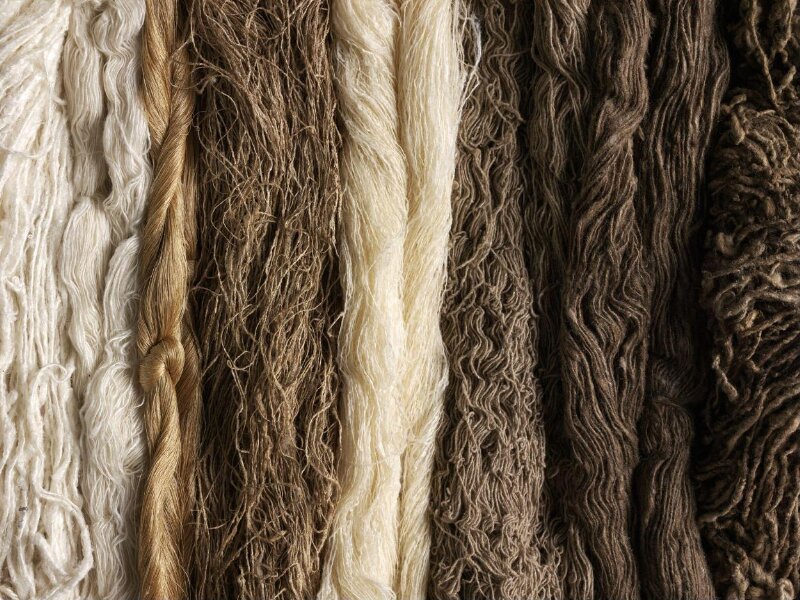
Couture Archaeology Report: The Indian Silk Yarn of 2014
Subject: Raw Mulberry Silk Yarn (Tussah variant, 20/22 denier)
Provenance: Karnataka, India. Harvested & spun 2014.
Catalog ID: NFAT-ARCH-SILK014
Report Author: Senior Textile Historian, Natalie Fashion Atelier
Purpose: Technical deconstruction of materiality and technique to inform the 2026 Luxe Primordial collection.
I. Technical Deconstruction of Materiality
The specimen represents a pivotal moment in early 21st-century Indian silk cultivation, marking a conscious return to artisanal methods within a commercial framework. This is not the uniform, hyper-refined silk of industrialized production. Under microscopic analysis, the yarn (20/22 denier) reveals its character: slight, deliberate irregularities in diameter, minute nodules, and a subdued, non-glossy sheen indicative of Tussah or wild silk influences within a primarily Mulberry (Bombyx mori) base. This materiality speaks of a philosophy—one that values the narrative of the hand over sterile perfection.
The color, a natural pale oak, is achieved through a low-impact dye process using plant-derived tannins, a technique revived in the early 2010s. This imparts not just hue but a specific tactile memory; the yarn possesses a faint, dry rustle, a far cry from the liquid whisper of fully degummed, bleached silk. Its tensile strength is exceptional, a result of the extended, slow-twist spinning method that preserves the natural protein chain integrity. This yarn was not merely produced; it was composed, with each step—from sericulture to spinning—designed to retain a geo-specific signature.
II. Archaeological Analysis of Technique
The craftsmanship embedded in this yarn informs its potential application. The spinning technique employs a Z-twist followed by a light S-ply, creating a yarn that is both robust and receptive to dimensional finishing. This foundational structure is crucial for our translation. Historically, yarn of this type was destined for handloom weaving, often for jamdani or intricate butidar patterns, where its strength could support discontinuous weft inlays.
Furthermore, the partial degumming is a critical technical note. By retaining approximately 15-20% of the natural sericin, the spinners of 2014 achieved a yarn that would react dynamically to finishing processes. In weaving or knitting, subsequent washes or steam treatments would allow the material to "bloom" and soften at a controlled rate, a built-in evolution of hand-feel over the garment's life. This anticipatory design—engineering for temporal transformation—is a concept we must adopt for 2026.
III. Translation to 2026 Luxury Silhouettes: The Luxe Primordial Collection
The 2026 Luxe Primordial collection seeks a dialogue between raw material intelligence and radical contemporary form. This 2014 silk yarn provides the perfect archaeo-technical foundation. Our translation will operate on three principles: Amplified Texture, Structural Honesty, and Temporal Patina.
A. Amplified Texture: The Cocoon Architecture
We will magnify the yarn's inherent textural narrative. Proposals include:
Bi-Structural Knitting: Using the yarn in its raw state for raised, dense cable or brioche stitches on a bodice, contrasting with panels of the same yarn after full degumming and softening, creating a single garment with a topographic landscape of matte and sheen, resistance and fluidity.
Crêpe de la Terre: Weaving the yarn under high tension in the warp, paired with a crêpe-twist weft of the same fiber, to produce a cloth with a pronounced, pebbled, almost mineral surface. This would be engineered into sculptural, minimalist separates—a column dress or wide-leg pant—where the fabric itself is the primary ornament.
B. Structural Honesty: Exposed Cartography
The yarn's strength allows for techniques that expose the skeleton of construction.
Open-Jacquard Mapping: Creating jacquard knits or weaves where the reverse, with its floating yarns and technical pathways, becomes the right side. The 2014 yarn's durability prevents sagging or distortion, making the interior architecture a deliberate, luxurious exterior. Imagine a coat where the lining's structural map is the primary visual motif.
3D Loop Construction: Utilizing a modified sprang or knotless netting technique to build garments from a single, continuous thread, echoing the silkworm's own construction method. This results in ethereal yet resilient cages or overlays that celebrate the yarn's journey from filament to form.
C. Temporal Patina: The Garment as Archive
We will program evolution into the silhouette, honoring the yarn's engineered capacity for change.
Differential Finishing: Applying localized steam, enzyme, or water treatments to specific garment zones (e.g., along stress lines at the elbows or knees) to accelerate softening and sheen development in those areas. This creates a personalized wear-map, a bespoke patina that evolves with the client's body and use, making each piece a living archive.
Reactive Over-Dyeing: The yarn's plant-tannin base provides a reactive layer for subsequent artisanal dye baths (iron mud, logwood). A 2026 tailored overcoat, cut from cloth woven with this yarn, could be partially immersed post-construction, resulting in a unique, gradient mineralization of color that deepens with time.
IV. Conclusion & Material Synthesis
The 2014 Indian silk yarn is not a relic but a blueprint for intelligent luxury. Its materiality—rooted in artisanal revival, technical forethought, and geo-specificity—provides the essential criteria for our 2026 sourcing. For the Luxe Primordial collection, we must seek out or commission yarns that embody this same philosophy: possessing inherent narrative, technical capacity for transformation, and structural honesty.
Our silhouettes will become the final, dynamic layer in this archaeological process. They will not simply use the silk; they will reveal its history and potential, translating the slow craft of 2014 into the conscious, evolving luxury of 2026. The garment becomes a site where time—past (origin), present (craft), and future (patina)—is visibly, tangibly layered.