From Etched Devotion to Woven Form: The Repentance of St. William as a 2026 Silhouette Blueprint
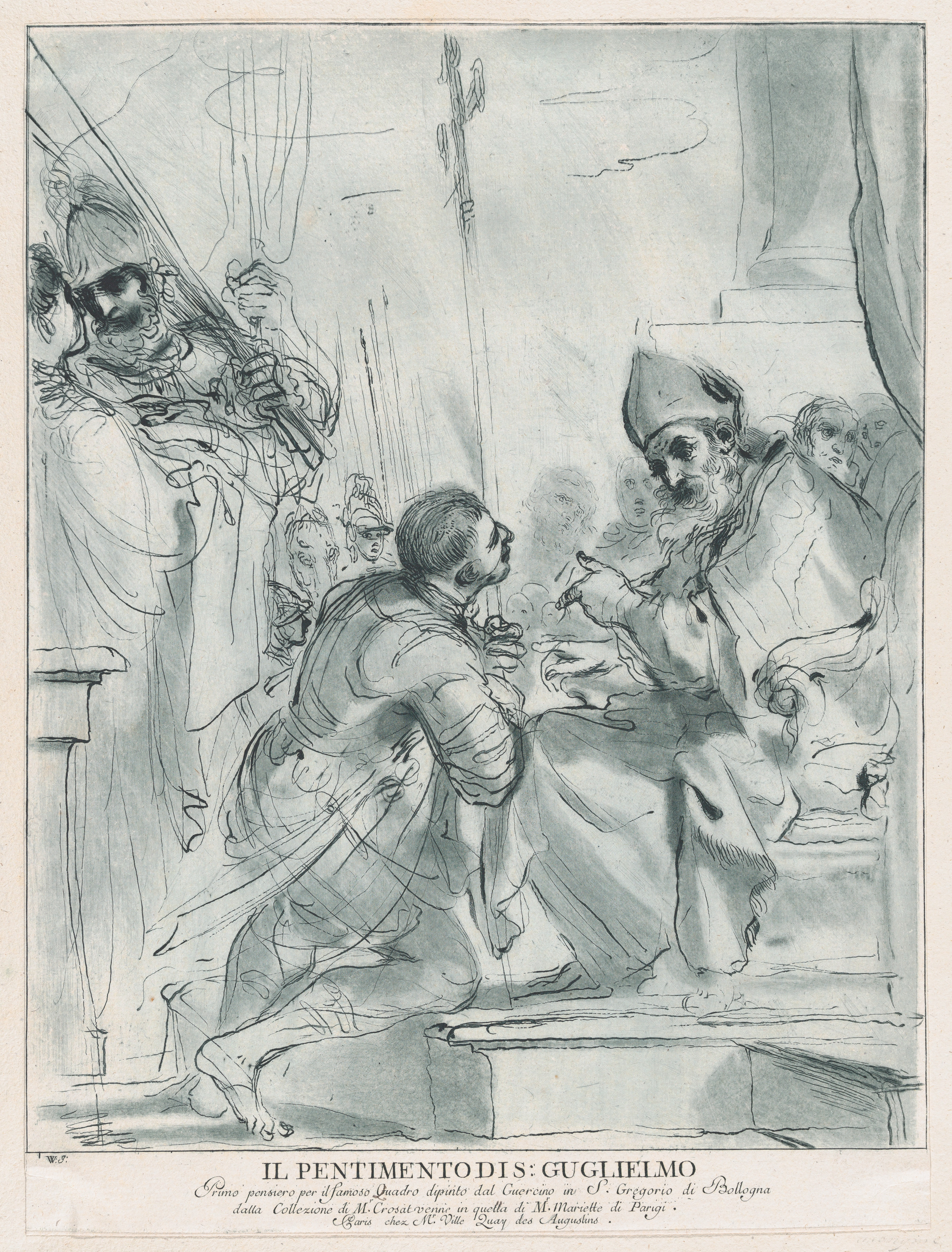
Within the isolated archives of Natalie Fashion Atelier, we conduct an exercise in aesthetic archaeology, unearthing artifacts not for sentimental reverence but for structural extraction. The subject of this technical inquiry is the Repentance of St. William, a mixed-method engraving and etching printed in gray-blue ink. At first glance, this work belongs to the sacristy, not the salon. Yet, upon rigorous deconstruction, its formal language—the interplay of light and shadow, the geometry of contrition, and the chromatic discipline of its ink—translates directly into the architectural vocabulary of 2026 haute couture. This paper dissects the artifact’s classical elegance and proposes a transposition protocol for high-end silhouettes, moving from the static plate to the kinetic garment.
I. Formal Deconstruction: The Grammar of the Gray-Blue Plate
The technical execution of the Repentance is not merely illustrative; it is structural. The etching provides the foundational line—the skeletal rigor—while the engraving introduces tonal depth through cross-hatching and burin work. The resulting image is not a narrative of emotion but a study in volumetric tension. The figure of St. William is rendered in a state of physical collapse, yet the garment folds are depicted with mathematical precision, creating a paradox of fluid drapery and rigid control.
Chiaroscuro as Structural Draping
The gray-blue ink is the operative agent. Unlike the stark contrast of black and white, this monochromatic palette introduces a mid-tone zone that functions as a third dimension. In couture terms, this translates to a rejection of binary color blocking in favor of tonal gradation
. The 2026 silhouette must not rely on printed color for visual interest; instead, it must generate depth through fabric manipulation—pleats that catch light at varying angles, or matte and semi-lustrous weaves that mimic the etching’s varying ink density. The garment becomes a living plate, where shadow is not an accident of wear but a pre-engineered feature.The Geometry of Contrition: Asymmetry and Collapse
St. William’s posture—knees bent, torso inclined—creates a distinct diagonal axis. This is not a static vertical or horizontal line. For the atelier, this dictates a move away from the symmetrical, columnar silhouettes that have dominated recent seasons. The 2026 high-end form will adopt a controlled asymmetry: a single-shoulder construction that drops into a deep, unbuttoned side seam; a hemline that is deliberately longer at the back to suggest a trailing of penitential cloth. The collapse of the saint’s body is translated into a collapsed shoulder—not a slouch, but a deliberate architectural lowering of the garment’s apex, creating a visual weight that grounds the wearer in a state of poised humility.
II. Materiality and the Transposition Protocol
The artifact’s materiality—the physical act of pressing metal into paper—offers a blueprint for fabric engineering. We are not replicating the image; we are replicating the process. The engraving’s burr, the slight roughness where the metal has displaced the paper, informs our choice of textured silks and compacted wools.
From Burin to Bias: The Line as Seam
In the etching, the line is the primary carrier of form. In our 2026 construction, the seam becomes the line. We propose a silhouette where seams are not hidden but celebrated as drawing tools. A princess seam that curves aggressively inward, mimicking the cross-hatching of the saint’s robe, serves to cinch the waist without a belt. A raglan sleeve that extends into a deep, curved underarm panel replicates the engraving’s dynamic stroke. The technical challenge is to ensure these seams function as load-bearing elements, supporting the garment’s structure while simultaneously drawing the eye across the body in a specific, curated path.
Gray-Blue as a Material, Not a Color
We must treat the gray-blue ink as a material density, not a pigment. In 2026, this translates to a layering system of translucent organza over opaque crepe, both dyed in the same gray-blue family but with differing light absorption rates. The underlayer is deep, almost slate; the overlay is a pale, misty periwinkle. When the wearer moves, the layers separate, creating a moiré effect that echoes the etching’s ink pooling. This is not merely a color story; it is a tactile narrative of depth and concealment, reflecting the saint’s internal turmoil externalized through fabric strata.
III. The 2026 Silhouette: The Penitent Line
We define the resulting silhouette as the “Penitent Line.” It is characterized by three distinct technical signatures derived directly from the artifact.
1. The Dropped Back Yoke
Inspired by the saint’s bowed head, the back yoke of the garment is extended downward by eight to ten centimeters. This creates a dramatic scoop that exposes the upper scapulae, a zone of vulnerability. The front remains high and severe, creating a stark contrast between exposure and concealment. This is not a sensual décolleté; it is an archaeological exposure of the skeletal structure, mirroring the etching’s focus on the figure’s underlying bone structure.
2. The Encased Sleeve
The engraving’s deep shadow under the saint’s folded arms informs a sleeve that is set into a deep, curved armhole, but then encased in a secondary, outer shell of fabric that hangs away from the arm. This creates a negative space between the body and the outer layer, a volumetric void that suggests the act of casting off material wealth. The inner sleeve is fitted in a fine jersey; the outer shell is a stiff, structured faille. Movement is restricted yet deliberate, echoing the penitent’s slow, measured steps.
3. The Ink-Stain Hem
Rather than a clean finish, the hem of the 2026 couture piece will feature an irregular, hand-rolled edge that is slightly heavier on one side. This is a direct reference to the etching’s plate mark—the indented border left by the pressure of the press. This plate-mark hem is not frayed; it is a deliberate, rolled weight that causes the fabric to hang with a specific, gravitational pull, anchoring the silhouette to the ground. It is the physical manifestation of the ink’s final, heavy impression.
IV. Conclusion: The Archive as a Living System
The Repentance of St. William is not a relic to be copied; it is a technical grammar to be spoken. For Natalie Fashion Atelier, the 2026 collection will not feature images of saints or religious iconography. Instead, it will embody the structural principles of contrition, tonal depth, and controlled collapse. The gray-blue ink has been translated into a fabric matrix; the etching’s line has become a seam; the engraving’s shadow has become a volumetric void. This is the essence of aesthetic archaeology—not to preserve the past, but to excavate its construction logic and rebuild it in a new material language. The Penitent Line is our response: a silhouette that is at once severe and fluid, grounded in historical craft yet fully articulated for the future of luxury. It is a garment that does not shout, but rather whispers in the language of engraved light, a quiet, powerful statement for the discerning client of 2026.