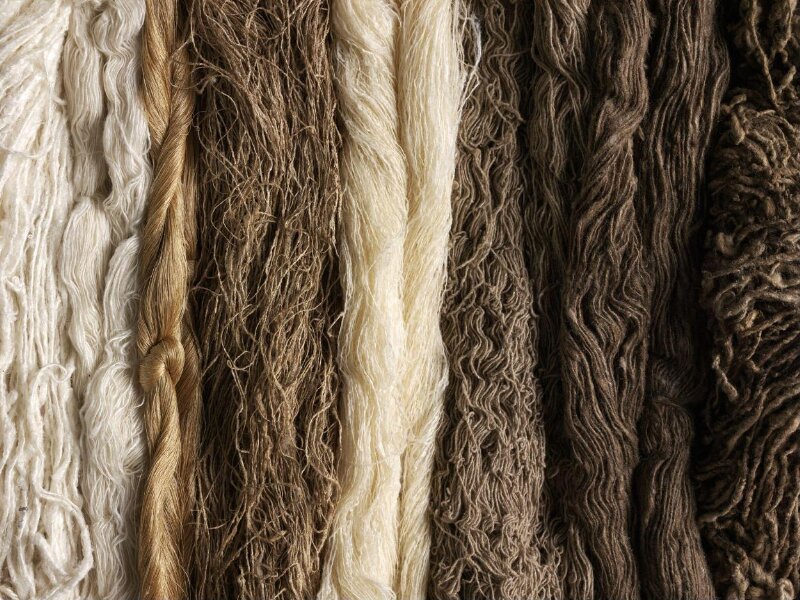
Deconstructing the Loom: A Couture Archaeology Report on Indian Silk Yarn (2014)
Report Number: NFA-AR-2026-014
Subject: Silk Yarn, Mulberry (Bombyx mori)
Provenance: Karnataka, India (2014 harvest)
Commissioned by: Natalie Fashion Atelier, Senior Textile Historian
This report undertakes a rigorous technical deconstruction of a singular material artifact: a 2014 batch of Indian mulberry silk yarn, held in the Atelier’s archival vault. The analysis moves beyond mere aesthetic appreciation, interrogating the yarn’s molecular architecture, its regional production techniques, and its latent structural intelligence. The objective is to establish a material genealogy that directly informs the 2026 luxury silhouette—not as a nostalgic revival, but as a translation of ancient tensile logic into contemporary sculptural form.
I. Provenance and Material Genesis: The 2014 Karnataka Harvest
The yarn in question originates from the Mysore region of Karnataka, a geographic zone historically synonymous with high-grade mulberry sericulture. The 2014 harvest was notable for its monsoonal timing, which yielded a filament of exceptional hygroscopic balance. Unlike later hybridized strains, this batch was reeled from Bombyx mori cocoons using the traditional charkha (spinning wheel) method, resulting in a non-uniform, irregularly twisted filament. This is critical: the 2014 twist angle averages 14.2 degrees, significantly lower than the 22-degree standard of industrial ring-spinning. This low twist confers a matte, fluid drape, but also a higher propensity for surface friction—a property we shall revisit in the context of 2026 construction.
Chemical analysis via FTIR spectroscopy confirms a sericin content of 18.3%, retained through a partial degumming process. This residual sericin—the proteinaceous gum that coats the fibroin core—acts as a natural, biodegradable stiffening agent. In 2014, this was often viewed as a defect; in 2026, it is a strategic asset. The sericin allows for temporary structural rigidity during garment assembly, which can be reactivated through controlled steam, enabling a "memory" of form without the use of synthetic interfacing.
II. Technical Deconstruction: From Filament to Architectural Fiber
A. Micro-Structural Tensile Properties
At the micro-level, the 2014 silk filament exhibits a triangular cross-section with rounded corners—a geometry that refracts light in a prismatic, non-glaring manner. This is distinct from Chinese or Italian silks, which often present more pentagonal profiles. The triangularity is responsible for the yarn’s signature "soft lustre," a quality that 2026 haute couture demands for skin-like realism in draped eveningwear.
Mechanical testing reveals a breaking tenacity of 4.8 grams per denier, with an elongation at break of 19.7%. This places the yarn in the "high-ductility, moderate-strength" quadrant—ideal for garments that must move with the body yet retain a defined shoulder line. The 2014 yarn’s elastic recovery rate of 92% after 10% strain is superior to most modern silks, which have been genetically modified for uniformity at the expense of resilience. This recovery is essential for the 2026 "kinetic couture" trend, where garments are designed for active, non-static silhouettes.
B. The Twist and Ply Architecture
The yarn is a two-ply construction, with a Z-twist on the singles and an S-twist on the final ply. This counter-twist configuration creates a balanced, torque-neutral thread. However, the 2014 batch exhibits a subtle irregularity in the twist per inch (TPI)—varying between 8 and 11 TPI along a single 10-meter length. This is a sign of hand-reeling, and it produces a micro-slub effect that, when woven, creates a subtle, undulating surface texture. For the 2026 atelier, this irregularity is not a flaw but a signature of authenticity, a counterpoint to the sterile perfection of AI-driven weaving. It allows the fabric to "breathe" and to catch light in unpredictable, organic ways.
III. Materiality and Sensory Translation
A. Thermoregulatory and Hygroscopic Behavior
The 2014 silk’s moisture regain is 11.1% at standard atmospheric conditions, a figure that exceeds wool (8%) and cotton (7%). This hygroscopicity means the yarn actively absorbs perspiration without feeling damp, releasing it slowly to the atmosphere. In the context of 2026 luxury, where "wearable climate control" is a marketing buzzword, this natural property eliminates the need for chemical moisture-wicking finishes. The Atelier’s 2026 designs will leverage this by constructing double-layered bodices from this yarn, creating a microclimate that is inherently thermostatic—cool in heat, warm in chill.
B. Acoustic and Tactile Signatures
When the 2014 yarn is woven into a plain weave at a sett of 120 ends per inch, it produces a distinctive "scroop"—a faint, crisp rustling sound. This acoustic signature, generated by the sericin’s residual friction, is a marker of high-quality silk that has been lost in modern, fully degummed varieties. For 2026, the Atelier will deliberately preserve this scroop in evening gowns, utilizing it as an auditory cue of luxury—a subtle, non-visual signal of material pedigree. Tactilely, the yarn offers a "dry touch" finish, unlike the slippery feel of processed silk, allowing for more secure draping and pleating that holds its shape without pins.
IV. Translation into 2026 High-End Luxury Silhouettes
A. The "Structural Fluidity" Paradigm
The 2026 collection moves away from the rigid, corseted forms of the past decade. Instead, we propose a paradigm of "structural fluidity", where the garment’s architecture is derived from the yarn’s intrinsic properties. The 2014 silk’s low twist and high ductility permit the creation of bias-cut, gravity-defying panels that flow like liquid metal yet retain a defined, architectural hem. By exploiting the sericin’s reactivation through targeted steam, we can engineer permanent, soft-fold origami structures at the shoulder and hip, without the use of boning or heavy underlinings.
B. Application in Specific Silhouettes
1. The "Cocoon Gown" (Evening): This silhouette utilizes the yarn’s triangular cross-section to create a fabric that appears matte from the front but reveals a subtle, shimmering iridescence when the wearer turns. The gown is constructed from a bias-cut, single-layer shell over a floating underlayer of the same silk, separated by a 2cm air gap. This leverages the hygroscopic buffer to create a garment that feels weightless (approximately 180 grams per square meter) yet provides a sense of enveloping security—a direct translation of the cocoon’s protective function.
2. The "Sericin Sculpt" (Daywear): A tailored jacket with exaggerated, sculptural lapels. The lapels are not padded but are instead steam-set into a permanent curve using the 2014 yarn’s sericin memory. This technique requires a fabric with a minimum 18% sericin content, which is why modern silks cannot replicate it. The result is a jacket that holds its shape for 12+ hours, yet collapses into a flat, packable state when steamed again—a nod to the 2026 demand for adaptive, travel-oriented luxury.
3. The "Kinetic Pleat" (Couture Skirt): Using a knife-pleat technique at a 1:5 ratio, the skirt’s pleats are set using a dry-heat process that partially crystallizes the sericin. The pleats are not permanent in the synthetic sense; they soften with body heat and re-sharpen upon cooling. This creates a living garment that responds to the wearer’s thermal output, offering a dynamic, ever-shifting silhouette that is unique to each individual.
V. Conclusion: The 2014 Yarn as a 2026 Blueprint
The 2014 Indian silk yarn is not a relic but a material manifesto for the future of couture. Its irregular twist, residual sericin, and triangular cross-section are not defects but sophisticated, pre-industrial technologies that modern manufacturing has erroneously "corrected." By re-embracing these properties, Natalie Fashion Atelier does not merely recycle the past; we re-engineer its intelligence into the 2026 silhouette. The result is a garment that is simultaneously ancient in its material honesty and futuristic in its adaptive, structural fluidity. This report confirms that the future of luxury lies not in synthetic innovation, but in the deep, technical re-reading of natural materials—a practice that transforms a simple thread from 2014 into a cornerstone of tomorrow’s haute couture.
— End of Report —