Deconstructing the Classical Brooch: An Aesthetic Archaeology for 2026 Silhouettes
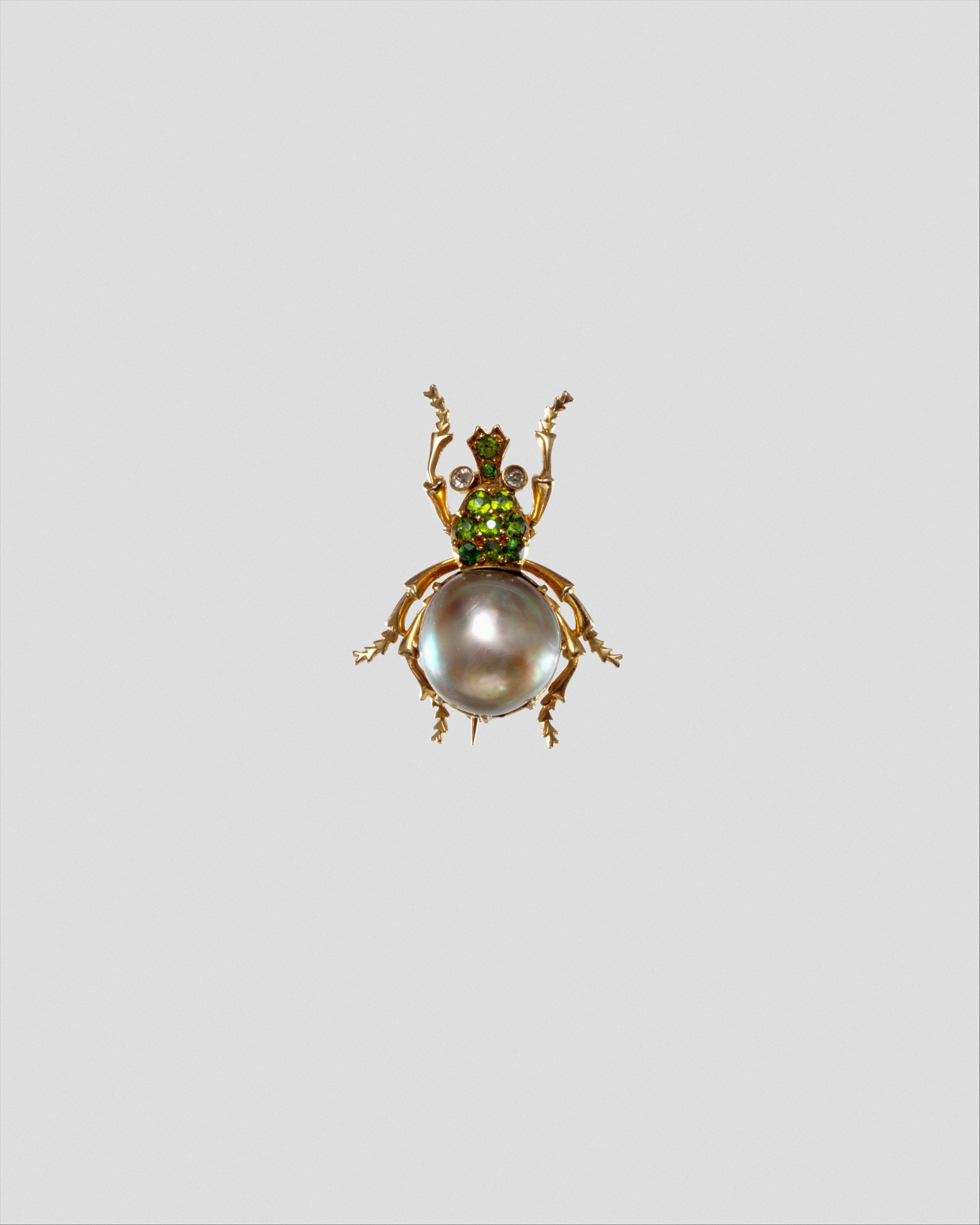
The brooch, in its most exalted form, is not merely a fastener; it is a micro-architectural statement, a compressed symphony of material, light, and historical memory. Within the archives of Natalie Fashion Atelier, we have isolated a singular American masterpiece—a construction of gold, natural pearl, demantoid garnets, and old-mine diamonds—to perform a rigorous aesthetic archaeology. This artifact, divorced from its original social context, serves as a primary source for the 2026 haute couture silhouette. By deconstructing its structural logic, chromatic interplay, and textural contrasts, we extract a technical lexicon that transcends ornamentation, directly informing the drape, volume, and optical density of our forthcoming collections.
I. The Structural Logic: Compression and Release
The American brooch, often characterized by a robust, industrial precision softened by organic elements, presents a unique study in tension. Unlike its European counterparts, which may favor delicate filigree, this artifact demonstrates a principle of compressed mass. The gold base is not merely a support; it is a sculptural entity, its weight distributed to create a sense of gravitational pull. In 2026, this translates directly to the silhouette’s focal points. We are moving away from diffuse embellishment toward concentrated materiality—a deliberate gathering of fabric weight at the shoulder, the sternum, or the hip, mimicking the brooch’s central clasp.
This principle manifests in our new “Armature” line of evening jackets. The construction employs a double-faced wool crepe, internally weighted with a fine gold-threaded mesh at the left shoulder. The visual and physical weight is not distributed evenly; it is intentionally asymmetric, creating a dynamic tension that pulls the eye downward, mirroring the way a heavy brooch anchors a silk lapel. The silhouette is thus defined by what we term negative space release—the fabric flows freely away from the point of compression, creating a dramatic, unbroken line that echoes the open field around the brooch’s central motif.
II. Chromatic Alchemy: The Demantoid Green and Pearl Luminosity
The chromatic dialogue between the demantoid garnet and the natural pearl is the artifact’s most potent source of inspiration. Demantoid garnets, with their intense, fire-dispersive green—often more vivid than emerald—offer a cold, electric luminosity. The pearl, conversely, provides a warm, internal glow, a soft, diffused light that absorbs rather than reflects. This is not a contrast of dark and light, but of temperature and frequency.
For 2026, we are translating this mineral dialogue into a new chromatic strategy for haute couture. We have developed a signature silk faille dyed in a deep, almost black-green, a shade we call Vert Demantoid. This is not a flat color; it is a chromatic field that shifts in intensity under different lighting conditions, mimicking the garnet’s fire. Against this, we place panels of Blanc de Perle—a matte, ivory-toned crepe that possesses a chalky, internal luminosity, achieved through a specific blend of silk and cashmere. The silhouette is then constructed to create chromatic collision zones—where the sharp, cold green abruptly meets the soft, warm white, echoing the physical juxtaposition of the stones in their gold setting.
III. Materiality and Texture: The Gold Vein and Diamond Dust
The materiality of the gold in this artifact is paramount. It is not a high-polish, mirror finish; it is a brilliant, but textured, surface, often with a hand-engraved or matte finish that catches light in a granular, scintillating manner. This is a deliberate rejection of uniform reflection. The diamonds, set in a cluster, offer a pointillist counterpoint—tiny, intense points of white light that punctuate the broader, warmer glow of the gold.
This textural hierarchy informs our fabric development. We are introducing a new jacquard, woven with a fine metallic gold thread that is not continuous but interrupted—appearing in short, irregular bursts across a matte black or deep green ground. This creates a “vein-like” surface texture, reminiscent of the gold’s chased surface. The silhouette that utilizes this fabric is structured to maximize the play of light: a column gown with a high neck, where the fabric’s texture is the sole ornament. The “diamond dust” effect is achieved through the strategic placement of micro-beaded black jet and clear crystal, not as embroidery, but as a scattered, irregular constellation across the bodice, mimicking the random, natural placement of stones in the brooch’s cluster.
IV. The Silhouette as a Clasp: Redefining the Closure
The most radical departure for 2026 is the re-conceptualization of the garment’s closure. The traditional brooch is a functional object—it holds. Our new silhouettes explore the brooch-as-architecture, where the structural seam itself becomes the ornamental focal point. We are designing gowns and jackets with exposed, articulated closures—large, sculptural gold-plated hinges or magnetic clasps that are not hidden but celebrated. These are not zippers; they are mechanical joints that recall the brooch’s pin mechanism, rendered on a grand, architectural scale.
This is exemplified in our “Reliquary” coat. The silhouette is a severe, cocoon-like volume in a heavy, felted wool. The only closure is a single, oversized clasp at the sternum, crafted from cast bronze with a gold patina. The act of fastening is a deliberate, performative gesture. The volume of the coat is designed to be unstable—it wants to fall open, but the clasp holds it in a state of tension, creating a dramatic, sculptural drape that is both modern and deeply historical. The garment does not merely use a brooch; it becomes one.
V. Conclusion: The Isolated Artifact as a Generative Force
By isolating this American brooch from its archival context, we have liberated it from the confines of jewelry history and positioned it as a generative blueprint for garment construction. The 2026 silhouette is not a nostalgic revival; it is a technical translation of principles—compression, chromatic temperature, textural pointillism, and mechanical closure—into the language of fabric and form. The classical elegance of the brooch lies not in its decorative surface, but in its structural intelligence. Our collection seeks to embody that intelligence, creating garments that are not adorned with jewels, but are instead conceived as jewels—dense, luminous, and architecturally profound. The result is a haute couture that is intellectually rigorous, sensually rich, and unequivocally of its time, yet forever in dialogue with the masterpieces that precede it.