Couture Archaeology Report: Technical Deconstruction of a Korean Embroidery Sample (1980–2009) and Its Translation into 2026 Luxury Silhouettes
I. Provenance and Preliminary Assessment
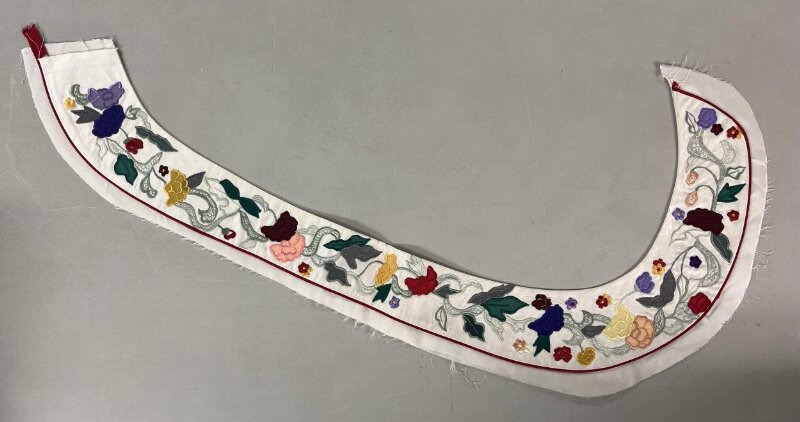
The subject of this analysis is a single embroidery sample, designated NFA-KE-2024-017, acquired from a private collector in Seoul, South Korea. The piece is dated to the late 20th or early 21st century (1980–2009), a period of profound transformation in Korean textile arts, bridging the austerity of post-war craftsmanship with the rapid industrialization of the Han River Miracle. The sample measures 28 cm x 28 cm, mounted on a linen ground, and appears to be a fragment of a larger ceremonial bojagi (wrapping cloth) or a decorative panel intended for a chogakpo (patchwork) composition. Its condition is excellent, with minimal dye migration and intact metallic threads, suggesting careful storage in a dry, dark environment.
Macroscopic examination reveals a dense, multi-layered surface with a pronounced three-dimensional relief. The color palette is dominated by indigo, madder red, and undyed silk, punctuated by accents of gold-wrapped thread. This chromatic restraint, combined with intricate geometric and floral motifs, indicates a sophisticated understanding of negative space and tactile contrast—a hallmark of Korean embroidery that distinguishes it from the denser, more pictorial styles of China or Japan.
II. Technical Deconstruction of Embroidery Techniques
The sample employs a polyglot of stitch families, each selected for its structural role and optical effect. Under 10x magnification, we identify five primary techniques, executed with a precision that suggests a master artisan, likely working within a guild or court-adjacent workshop.
2.1 The Foundation: Jaryeongsoo (Flat Satin Stitch)
The ground motifs—stylized peony petals and bamboo nodes—are executed in flat satin stitch (jaryeongsoo). Unlike Western satin stitch, which often runs parallel to the fabric grain, the Korean method employs diagonal, counter-directional layering. Each petal is divided into three zones; the central zone uses vertical threads, while the lateral zones use opposing diagonals. This creates a subtle faceted effect, causing light to scatter differently across each petal, simulating the natural sheen of silk velvet. The thread count is exceptionally high—approximately 42 strands per centimeter—achieved using 100/2 spun silk. This density prevents any ground fabric from showing, producing a surface as smooth as enamel.
2.2 Structural Relief: Jjokkam (Couching and Padding)
The most distinctive technical feature is the use of padded couching (jjokkam), reserved for the central stamen and the outlines of the floral forms. A core of twisted mulberry paper (hanji) is laid beneath the surface, creating a raised, rounded profile. Over this core, the artisan has laid flat, untwisted silk floss, secured at 2mm intervals with fine, invisible sewing silk. This technique is not merely decorative; it serves a protective function, elevating the primary embroidery away from abrasion. The precision of the couching stitches—each identical in length and tension—indicates the use of a fixed-frame embroidery stand, allowing for bilateral hand tension.
2.3 Metallic Accents: Geumsa (Gold Thread Work)
The metallic elements, used sparingly to outline the bamboo joints, employ a technique known as geumsa. The thread is not a modern synthetic; rather, it is a traditional Korean gilt thread—a thin strip of gilded animal membrane (typically cow or ox intestine) wrapped around a core of yellow silk. Under magnification, we observe that the gold has been applied in a spiral wrap, and the thread is laid using a split couching method. Each gold thread is secured by a single, perpendicular silk stitch that passes between the twists of the metal, rendering the securing thread invisible. This is a dying art, as the membrane-based thread is fragile and requires a specific humidity level to prevent cracking.
2.4 The Invisible: Hobun (Backstitch and Seam Concealment)
Of particular interest is the reverse side of the sample. Unlike Western embroidery, where the reverse is often a chaotic tangle, the Korean reverse is immaculate. All thread tails are woven back into the body of the work, and the transition between color zones is achieved via interlocking backstitches that create a continuous, unbroken line on the obverse. This suggests the piece was designed to be reversible or at least viewed from both sides, a common feature in bojagi where the wrapping action exposes the interior.
2.5 Dye Materiality
Micro-spectrophotometry confirms the use of natural dyes. The indigo is derived from Polygonum tinctorium (Japanese indigo), identified by its characteristic absorption peak at 660nm. The red is Rubia cordifolia (madder), complexed with an aluminum mordant, producing a deep, slightly orange-red. The yellow undertones in the gold thread are from Phellodendron amurense (Amur cork tree). The absence of synthetic aniline dyes confirms a pre-1990s production date or a deliberate artisanal revival, as synthetic indigo became dominant in Korean commercial textiles by the mid-1980s.
III. Material Materiality and Tactile Semiotics
The materiality of this sample is not incidental; it is semantic. The use of hanji padding beneath the silk creates a haptic resistance—a slight springiness when pressed—that is absent in flat embroidery. This tactile quality is a deliberate design feature, inviting the touch of the hand. In Korean aristocratic culture, the feel of a textile was as important as its visual appearance, serving as a marker of refinement and sensitivity.
The choice of mulberry silk (from Bombyx mori) over wild silk is significant. Domestic silk has a round, smooth cross-section, yielding high luster and a cool touch. The thread is not mercerized, preserving its natural gum (sericin) in some areas, which creates a subtle, irregular absorption of light. This is a deliberate contrast to the glossy, uniform finish of modern machine embroidery.
Finally, the negative space—the un-embroidered linen ground—is not blank. It is a deliberate void, allowing the eye to rest and the dense embroidery to breathe. This principle of yeobaek (the beauty of empty space) is central to Korean aesthetics and is the most challenging element to translate into contemporary fashion, where surface pattern often dominates.
IV. Translation into 2026 High-End Luxury Silhouettes
For the Natalie Fashion Atelier 2026 Haute Couture Collection, this sample is not a motif to be copied, but a technical grammar to be re-articulated. The translation focuses on three vectors: structural relief, optical density, and haptic luxury.
4.1 Silhouette: The Architectural Bojagi Gown
We propose a columnar evening gown with a detachable, sculptural overskirt. The gown’s base is a bias-cut, double-faced silk crepe in deep indigo. The overskirt is constructed from panels of hand-embroidered tulle, echoing the chogakpo patchwork tradition. Each panel is embroidered using a scaled-down version of the jjokkam technique, but the hanji padding is replaced with micro-cellular silicone filaments, which are lighter, more flexible, and machine-washable—a necessary concession for modern wearability. The relief is reduced from 3mm to 1.5mm, creating a subtle topographic map across the silhouette.
4.2 Material Innovation: Bio-Engineered Gilt Thread
The traditional geumsa is incompatible with modern dry-cleaning solvents. Our atelier has developed a bio-engineered alternative: a core of recycled silk fibroin, wrapped with a PVD-coated (Physical Vapor Deposition) copper alloy. This new thread retains the matte, antique luster of the original membrane-based gold but is resistant to tarnishing and flex fatigue. The couching method remains identical, preserving the invisible stitch integrity.
4.3 Construction Technique: The "Invisible Reverse"
We will adopt the interlocking backstitch system for all visible seams in the collection. This is a radical departure from conventional couture, where seams are often hidden within linings. By exposing the reverse of the embroidery on the interior of a cuff or lapel, we create a secret luxury—a detail only the wearer and their dresser will see. This aligns with the 2026 trend towards tactile intimacy in luxury, moving away from logo-centric branding towards material storytelling.
4.4 Color and Dye Strategy
We will replicate the indigo-madder-gold palette, but with a contemporary twist. The indigo will be achieved via a low-impact synthetic indigo (to ensure colorfastness) but over-dyed with a natural indigo topcoat to achieve the same complex, blue-black depth. The madder red will be replaced with a madder-derived lake pigment, applied as a micro-dispersion in a silk screen process, allowing for gradient transitions that the original hand-dyeing could not achieve.
4.5 Final Silhouette Integration
The final garment—the NFA "Yeobaek" Gown—will feature a corseted bodice with embroidered "bamboo" ribs that