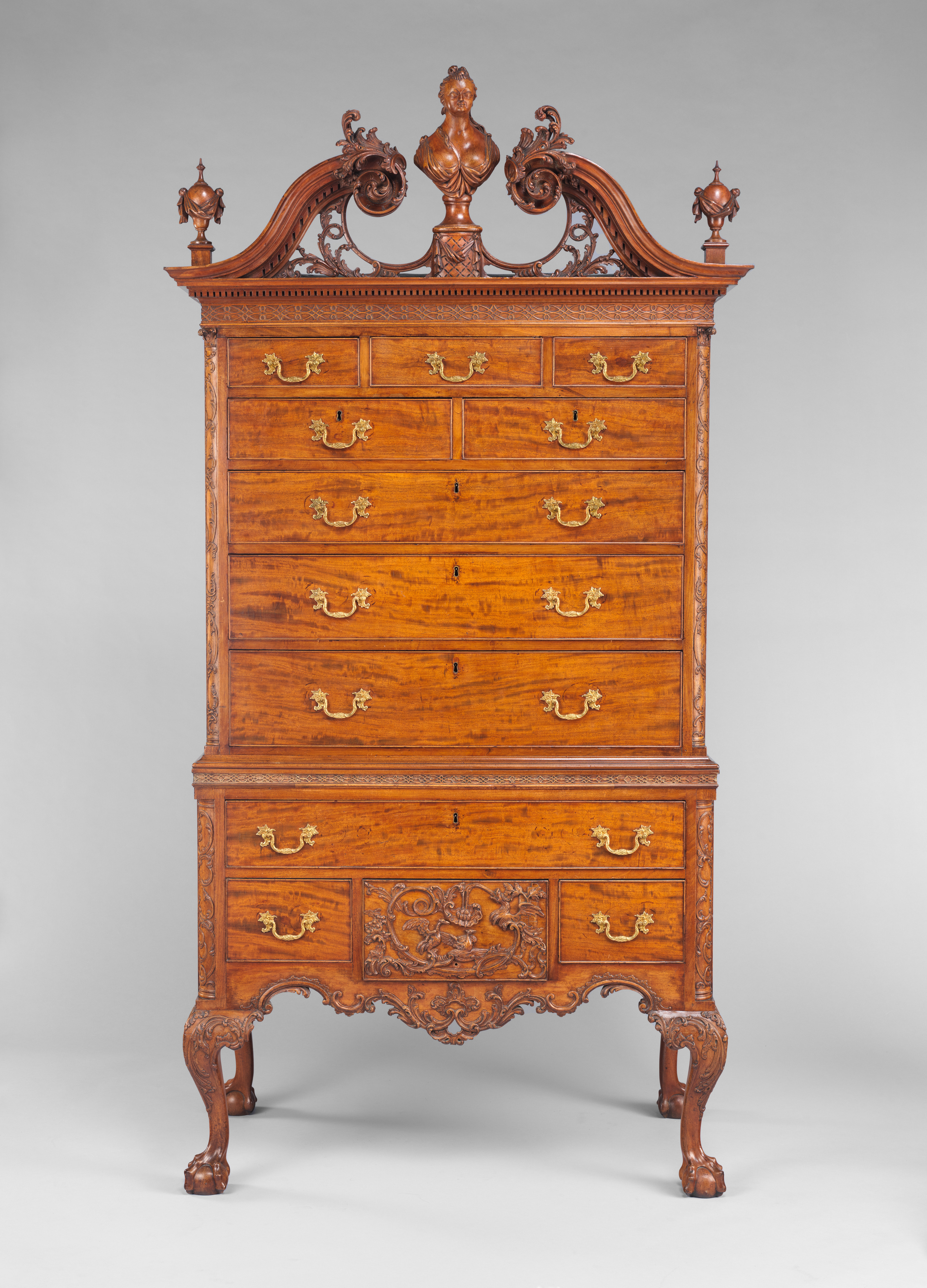
Deconstructing the Classical: The American High Chest as a Blueprint for 2026 Silhouettes
The contemporary atelier, in its pursuit of the next paradigm, often looks forward with such intensity that the rearview mirror is neglected. Yet, for Natalie Fashion Atelier, the future of luxury is excavated from the past. Our latest research artifact, drawn from the archives of American aesthetic archaeology, is not a garment but a piece of furniture: the high chest of drawers, circa 1780, constructed from mahogany, mahogany veneer, yellow pine, yellow poplar, northern white cedar, and brass. At first glance, the transposition from a Philadelphia cabinetmaker’s bench to the Parisian couture floor seems anachronistic. However, a rigorous deconstruction of this object’s structural logic, material hierarchy, and proportional rhythm reveals a profound lexicon for the 2026 haute couture collection. This artifact is not merely an inspiration; it is a technical specification sheet for silhouette, drape, and surface treatment.
Structural Logic: The Architecture of the Silhouette
The high chest is a study in verticality and controlled mass. Its defining characteristic is the dramatic elevation of storage—a columnar presence that commands a room without sacrificing utility. For 2026, this translates directly into the “Columnar Torso” silhouette. We are moving away from the deconstructed, fluid lines of the past decade toward a structure that is rigidly architectural yet fluid in its interior. The chest’s base, often a lowboy, provides a solid, grounded foundation. In our couture, this is the structured corset or the high-waisted, boned underlayer—invisible but essential, providing the “base support” that allows the upper garment to rise with unimpeded grace.
The chest’s central section, with its graduated drawers, informs the “Graduated Torso” technique. Here, the fabric is not cut in a single line but is pieced in horizontal panels that subtly increase in volume as they descend. This is not a simple tiered skirt; it is a meticulous manipulation of fabric weight and seam placement to create a visual rhythm of increasing mass, mirroring the drawers’ incremental depth. The effect on the runway is a silhouette that appears to breathe, expanding and contracting in a controlled, almost metronomic cadence. The final element, the pediment or crown, is the most critical. In the high chest, this is often a broken scroll or a swan-neck pediment—a moment of dramatic release. For 2026, this is the “Apex Collar”, a sculptural, almost architectural neckline that rises from the shoulders, not as a soft ruffle, but as a rigid, cantilevered structure. It is the point where the garment ceases to be clothing and becomes a statement of spatial ownership.
Materiality as a Narrative: The Veneer and the Core
The material list of this artifact is not a simple inventory; it is a philosophical treatise on value and integrity. The primary material, mahogany, is prized for its rich, deep tone and its stability. In our 2026 fabrics, this is translated through “Substantive Silk”—a heavy, high-thread-count silk twill that has a natural luster and a dense, almost wooden drape. It does not float; it falls with a deliberate, weighted grace, echoing the solidity of the primary wood.
More fascinating is the use of mahogany veneer over a core of yellow pine and poplar. This is a masterclass in material economy and surface deception. The veneer is not a cheaper substitute; it is a deliberate choice to showcase the most beautiful grain of the wood while using a more stable, less expensive core. For the atelier, this informs our “Dual-Skin Construction.” We are developing a technique where a luxurious outer layer—perhaps a hand-painted silk or a metallic lamé—is bonded to a core of a more utilitarian, but structurally superior, fabric like a tightly woven cotton drill or a technical horsehair. The result is a garment that has the opulent surface of a couture piece but the structural integrity and comfort of a tailored suit. This is not about cost-cutting; it is about “surface integrity”—ensuring that the aesthetic impact is not compromised by the garment’s inability to hold its shape.
The inclusion of northern white cedar, typically used for drawer linings, is a subtle but profound detail. Cedar is aromatic and insect-repellent; it is a functional, hidden layer. In our 2026 collection, this translates to “Invisible Functionality.” We are integrating hidden interior pockets, micro-ventilation panels, and even lightweight, flexible boning within the garment’s lining. These elements are not visible on the exterior but serve a critical purpose: they enhance the wearer’s comfort and the garment’s performance. This is the luxury of the hidden—the knowledge that every layer, seen or unseen, is executed with the same level of meticulous craft.
Proportion and Negative Space: The Brass Accent
The brass hardware—the escutcheons, the handles, the hinges—serves as the jewelry of the piece. It is not merely decorative; it is a functional interruption of the wood’s surface. In couture, this is the “Strategic Accent.” We are not using brass as a material, but as a concept of placement. The placement of a seam, a single oversized button, or a line of intricate beading must function as the brass does: it must break the visual monotony of the fabric and draw the eye to a specific point of architectural interest. The absence of brass on certain drawers creates a negative space that highlights the wood’s grain. In our garments, this is the “Silent Panel.” A section of the garment, devoid of embellishment or seam, allows the fabric’s own texture and drape to speak. This quietness makes the adjacent, more ornate sections more impactful.
From Artifact to Art Form: The 2026 Synthesis
The high chest of drawers is not a literal inspiration; it is a conceptual framework. Its legacy is not in the replication of its form but in the extraction of its principles. The 2026 Natalie Fashion Atelier silhouette is defined by a “Structural Elegance”—a garment that is simultaneously rigid and fluid, monumental and intimate. It is a silhouette that respects the body’s architecture while imposing its own. The use of dual-skin construction, graduated panels, and strategic accents creates a garment that is a piece of wearable archaeology, a dialogue between the 18th-century cabinetmaker and the 21st-century couturier.
This artifact has taught us that true luxury is not about excess but about “Curated Mass.” It is about understanding the weight of a fabric, the integrity of a seam, and the importance of a silent moment. The 2026 collection will not feature mahogany or brass, but it will embody their principles: the gravity of the wood, the precision of the veneer, the utility of the cedar, and the brilliance of the brass. It will be a collection that stands tall, grounded in a rich heritage, yet poised for the future. This is the new classical—a synthesis of historical rigor and avant-garde vision, crafted for the discerning client who understands that the most profound innovation is often a conversation with the past.