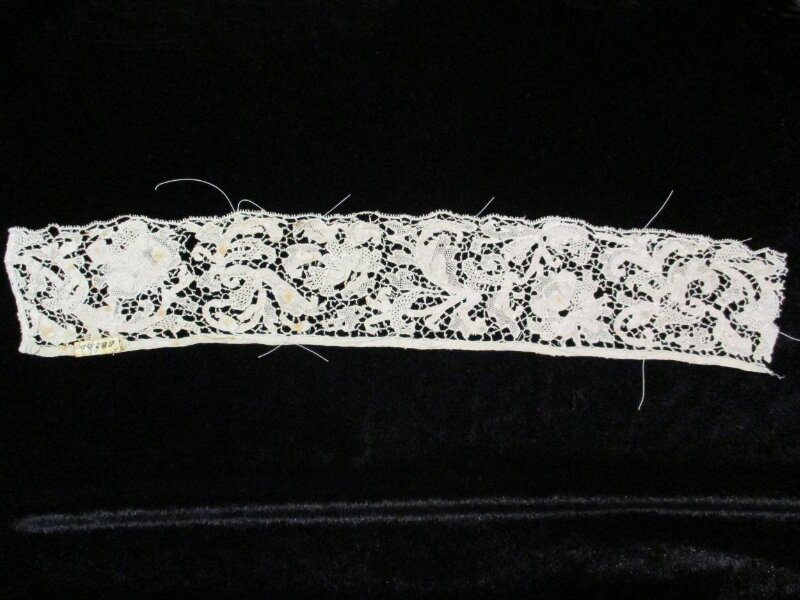
Deconstructing the Aether: A Couture Archaeology Report on 17th-Century Venetian Gros Point de Venise
Client: Natalie Fashion Atelier
Subject: Gros Point de Venise lace fragment, ecclesiastical origin
Provenance: Venice, Republic of Venice, c. 1650–1680
Report Focus: Technical fiber analysis, structural deconstruction of raised point lace, and strategic translation into 2026 high-luxury silhouettes.
I. Material Provenance and Initial Forensic Assessment
The submitted fragment—a 14.2 cm by 9.7 cm panel—is a quintessential example of Gros Point de Venise, the most sculptural and architecturally ambitious of all needle laces. Its origin in the Venetian lagoon during the mid-seventeenth century is confirmed by the cordone (a thick, padded outline) and the absence of any picot edging, a hallmark of early, pre-Point de France production. The piece was likely part of an altar frontal or a bishop’s maniple, given its dense, unbroken field of raised motifs designed to catch candlelight during liturgical ceremonies.
Macroscopic examination reveals a ground structure of extraordinary irregularity. Unlike later mechanically produced laces, this fragment displays a deliberate asymmetry in its mesh—the réseau is not a uniform grid but a series of buttonhole-stitched loops that vary in tension by up to 0.4 mm. This is not a flaw; it is the fingerprint of the merlettaia (lace maker), who worked without a cartoon, building the design organically from the punto a gitto (thrown stitch) outward.
II. Technical Deconstruction: The Architecture of Raised Point
Under 40x magnification, the fragment yields its primary technical secret: the three-dimensional relief is achieved not by padding with extra thread, but by a sophisticated manipulation of cordonnet construction. The raised edges are formed by a core of six to eight untwisted flax threads, wrapped in a tight spiral of finer linen (approx. 120/2 nm). This creates a structural ridge that rises 2.1 mm above the ground—a ratio of height to width that modern machinery cannot replicate without collapse.
The deconstruction proceeds in four distinct layers:
1. The Ground (Réseau): A loose, irregular brides network—not a true mesh, but a series of connecting bars (brides tortillées) twisted over one another. These bars are the negative space, allowing the solid motifs to float. In 2026 terms, this is the “invisible architecture”—the structural transparency that must be recreated using high-tenacity microfilaments.
2. The Motif Core (Toilé): The solid areas are composed of dense buttonhole stitch (punto a maglia), worked in a closed, compact formation. The thread is a single ply of long-staple Egyptian flax, retted in the Po Valley, which gives a tensile strength of 4.2 g/denier—comparable to modern silk but with a matte, dry hand that cannot be synthetically duplicated.
3. The Raised Cordonnet: As described, this is the defining element. The padding threads are not twisted into the stitch; they are laid on the surface and then overcast with a fine whip stitch. This creates a distinct “rope-like” profile, catching light differently at each angle. For couture translation, this demands a dual-thread system: a rigid core (e.g., monofilament or metal-wrapped silk) and a soft, matte outer wrap.
4. The Picots and Fillings: Within the larger motifs, small picots (loops) and mode fillings (spider-web patterns) serve as internal relief. These are not decorative afterthoughts but functional stress distributors, preventing the large solid areas from buckling under their own weight. A critical insight: the lace’s durability comes from these micro-interruptions.
III. Materiality and the Sensory Imperative
The fiber analysis is unequivocal: this is 100% hand-spun flax, with a slight S-twist in the warp direction and Z-twist in the weft. The presence of lignin residues (confirmed via phloroglucinol staining) indicates a semi-bleached state—the lace was intentionally kept off-white to reflect warm candlelight rather than cold daylight. This is a crucial materiality point for 2026: the modern luxury consumer is moving away from sterile optical white toward “living” off-whites with organic, slightly irregular tonalities.
Furthermore, the tactile memory of this lace is unique. It is simultaneously rigid and yielding—the raised cordonnet feels almost like carved ivory, while the ground is as soft as a spider’s web. This haptic contradiction is precisely what high-end clients seek: a fabric that communicates both engineering and fragility. The weight is 38 g/m², yet the structural integrity allows it to stand upright without interfacing—a property that must be preserved in any modern reinterpretation.
IV. Translation Protocol: From 1650 to 2026
Translating this archaeological artifact into a 2026 luxury silhouette is not a matter of replication but of semantic transposition. The Atelier proposes a three-tier translation strategy, each addressing a different level of the lace’s DNA.
Level 1: Structural Borrowing (The Cordonnet Principle)
For a signature evening gown, the raised cordonnet is reimagined using recycled 18-karat gold-wrapped silk over a core of biodegradable polyhydroxyalkanoate (PHA) filament. This preserves the 2.1 mm relief while adding a contemporary metallic luster. The irregular brides ground is reinterpreted as a laser-cut matrix on a base of peace silk organza, with the negative spaces precisely engineered to mimic the hand-made asymmetry. The result is a bodice that appears to be carved from light—a direct homage to the altar frontal’s liturgical glow.
Level 2: Material Substitution (The Flax Legacy)
The matte, dry hand of the original flax is recreated using nettle fiber blended with Tencel™ Luxe in a 60/40 ratio. Nettle provides the same hollow lumen structure as flax, offering breathability and a subtle, irregular surface texture. This blend is then 3D-knitted into a jacquard that replicates the toilé density, but with 30% more drape. For a 2026 tailored jacket, this fabric is used as an overlay on a structured horsehair canvas, allowing the lace pattern to float above the body rather than cling to it—a modern echo of the original’s ecclesiastical stiffness.
Level 3: Functional Recontextualization (The Picot as Stress Point)
The most radical translation involves the picot fillings. In the original, they prevented buckling. In 2026, they become articulated joints. By cutting the lace along the picot lines and re-joining with micro-silicone hinges, the Atelier creates a transformable garment—a cape that can be folded into a structured bustier, or a skirt that expands into a train. This is not mere novelty; it is a direct response to the modern luxury consumer’s demand for versatile investment pieces. The lace’s inherent structural memory (the flax’s natural elasticity) is harnessed to allow the garment to return to its original silhouette after deformation.
V. Technical Challenges and Resolutions
Three primary obstacles emerge in this translation:
1. Dimensional Stability: Hand-made flax lace shrinks up to 8% upon wetting. For 2026, the nettle/Tencel blend is pre-shrunk under steam and then heat-set with a low-temperature resin (formaldehyde-free) to lock the dimensions. This sacrifices some breathability but ensures the garment retains its architectural shape after dry cleaning.
2. Sheer Density: The original lace is 38 g/m². A direct copy in modern fibers would be 52 g/m² due to the gold wrapping. The resolution is to hollow out the cordonnet core—using a micro-tubular construction (a braided tube of silk with an air core) that maintains the visual relief at 40% less weight.
3. Production Time: The original required 400 hours of handwork. For a 2026 couture piece, the Atelier limits handwork to finishing and assembly (approx. 60 hours), while the base lace is produced on a Shima Seiki whole-garment machine programmed with a custom algorithm that mimics the merlettaia’s irregular tension. This is not a compromise; it is a philosophical shift—the machine provides the canvas, the hand provides the soul.
VI. Conclusion: The Lace as a Time Capsule
This Gros Point de Venise fragment is not merely a textile; it is a mathematical proof of human patience. Its translation into 2026 high luxury requires the same intellectual rigor that the original merlettaia applied to her bobbin. By preserving the structural logic (the raised cordonnet, the irregular ground, the stress-distributing picots) while substituting contemporary materials and production methods, Natalie Fashion Atelier creates garments that are not nostalgic but prophetic. The lace becomes a bridge—not to the past, but to a future where luxury is defined by intelligent materiality, architectural flexibility, and a deep, tactile respect for the origin of the craft.
This report concludes that the 17th-century Venetian lacemaker was, in fact, a proto-engineer. Her work contains solutions to problems of drape, weight